



















Grief stories often depend on one basic calculation: how much ordinary life can a film establish before loss changes the meaning of everything we have seen. Paul Andrew Williams understands that calculation better than most of Faith suggests. Before the film asks its audience to accept anything supernatural, it spends time on shifts at a sweet factory, a pub quiz, a council-estate home, a tired mother telling her son to settle down before bed. Those details are modest by design. They give Erin Doherty something far harder to play than misery. They give her a life.
Doherty plays Gina, a single mother raising nine-year-old Jamie while working on a factory production line. She is affectionate without being saintly, protective without becoming sentimental. When Jamie gets punched by another boy, Gina confronts the boy’s mother. At work she has time for her colleagues. At the pub quiz she can still laugh at a bad answer. Then Michael appears.
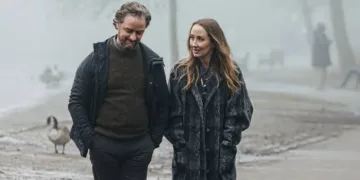
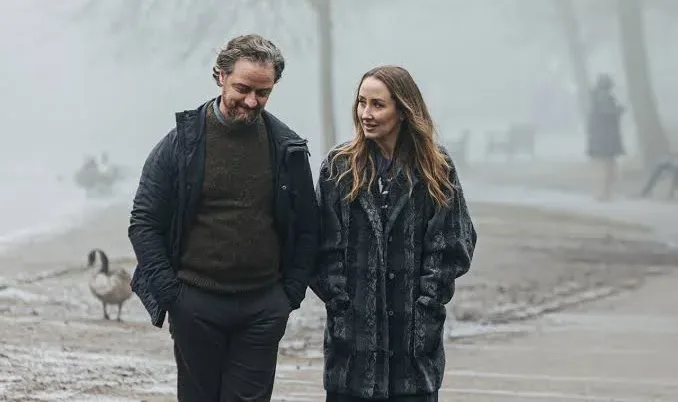
James McAvoy plays him with such subdued politeness that Gina barely knows what to do with him. He helps her pub-quiz team, walks her home and seems interested without behaving like the men she appears accustomed to meeting. Gina reads romance into his attention. Michael keeps resisting that interpretation without quite explaining why.
For a while, their mismatch gives Faith a welcome comic pulse. McAvoy’s stillness plays nicely against Gina’s growing curiosity, especially once his behavior becomes strange enough to invite suspicion. He somehow knows that Gina’s babysitter has stolen money. He volunteers at a food bank, does not seem especially interested in earning anything and carries himself with the confidence of someone who already knows how every conversation will end. Gina jokingly wonders if he might be doing community service. It is a funny explanation because it is also such an ordinary one. She is trying to fit an inexplicable person into a world she understands.
This is where Williams begins moving the film away from social realism. The shift works because it happens by degrees. A useful way to think about genre here is as a set of expectations rather than a fixed category. Early scenes teach us to read Gina’s life through recognizable social detail. Michael starts violating those expectations before the film tells us what sort of story has replaced them.
The trouble is that McAvoy makes Michael’s basic goodness fairly easy to trust. His calm gaze, restrained delivery and refusal to exploit Gina’s attraction make him mysterious, but rarely frightening. That removes one possible source of tension. The stronger question becomes why a man who seems to know things he should not know remains unable, or unwilling, to protect Gina from what is coming.
What comes next changes the film completely. Jamie dies around his tenth birthday, and Faith abandons much of its earlier warmth for an extended study of Gina’s grief. Williams does not rush through the aftermath. Gina drinks, isolates herself, lashes out, rejects help and begins turning her rage inward. One memory tortures her in particular: she told Jamie to be quiet shortly before his death.
Doherty is extraordinary here because she never plays grief as one sustained emotional note. Her earlier performance matters. We have seen Gina impatient, flirtatious, funny, defensive and tender, so her collapse registers as the destruction of a person rather than the arrival of an Acting Scene. Her fury has direction. Sometimes it points toward Michael, sometimes toward herself, sometimes toward a universe that seems to have produced suffering without bothering to provide an explanation.
I found the film strongest when it allowed that anger to remain unresolved. Doherty makes Gina’s despair specific enough that the usual language surrounding cinematic grief starts feeling inadequate. Williams is also unusually willing to stay with her after sympathy becomes uncomfortable. The decision has a cost. Once a film asks an audience to sit this close to suffering for this long, whatever comes after carries an enormous burden. Catharsis cannot arrive merely because the screenplay says it should.
The filmmaking prepares for the spiritual turn better than the writing does. Cinematography can create associations before a script states them directly, and Faith repeatedly uses that advantage. Simona Susnea’s images are softened by drizzle, mist and a blue-grey palette that keeps even hopeful moments slightly chilled. Williams also returns to the sweet-factory machinery: spirals of mallow extruding endlessly, mechanical arms folding sticky masses of toffee. At first these shots feel almost documentary-like, interruptions from the story that ask us to watch routine become abstract movement. Later they acquire a darker weight.
Raffertie and NYX’s electronic, choral score pushes the same idea from another direction. Sound begins suggesting something sacred or unknowable while Gina’s surroundings remain stubbornly physical. Those choices create an interesting tension between the measurable world and experiences that refuse measurement.
Then the film begins explaining itself, and this is where Faith becomes shakier. Religious imagery grows heavier, Michael’s nature becomes harder to treat as mere ambiguity, and the story asks for a metaphysical leap that its earlier realism had trained us to resist. A film called Faith has every right to demand uncertainty from its audience. I would argue that uncertainty is where the title becomes interesting. Faith means less if the film eventually starts supplying answers.
There is still something moving in the attempt. McAvoy wisely leaves emotional space around Doherty rather than competing with her, and Williams never loses sight of Gina as the person whose pain gives all this theology meaning. The supernatural material does not erase what came before it. I believed Gina’s love for Jamie, her guilt, her anger and the frightening possibility that a person can survive something without understanding why survival remains possible.
Michael still creates a problem the screenplay never fully solves. If he possesses extraordinary knowledge, Gina’s obvious question becomes ours: why could he not prevent Jamie’s death? His presence turns the film’s spiritual ideas into something concrete enough to interrogate, which makes evasive answers harder to accept. The moment Faith tries to explain that mystery is the moment I trusted it less.
Faith had its world premiere in the Special Presentations program at the Toronto International Film Festival on September 11, 2026. The British supernatural drama follows a hardworking single mother whose budding romance with a mysterious stranger is upended by an unimaginable tragedy.
Full Credits
Title: Faith
Distributor: True Brit Entertainment
Release date: September 11, 2026 (Toronto International Film Festival)
Running time: 1 hour 49 minutes (109 minutes)
Director: Paul Andrew Williams
Writers: Paul Andrew Williams
Producers and Executive Producers: Dominic Tighe, Danny Page
Cast: Erin Doherty, James McAvoy, Liv Hill, Smylie Bradwell, Sandra Huggett, Clea Martin
Director of Photography (Cinematographer): Simona Susnea
Composer: NYX, Raffertie
The Review
Faith
Faith is at its best when Paul Andrew Williams trusts ordinary behavior, Erin Doherty’s devastating performance, and the uneasy distance between grief and explanation. Its social realism gives Gina’s loss real weight, while James McAvoy brings warmth and quiet strangeness to Michael. The supernatural turn is less convincing. By making its spiritual ideas increasingly explicit, the film weakens the uncertainty that had given them power. Doherty keeps the emotional truth intact even when the theology begins asking questions the screenplay cannot answer.
PROS
- Erin Doherty’s exceptional performance
- Convincing working-class domestic detail
- Strong gradual shift between genres
- Atmospheric factory imagery and sound
- McAvoy’s restrained, sympathetic presence
CONS
- Supernatural explanation reduces ambiguity
- Michael’s goodness limits early suspense
- Religious symbolism becomes too explicit
- Central theological question remains unresolved