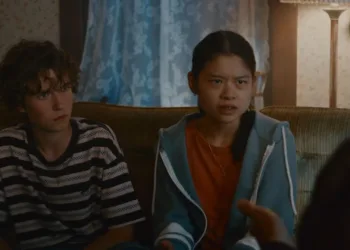




























Pumpkin apologizes for talking too much when she finally has guests at her Halloween table. She has candy to feed them and four years of silence to fill. The awkwardness of this meal gives Hallowarrior its most unsettling account of hospitality: a girl has preserved the customs of welcoming people long after losing any opportunity to learn whom she should trust. Thalia, the apparent leader of the visitors, indulges her conversation. Pumpkin’s preparations have found an audience, and for a little while that seems sufficient.
The rules governing this household have survived their authors. Pumpkin is sixteen, yet she still considers herself too young for the alcohol Royce drinks. A plague took her family when she was twelve; since then she has scavenged nearby farms by bicycle and kept herself alive in their upstate New York home.
Milly Shapiro makes these different ages coexist persuasively. Pumpkin’s practical independence belongs to someone accustomed to managing alone, while her eagerness at the table belongs to a child waiting for adults to take an interest. The alcohol prohibition is especially revealing. She has learned to live without supervision while retaining a small piece of its authority.
Writer-director Ben Sottak places that interrupted childhood inside a distinctly American seasonal environment. The farmhouse’s handmade crafts and purchased Halloween decorations preserve the mixture of family activity and shop-bought festivity through which Pumpkin remembers the holiday.
Jack-o’-lanterns and autumn colors make the rooms inviting without concealing peeling wallpaper and rot. The production design allows affection and neglect to remain visible together. Preparing the house gives Pumpkin something to do beyond finding supplies, but the radio invitation exposes what decorating cannot accomplish. A celebration organized around visitors has become painfully incomplete.
Shapiro’s achievement is to keep that need for company active even when caution would serve Pumpkin better. Her openness follows from deprivation, and the film gives it a dangerous counterpart in Shannyn Sossamon’s Thalia. Sossamon lets maternal warmth and menace inhabit the same exchanges.
When Thalia offers a drug that she says will reduce pain, apparent concern becomes a means of gaining access to a vulnerable girl. She understands how readily care can be recognized through familiar gestures. Royce’s drinking and Wendy’s repeated wish to leave disturb the arrangement, but Pumpkin has strong reasons to remain invested in the welcome Thalia appears to offer.
The defense of the house places Hallowarrior within a seasonal tradition that crosses national borders. The American Home Alone and the French 3615 code Père Noël provide useful points of comparison: both connect a child’s knowledge of domestic space with the reversal of adult power during a holiday.
That shared premise does not erase differences in tone. Here, Pumpkin’s relationship with the house is inseparable from the people she has lost. Its contents preserve a family culture she continues to practice alone. Converting that environment into a weapon means putting those inherited pleasures to a use nobody taught her.
Halloween makes the conversion particularly apt. Its games already invite people to approach things presented as frightening or unpleasant, trusting that the danger is contained. Pumpkin and Wendy remove that protection. Razor blades hidden in candy turn a familiar festive treat against the attackers; a tub of rotten bobbing apples becomes a means of drowning one.
The ideas have a nasty clarity because their original purposes remain recognizable. Pumpkin does not need to acquire an entirely new world of equipment for the invasion. The materials with which she hoped to entertain guests are already available.
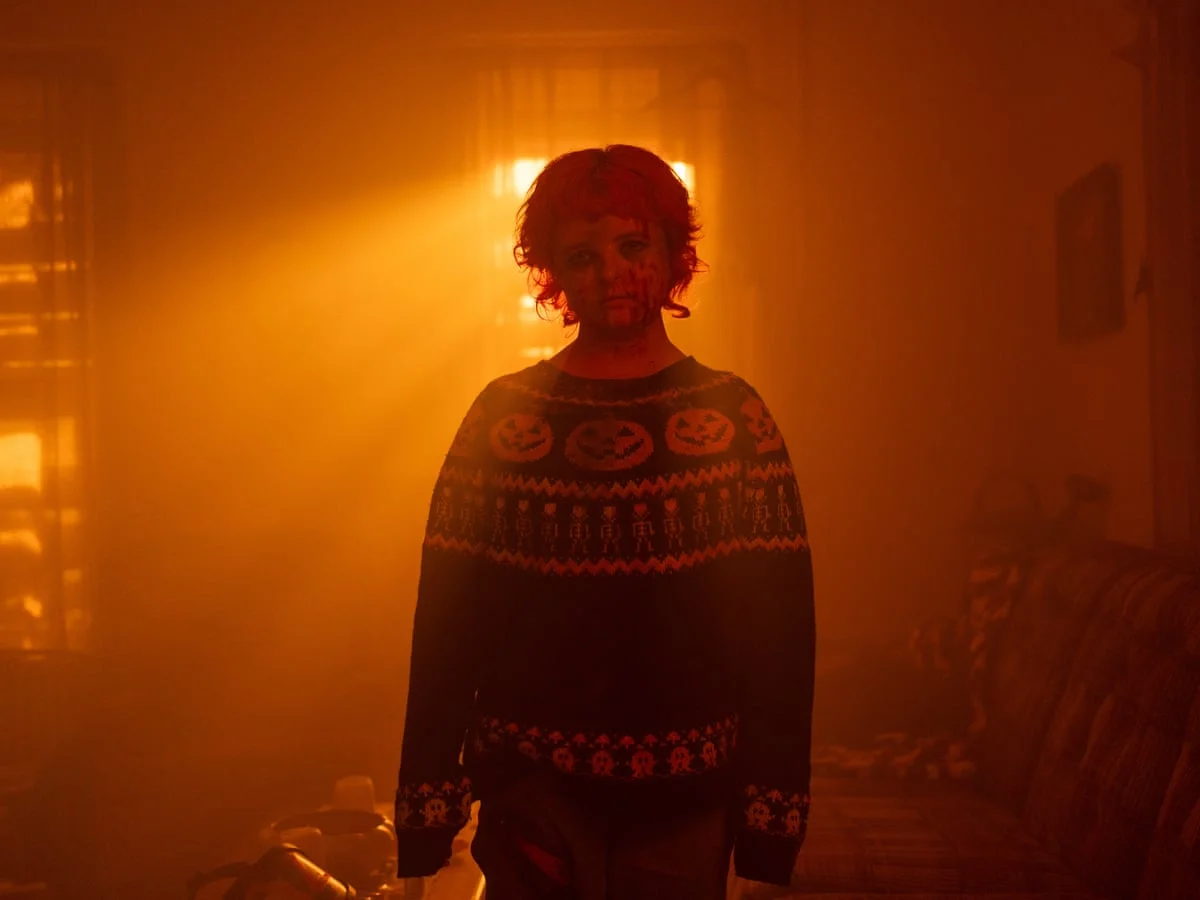
Those inventions would lose much of their interest if Pumpkin became effortlessly proficient at killing. Shapiro keeps her resistance connected to the girl who wanted the visitors to stay. Violence distresses her, and her imperfect execution gives the defense an uncertainty that simple ingenuity could not supply. Sottak is less successful at making the physical action match the strength of its conception. The dim lighting limits the visibility and impact of the bloodshed, blunting the physical payoff of those inventive traps.
The expansion of Thalia’s group creates a related problem of focus. Masked cannibals, drugs, elaborate makeup, and practical effects give the invading crowd considerable visual personality. Their arrival enlarges the threat while reducing the time available for the kind of encounter that made Thalia disturbing.
Her attention to Pumpkin is specific: she can exploit this girl’s loneliness. Further attackers increasingly require the house to function as an arena for violent incidents. Across roughly eighty minutes, the film moves briskly, yet its widening cast and hints of a larger post-apocalyptic society receive limited development. The change from an uneasy meal to a crowded assault supplies action at the expense of sustained intimacy.
Wendy provides the most useful connection between those scales. Ajani Russell gives her initial sullenness an undertow of sadness, and her warnings gradually acquire a practical value that Thalia’s reassurance lacks. Working with Pumpkin to defend the farmhouse turns companionship into something they must do together.
The holiday’s original promise of gathering survives in a changed form: Pumpkin can still share her home, although the relationship that makes sharing possible begins with disagreement, distrust, and help offered under pressure. Her willingness to admit people has made her vulnerable. Wendy gives her a reason to keep distinguishing among them.
Hallowarrior held its world premiere at the Tribeca Festival on June 10, 2026, and is scheduled for a United States streaming release on Shudder on October 16, 2026. The post-apocalyptic horror film follows the last surviving girl on Earth who must defend her sanctuary on Halloween night against a savage gang of raiders.
Where to Watch Hallowarrior (2026) Online
Full Credits
Title: Hallowarrior
Distributor: Shudder
Release date: June 10, 2026 (Tribeca Festival), October 16, 2026 (United States)
Running time: 1 hour 20 minutes (80 minutes)
Director: Ben Sottak
Writers: Ben Sottak
Producers and Executive Producers: Emmajane Hoffman, Gabriel Rosenstein, Ben Sottak, Jake Casey, Danielle Benedict
Cast: Milly Shapiro, Ajani Russell, A. J. Bowen, Shannyn Sossamon, Vic Plajas, Taylor Valentine Lupini, Logan Beveridge, Bobby McFarlane
Director of Photography (Cinematographer): Steven Jacob Russell
Editors: Andi Ralph
Composer: Emmajane Hoffman, Elizabeth Maniscalco
The Review
Hallowarrior
Hallowarrior gives American Halloween rituals a touching purpose: preserving family life after the family is gone. Milly Shapiro makes Pumpkin’s resourcefulness and hunger for company equally credible, while Shannyn Sossamon turns apparent care into a threat. The seasonal traps grow naturally from that setting, although dim lighting weakens their impact. An expanding invasion dilutes the intimate danger, leaving the film strongest when hospitality, loneliness, and survival occupy the same room.
PROS
- Shapiro’s convincing balance of independence and childhood vulnerability.
- Sossamon’s unsettling mixture of warmth and menace.
- Halloween decorations that express family attachment and decay.
- Inventive traps rooted in seasonal activities.
CONS
- Dim lighting blunts the violence’s visual impact.
- The larger invasion crowds out Thalia’s intimate threat.
- Hints of the wider post-apocalyptic society remain underdeveloped.