




























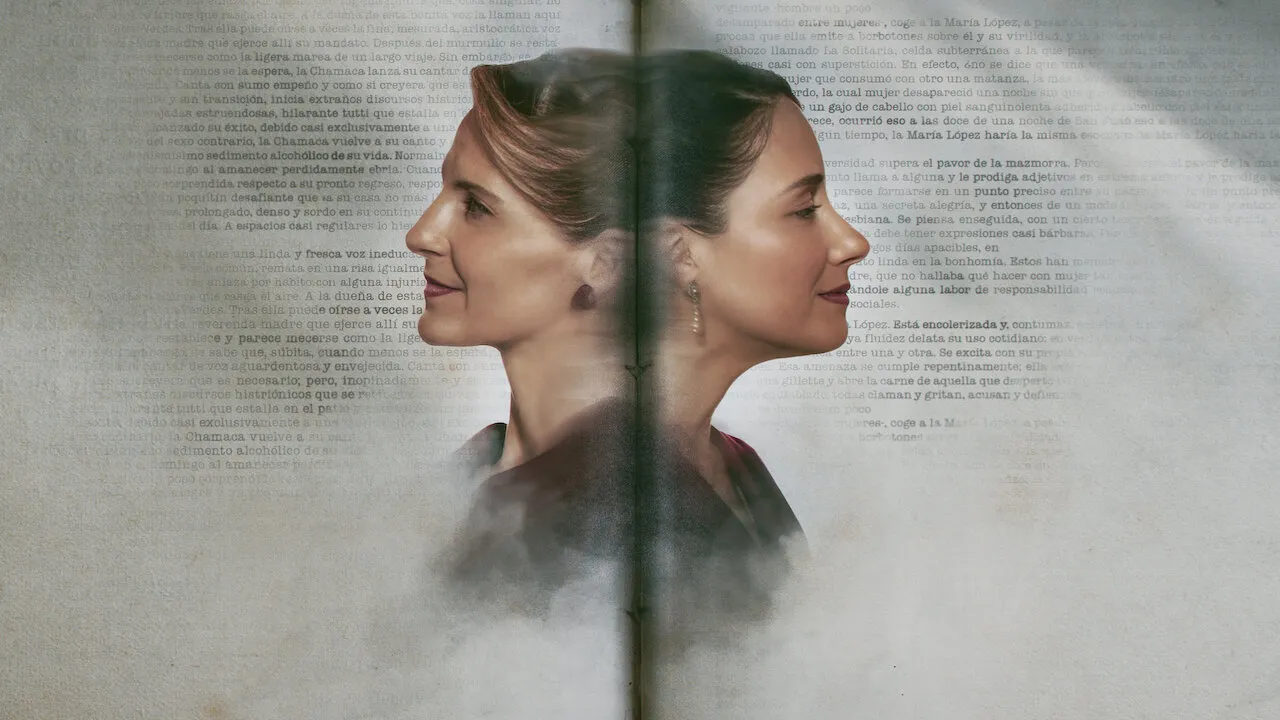

In Her Place, director Maite Alberdi conjures a portrait of 1955 Chile that feels once sharply specific and weirdly universal, a Santiago caught in the crossfire of its contradictions. It’s a country torn between tradition and modernity, where a woman’s worth is determined by her dishes’ cleanliness rather than her mind’s sharpness.
The film, a mix of historical drama and feminist fantasy, uses the true story of María Carolina Geel, a writer who shot her lover dead in the luxurious dining room of the Crillón Hotel as its narrative fulcrum.
Geel’s crime was more than just a murder; it became a cultural spectacle tinged with scandal, gender politics, and a country’s voyeuristic obsession. On the other hand, Alberdi makes an equally daring choice: to sideline Geel in favor of a fictional admirer, Mercedes, a downtrodden paralegal who fits into Geel’s glittering life almost too well.
The alluring yet unpleasant interplay between fact and fantasy is set up by this choice, which also sets up the core tension of the film. Is Mercedes an avatar for the director, a symbol of innumerable women’s unfulfilled dreams, or merely a narrative device to investigate the alluring potential of “what if”? Alberdi does not appear to want to provide a firm answer to that question—and this ambiguity, as irritating as it is, is part of the film’s unique beauty.
Mercedes: A Life Lived in Parentheses
Mercedes, the exhausted paralegal at the heart of In Her Place, is a woman defined not by her ambitions but by the unwavering demands of others. As a senior judge’s secretary, she is indispensable and invisible, a kind of bureaucratic ghost who haunts the halls of male authority, ensuring that the judicial machinery functions smoothly (and that her boss remembers where he left his lunch).
At home, her role is no less thankless: mother to two grown sons who refuse to grow up and wife to a fumbling photographer whose artistic pretensions appear inversely related to his ability. Mercedes’ existence is an experiment in quiet erasure, with her identity so completely flattened by the needs of others that her ambitions—whatever they may have been—are now only whispers.
However, her fascination with Mara Carolina Geel has a flicker of rebellion. Geel, the unabashed murderess and acclaimed author, is everything Mercedes isn’t: gorgeous, independent, and audacious. Mercedes’ internal monologue can almost be heard as she enters Geel’s luxurious, sunlit apartment (a space that feels more like a temple to self-actualization than a mere living room): “So this is what it feels like to breathe.”
Her motivations aren’t purely voyeuristic, though donning Geel’s velvet robes and red lipstick is undeniably thrilling. Geel represents more than just freedom; she embodies the kind of unashamed womanhood that Mercedes has never been allowed to envision for herself.
Her relationships with the males in her life score her longing for escape even more. Her spouse, Efraín, is a hapless dreamer whose reliance on her borders on infantilism. His inability to light his studio shots is both amusing and tragic. Her sons, big lads who have never understood the concept of a clean plate, are tiny tyrants in their own right.
Even her employer, supposed to be a figure of authority, relies so much on her that she could almost run the court alone. These men don’t just ignore Mercedes; they consume her, their desires devouring her time, energy, and fundamental sense of self. It’s little surprise that Geel’s life, free of sleeping husbands and heaps of dirty dishes, feels like the ultimate forbidden fruit.
Despite her escapism, Mercedes never becomes obsessed. Her ventures into Geel’s world are tentative, almost timid as if she were testing the seas of independence without fully diving in. This restraint is both a virtue and a fault of the film: we witness Mercedes’ need but never really comprehend it. Perhaps that is the point. After all, how do you express a desire you’ve been told to suppress?
The Velvet Mirage: Geel’s Life as Symbol and Escape
At its heart, In Her Place is a film about longing—specifically, the yearning that occurs when societal expectations crush originality into servitude. Mercedes’ interest in Mara Carolina Geel’s life is not just a quiet rebellion against the strictly prescribed roles allocated to her by 1950s Chilean society (roles that, depressingly, still reverberate today). Alberdi depicts Mercedes’ visits to Geel’s flat as a symbolic act of trespass—against class barriers, gender standards, and the crushing routine of her own life.

Geel’s character is a living symbol of female independence and creative freedom. Her opulent apartment, with its spacious rooms and abundance of books and pot plants, starkly contrasts Mercedes’ cramped, chaotic house. It’s more than just a space; it’s a refuge, a world that feels both impossible and tantalizingly close.
The velvet robes, red lipstick, and lingering aroma of expensive perfume are more than just props; they are talismans of a life free of familial obligations and societal censure. Geel’s lifestyle is, in many ways, an illusion. Still, Mercedes can’t help but pursue it, if only to escape the noise of her husband’s snoring and arguing children.
The contrast between Mercedes and Geel reflects the film’s stark class difference. Mercedes, a working-class lady whose work is invisible but necessary, is drawn to Geel’s upper-class lifestyle. But it’s more than just tangible wealth; it’s about the freedom that wealth provides—the ability to exist without being defined by serving others. Mercedes finds Geel’s uncompromising self-possession and refusal to comply with societal expectations of marriage and parenthood both foreign and alluring.
Mercedes dons Geel’s clothing and wears them to work, embodying—if only briefly—another version of herself, which is a particularly moving moment. Nonetheless, Alberdi resists the desire to allow this transition to devolve into fantasy. Mercedes does not turn into Geel; her entry into this borrowed life feels cautious, almost bittersweet. It’s an act of escapism that emphasizes, rather than eliminates, the profoundly ingrained disparities and oppressive conventions that define her realness.
Geel’s life thus becomes both a reflection and a mirage. It reflects Mercedes’ deepest wishes while amplifying her frustrations, providing a glimpse of what might be achievable but never fully offering a way out. And perhaps that is the film’s most poignant—and frustrating—point: for women like Mercedes, escape is always brief.
Velvet Shadows and Historical Echoes: The Film’s Visual Language
The Santiago of In Her Place is a painstakingly crafted time capsule, a world in which every shadow, piece of furniture, and clothing seemed to throb with the weight of 1955. This isn’t just set dressing; it’s a conscious conjuring of a civilization in transition, torn between the residual formality of the old world and the creeping modernism that will soon upend it.

The time setting serves as more than just a backdrop for the film’s female undercurrents, reminding us that Mercedes’ challenges are deeply personal and profoundly structural. After all, this was a time when women were not even allowed to enter the front doors of men’s clubs, let alone the chambers where choices were made.
Sergio Armstrong’s cinematography bathes this world in velvety tones, generating a daylight noir style that feels appealing and oppressive. The soft focus and warm lighting give Mercedes’ borrowed moments in Geel’s apartment an almost dreamy appearance, as if she is entering a parallel planet where her life may have been different. However, the artificial gloss of the pictures partly undercuts this illusion, serving as a subliminal reminder that Mercedes’ escape is, at most, fleeting.
Pamela Chamorro’s art direction and Muriel Parra’s costume design contribute to this tension. Geel’s luxurious and boldly feminine wardrobe becomes a symbol of her independence, whereas Mercedes’ drab, utilitarian garments mirror her unassuming existence. The difference is stark, almost painfully so. Even the plants in Geel’s apartment (lush, healthy, and uncontrolled) appear to ridicule Mercedes’ oppressive household existence.
Together, these aspects create an opulent and oppressive world, representing the film’s core tension: the alluring temptation of freedom vs the crushing weight of societal expectation. It is a visual language that whispers rather than shouts. Still, its message is no less powerful because of its restraint.
Dancing on the Edge: Humor and Heaviness in Harmony
In Her Place rides a tonal tightrope, balancing the weight of its feminist critique with an unexpected playfulness that borders on effervescence.
At first glance, Maite Alberdi’s decision to intersperse moments of humor and whimsy with a story about systematic misogyny and economic issues seems odd. After all, this is a film about a murder trial, societal oppression, and a lady drowning beneath the weight of domestic servitude. Despite the sad subject, the film’s tone is often light—almost cheeky. Alberdi winks at us as if to say, “Yes, the world is unjust, but isn’t it also absurd?”
Elisa Zulueta’s performance as Mercedes is a masterclass in understatement, and she bears most of the responsibility for this balancing act. Even as she trudges through her thankless daily work, she has a sparkle of humor in her eyes, a barely there smirk that says she is well aware of the ridiculousness of her circumstances. One sequence, in which she whispers lighting directions to her unfortunate husband as she rushes out the door, is both a comic family farce and a scathing critique of the invisible labor that women do.
This tonal interplay continues into the narrative itself. Mercedes’ quiet rebellion—wearing Geel’s dazzling clothes and reclining in her opulent apartment—feels almost amusing, even as it highlights the devastating restrictions of her own life. It’s a tricky balance, and while it risks trivializing the film’s weightier ideas, it ultimately makes the story more accessible, even disarming. Alberdi understands that laughter may be as keen as a knife when used carefully.
The Scandal That Sparked a Feminist Fable
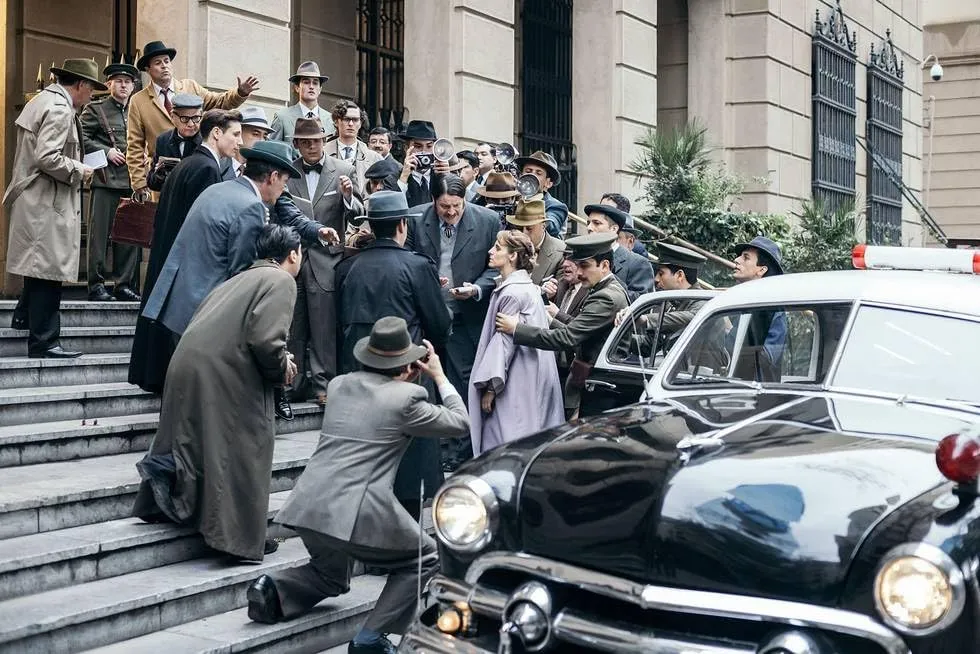
The true story of Mara Carolina Geel is the kind of fantastical tale that seems born for cinema. Geel, a well-known Chilean writer, shot her lover in cold blood at Santiago’s magnificent Crillón Hotel in 1955—a scene so showy that it virtually shouted for headlines. The crime, prompted by jealousy (and possibly an homage to surrealist poet María Bombal, who had committed a similar act in the same hotel years previously), gained quick attention.

But what happened next was even more shocking: Geel earned a very mild sentence (less than three years in a convent) and was awarded a presidential pardon before serving it. If the murder served as the spark, the public outrage and salacious fascination that ensued were the wildfires, a reflection of Chile’s confused ideas toward women, power, and morality in the 1950s.
At the time, Chilean society was dominated by rigid gender roles, and Geel’s actions—both the crime and her unrepentant demeanor—challenged those conventions in both titillating and dangerous ways. The media frenzy was not just about the murder; it was also about Geel’s violation of societal norms. She was unmarried, childless, and undeniably creative—qualities that made her curious and a cautionary story.
Alberdi’s film refracts this already rich material via the eyes of Mercedes, a fictitious admirer whose mundane life contrasts dramatically with Geel’s daring. By focusing on Mercedes’ obsession rather than Geel’s psychology, the film avoids the typical “true-crime biopic” approach in favor of a more introspective investigation of class, gender, and longing.
The historical details—Geel’s trial, the nunnery, and the eventual pardon—are present but softened as seen through Mercedes’ eyes. This method redirects the focus away from the case’s sensationalism and toward its consequences, transforming Geel into a symbol of rebellion and possibility rather than just a scandal. It’s a daring choice that unavoidably leaves the audience wanting more of Geel’s story, even as we’re drawn deeper into Mercedes’ quiet yearning.
A Whispered Revolution: The Impact of In Her Place
In Her Place is a film that quietly expresses its intentions, expecting the audience to lean in and listen. The key to its success lies in combining complex themes—feminism, socioeconomic imbalance, and the quiet rebellion of snatched moments—into a narrative that feels deceptively light.

Maite Alberdi’s delicate touch ensures that the film’s feminist critique never feels heavy-handed, instead appearing like a gentle drip of water on stone, destroying patriarchal institutions with understated grace.
The film’s lead character, Mercedes, whose quiet desire is brought to life with astonishing depth by Elisa Zulueta, is its greatest strength. Through her, the audience feels the oppressive weight of societal expectations and the temptation of a new life. The film’s Achilles’ heel, however, is its focus on Mercedes. The film loses a deeper examination of one of its most fascinating people by relegating María Carolina Geel to the role of muse and symbol. Geel’s story, full of boldness and scandal, feels like a squandered opportunity for a more compelling narrative.
The film’s visuals leave an impression. Its lush, painstakingly crafted period setting does more than simply define the era; it becomes a character in its own right, representing the restrictions and potential of 1950s Chile. The film’s restrained pacing and narrative subtlety, however, may leave some viewers unsatisfied, longing for a more forceful conclusion or emotional crescendo despite its beauty.
In Her Place, however, lingers in the imagination, not for what it resolves, but for what it suggests. It’s a quiet but purposeful subversion, a reminder that even the simplest actions of rebellion, like watering someone else’s plants or wearing lipstick, carry the weight of possibility.
The Review
In Her Place
In Her Place is a visually stunning and philosophically deep investigation of repression, escapism, and women's quiet rebellion against societal expectations. Although Mercedes' journey is captivating and humorous, the film's omission of María Carolina Geel's genuine story leaves a frustrating gap in the otherwise riveting narrative. It's a story that whispers when it should shout. Yet, its understated charm and feminist undercurrents keep it relevant long after the credits roll. It's an intriguing, imperfect reflection on identity and longing, beautifully created despite narrative flaws.
PROS
- Nuanced, standout performance by Elisa Zulueta as Mercedes.
- Stunning period-specific cinematography and art design.
- Thoughtful exploration of feminist themes and societal constraints.
- A delicate balance of humor and melancholia that avoids didacticism.
CONS
- Sidelining of María Carolina Geel’s fascinating true story.
- Pacing feels restrained, with moments of narrative inertia.
- Missed opportunities to delve deeper into the symbolic parallels between Geel and Mercedes.
- Some viewers may find the lack of dramatic resolution unsatisfying.







