


























In the dawn light of southern Iraq’s reed islands, the camera drifts over misty waterways, where nine-year-old Lamia navigates a fragile world. It is April 26, 1990, and two days remain until Saddam Hussein’s birthday. In a classroom ritual both bureaucratic and menacing, Lamia’s name is drawn from a tin, sealing her fate as the student tasked with baking the school’s ceremonial cake under crippling sanctions.
The film constructs its narrative with the precision of a fable, each episode unfolding like a chapter in a children’s tale warped by authoritarian absurdity. Lamia’s journey shifts between pastoral calm and urban turmoil, guided by her grandmother’s quiet resolve and accompanied by Hindi, her confidant rooster. The stakes are never abstract: flour, sugar and eggs are more precious than gold.
This opening gambit establishes the story’s dual rhythm—moments of tender lyricism interrupted by flashes of coercion. From reed boat to crowded souk, the viewer witnesses how storytelling techniques channel both wonder and dread without losing sight of its young heroine’s unwavering courage.
Politics in the Marsh: Iraq’s Silent Currents
Set two days before Saddam Hussein’s birthday, the film anchors its drama in the tangible weight of UN sanctions. Food and medicine vanish from markets; families queue for water trucks that feel more like grudging handouts than acts of goodwill. This backdrop isn’t window dressing—it informs every decision Lamia makes as she hunts for flour, sugar and eggs in a land stripped of basic sustenance.
Classroom rituals double as displays of power. Children chant oaths of fealty beside propaganda posters, their tiny voices echoing an adult coercion. Mandatory celebrations blur the line between education and indoctrination, revealing how cults of personality thrive when dissent carries a fatal price.
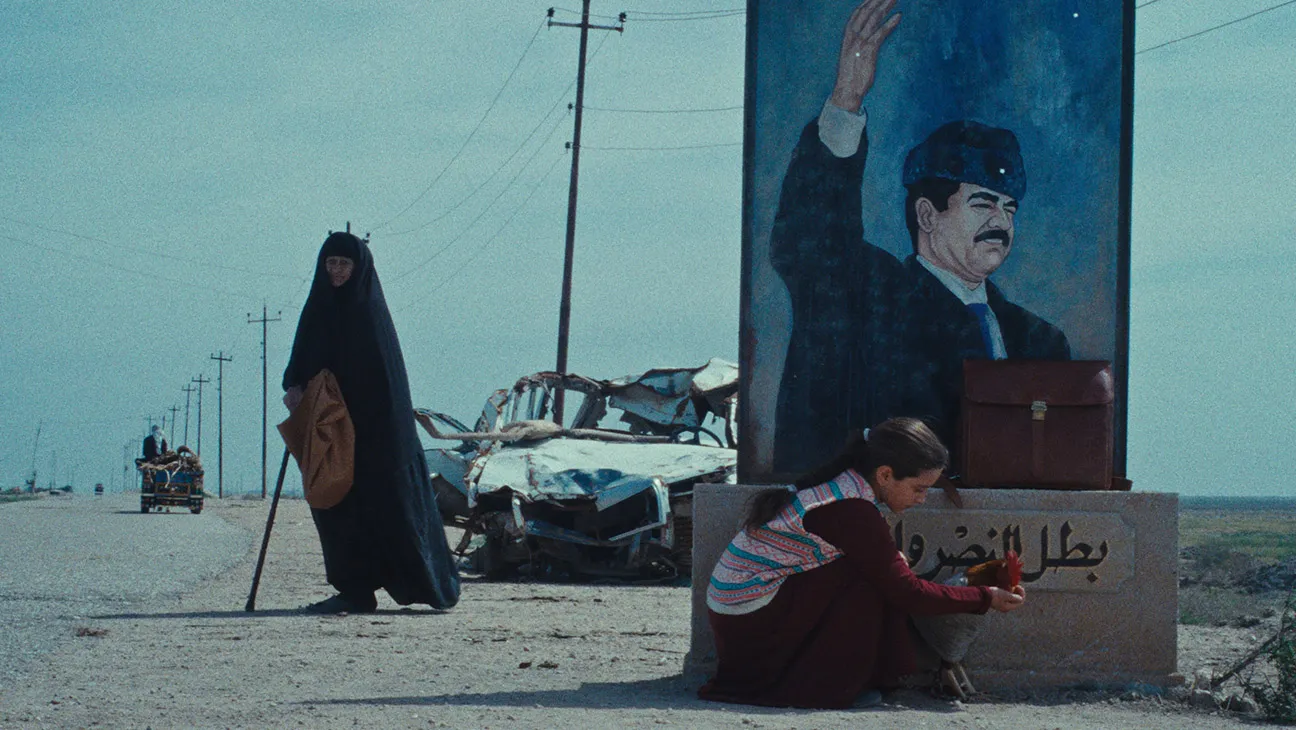
Visually, the story unfolds across the reed islands of the Euphrates–Tigris floodplain, where boats drift through a world both lush and precarious. Early sequences linger on the marsh’s verdant quiet, only to thrust Lamia into Baghdad’s cacophony. That contrast underscores a central tension: natural abundance forced into the service of an artificial regime.
Beneath these currents lie social hierarchies that feel as ancient as the land itself. Patriarchal norms surface in markets where girls and boys vie for currency, only to learn that adult bargains rarely favor the young. Economic class divides appear in haggling scenes, where grandparents barter prized possessions to afford a single loaf of bread.
Yet community traditions persist. Elders pass down survival tactics—ways to avoid the lottery draw or slip past checkpoints—demonstrating that resilience can exist even under tyrannical rule. In this context, the film doesn’t merely recount history; it situates Lamia’s quest within a tapestry of human endurance woven through centuries of marshland life.
From Draw to Duel: Mapping Lamia’s Journey
The story ignites with a simple classroom ritual: names drawn from a tin. Lamia’s slip of paper seals her fate—she must bake the president’s cake or face dire consequences. This inciting incident looms like a grenade: the mechanics of fear are laid bare in a moment as quiet as it is chilling.
Once chosen, Lamia embarks on a quest for four scarce essentials—flour, sugar, eggs and baking powder—each item weighted by economic collapse. She carries a pocket watch and sentimental trinkets to barter, tools that reveal storytelling knack for turning children’s ingenuity into dramatic tension. Along dusty market stalls, she meets a spectrum of adults: one offers genuine aid, another cajoles for sexual favors, a third stiff-arms her with bureaucratic indifference.
Parallel to Lamia’s odyssey runs her grandmother’s subplot. Bibi’s own journey to the city masks a hidden plan: to leave Lamia with distant relatives. When illness strikes and Bibi lands in a hospital ward, her desperation becomes a mirror of the regime’s cold grip. This dual narrative threads suspense through different stakes—childhood survival and a motherly betrayal under the guise of protection.
The narratives converge in a charged climax. Lamia, cornered by security forces in a teeming souk, must summon courage born of necessity. At nearly the same moment, Bibi stages a silent protest in a police station corridor, her frail figure demanding answers from uniformed indifference. The parallel confrontations underscore the film’s structural ambition: two arcs weaving into a single act of resistance.
Moments later, the story eases into its denouement. The cake’s ultimate fate remains ambiguous, reflecting the film’s refusal to tidy moral knots. Lamia walks away with more than flour on her dress; she carries a new grasp of loyalty—one earned, not commanded.
Faces of Survival
Lamia emerges as the film’s beating heart. Her eyes shift between fear and resolve, reflecting a narrative design that trusts a child’s perspective to carry weighty themes. She barters her father’s pocket watch and a few trinkets not as plot devices but as extensions of her inner resourcefulness. Under extreme pressure, she never telegraphs a leap into premature adulthood; instead, each hesitation or daring sprint through the market feels earned by circumstance.
Bibi, her grandmother, inhabits a dual role. As Lamia’s guide, she imparts survival tactics—how to haggle, where to hide. Yet her hidden motive to leave Lamia behind adds a bittersweet layer. Waheed Thabet Khreibat’s quiet intensity grounds the revelation in genuine heartbreak, reminding us that love can demand impossible choices. The film’s structure pivots on this secret, giving Bibi’s arc a tragic symmetry.
Saeed provides both comic relief and emotional ballast. His pickpocketing skills and one-liners mask a boy who has learned to adapt or perish. When he jokes about becoming president to eat all the cake, the line lands with both levity and irony. In the context of contemporary child-centered dramas, Saeed’s presence upholds a trend toward complex sidekicks who evolve beyond caricature.
Hindi, the rooster, could have been a mere mascot. Instead, he functions as a living talisman—an emblem of home and innocence. His crow punctuates key moments, drawing attention to how even small creatures can anchor a story’s emotional logic. That choice shows a storytelling confidence often missing in more risk-averse productions.
Supporting adults form a microcosm of Iraqi society under strain. Shopkeepers range from predatory to paternal, while the mailman’s kindness stands out as an oasis of decency. These characters avoid flatness: each encounter with Lamia reveals a different facet of communal resilience. By giving even minor roles distinct motives, the film maps a social ecosystem where loyalty and exploitation coexist.
Framing Decay and Melody
The film’s visuals unfold in two distinct registers. In the marshlands, wide, static shots capture the mist-veiled waterways, evoking a timeless quality. A gentle vignette edges each frame, signaling a story rooted in 1990 while distancing us from modern artifice. Conversely, market and alley scenes adopt handheld camerawork—jostling perspectives that thrust the viewer into Lamia’s urgent footsteps.
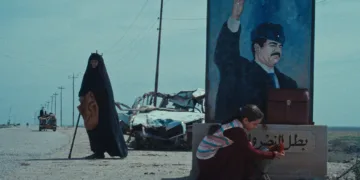
Production design speaks volumes without a word. Walls plastered with Saddam’s stern visage loom over modest homes. Clothing feels patched yet purposeful, a testament to survival. Barter stalls display spices and rusted scales, each haggle revealing scarcity’s constant pinch. A dropped coin clinks in a close-up, grounding us in economic desperation.
Sound bridges the visual contrasts. Natural ambience—rustling reeds, distant boat engines, buzzing flies—hints at both life and decay. Traditional oud strains weave through the score, lending cultural authenticity and emotional weight to pivotal moments. Then comes sonic punctuation: firecrackers crack open tension; a cola-bottle “explosion” snaps us to the stakes at hand.
This interplay of image and sound not only establishes place but amplifies narrative beats. Here, environment becomes character, and every rustle or chord reinforces the story’s urgent pulse.
Rituals of Resistance
The film’s central symbol—baking a birthday cake—unmasks the absurdity of authoritarian pageantry. In a country where flour is scarcer than freedom, Lamia’s sugar-spun duty becomes a coercive tribute. Every sift of powdered sugar echoes the regime’s insistence on loyalty, even as people starve.
Childhood innocence collides with exploitation throughout the story. Lamia’s wide-eyed trust makes each adult encounter fraught: a helpful vendor may demand more than money, while a kindly passerby vanishes when real danger strikes. That purity under siege underscores how regimes prey on hope.
Power here is never distant. It seeps into daily transactions, compelling obedience yet inviting quiet resistance. When Lamia hides her last egg in plain sight, she both submits and defies. The film crafts these moments without heavy-handed commentary, trusting audiences to read the subtext.
Amid oppression, familial love emerges as an act of rebellion. The silent bond between Lamia and Bibi carries more weight than any decree. A simple hand squeeze or shared glance out on the marsh speaks louder than speeches.
Subtle fairy-tale motifs—chance meetings, symbolic firecrackers—surface with restraint. They amplify tension without undercutting realism. In balancing fable and fact, the narrative proves that even the smallest coincidences can become profound acts of survival.
Craft and Cast in Tandem
Hasan Hadi’s first feature marries poetic imagery with stark authenticity. His camera drifts over misty marshes in moments of quiet lyricism, then snaps into handheld urgency within crowded souks. This episodic pace shines in standout set pieces—Lamia’s market escape, the night-time stakeout—though a few transitional beats sag under the weight of world-building.
At the narrative’s core is Baneen Ahmad Nayyef, whose subtle shifts in posture and the flicker in her gaze convey a child on the brink of understanding cruelty. She doesn’t grandstand; instead, she reacts, and those reactions anchor the film’s emotional logic. Opposite her, Waheed Thabet Khreibat embodies generational resolve. Her stillness and economy of motion speak volumes, underscoring a lifetime of endurance without resorting to melodrama.
Supporting roles, filled by non-professional actors, lend a textured realism. The genial mailman’s warm tone offers relief, while a predatory merchant’s leer reminds us that kindness is never guaranteed. These performances sketch an Iraq both familiar and foreign, where survival demands both vigilance and compassion.
Hadi strikes a careful tonal balance. A child’s unfiltered wonder—Hindi crowing at sunrise—sits beside darkly comic beats, such as a government clerk’s brusque indifference. Visual flourishes—a fluttering cloth in the breeze, sudden firecracker bangs—heighten stakes without feeling gratuitous, showcasing a director confident in using style to serve story.
Full Credits
Director: Hasan Hadi
Writer: Hasan Hadi
Producers: Leah Chen Baker
Co-Producers: Yanal Kassay
Executive Producers: Marielle Heller, Eric Roth
Cast: Baneen Ahmad Nayyef, Sajad Mohamad Qasem, Waheed Thabet Khreibat, Rahim AlHaj
Director of Photography (Cinematographer): Tudor Vladimir Panduru
Editor: Andu Radu
The President’s Cake is a co-production between the United States, Iraq, and Qatar.
The Review
The President’s Cake
The President’s Cake balances lyrical storytelling with stark realism, turning a child’s simple quest for cake into a powerful portrait of resilience under authoritarian absurdity. Hadi’s assured direction and Nayyef’s nuanced performance infuse each episodic beat with emotional weight, even as pacing occasionally lingers.
PROS
- Deep emotional resonance through Lamia’s perspective
- Authentic, textured portrayal of 1990s Iraq
- Baneen Ahmad Nayyef’s performance carries subtle intensity
- Striking contrasts between marshland serenity and urban bustle
- Effective fusion of fable elements with unflinching realism
CONS
- Episodic pacing produces occasional slow stretches
- Some secondary characters lack full development
- Grandmother’s subplot feels uneven in places
- Tonal shifts can register as jarring