















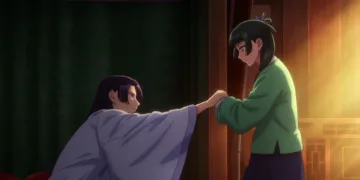













The film opens on a rain-slicked Kyoto street in a bygone era. A samurai, Kosaka Shinzaemon, prepares for a fatal duel, his purpose clear and his world defined by honor and steel. A sudden flash of lightning strikes his blade, and the world dissolves.
He awakens not just in a different time, but in a place of profound dislocation: a modern film set meticulously recreating the very world he just left. This is the ingenious premise of A Samurai in Time. Kosaka finds himself a living anachronism wandering through an artificial recreation of his own history.
He is surrounded by men in familiar warrior attire, yet they are merely extras in a jidaigeki, a period drama. The film immediately establishes its clever, self-aware tone, using the fish-out-of-water trope as a launchpad for something far more textured.
The Artifice of Authenticity
The movie’s film-set location becomes its primary narrative engine, a sandbox where reality and performance collide. Kosaka’s authentic samurai bearing is mistaken for intense commitment to a role, and his mastery of the sword lands him a job as a kirareyaku. This is a specific type of stunt performer, the cinematic equivalent of a Star Trek redshirt, whose specialty is being dramatically and repeatedly slain on camera.
Through this role, the film becomes a loving tribute to the craft of jidaigeki productions. It delights in deconstructing its own form, showing a scene in rehearsal and then revealing the polished final product, pulling back the curtain on the painstaking work behind the on-screen action. The humor is gentle and character-driven, stemming from his quiet bewilderment at the illusion.
He is baffled by prop swords that fail to make the expected shing sound when drawn, a detail true to life but contrary to cinematic language. He must “unlearn” his lethal efficiency to adopt a new style that plays well for the camera while ensuring the safety of his scene partners. The comedy is found not in mockery, but in his sincere effort to adapt to a world of artifice, whether facing a modern vacuum cleaner or the strange silence of a prop blade.
The Sorrow of Survival
The film’s emotional weight rests entirely on the shoulders of Makiya Yamaguchi’s central performance. As Kosaka, he projects a profound and unwavering dignity that anchors the story, providing a counterbalance to the film’s playful artifice and preventing its comedic setup from descending into farce. He performs each moment with a grave sincerity that gives the film its soul.

This is not merely a story of temporal displacement; it is a quiet, aching study of loss. Kosaka carries the gravity of a man who has outlived his entire world, a ghost haunted by memories of a time that exists now only on celluloid. In one of the movie’s most telling scenes, he weeps with joy and sorrow while eating a simple strawberry shortcake, a confection that represents a universe of progress and pleasure unavailable in his time.
The moment perfectly captures his awe at the new world and his deep grief for the one he has lost. His bond with Yuko, an ambitious assistant director, is built on a mutual respect for craft. It is a mature partnership, a meeting of two spirits dedicated to their code, whether that of a warrior or a filmmaker. Her combative, passionate drive to create gives him a foothold, an inspiration to forge a new path in this strange future.
A Duel Across Time
The narrative shifts and deepens when Kosaka’s rival from the opening duel, Hikokuro, reappears. He too was sent forward in time, but his journey happened decades earlier. He has aged and assimilated, becoming a famous and revered movie star under a new name.

The confrontation that follows is not one of chance, but of design. Hikokuro, now a powerful figure in the industry, orchestrates a new film production and personally hires Kosaka to co-star, setting the stage for them to finish their centuries-old fight. This ingenious development turns the film into a direct interrogation of the two men’s place in a world that has left their values behind.
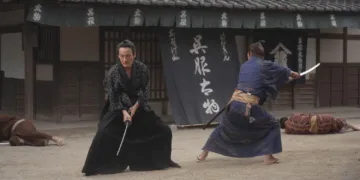
Their final duel is staged as the climax of the movie they are shooting together, a brilliant device that places real combat, with real stakes, in front of a camera and crew who believe they are merely capturing fiction.
It elegantly ties together the movie’s threads: its affection for jidaigeki, the nature of authenticity, and the search for purpose. The film’s pacing may feel deliberate in its latter half, but this focused meditation culminates in a thrilling and deeply satisfying resolution, a poignant reflection on how the past survives as a story fought by men for whom it was once life itself.
A Samurai in Time (Japanese: Samurai Taimu Surippā), is a 2024 Japanese fantasy comedy film. It premiered at the Fantasia Film Festival on July 28, 2024. The film was initially shown in only one theater in Japan but gained popularity through word-of-mouth and expanded to more theaters.
Full Credits
Director: Jun’ichi Yasuda
Writers: Jun’ichi Yasuda
Producers: Jun’ichi Yasuda
Executive Producers: Jun’ichi Yasuda
Cast: Makiya Yamaguchi, Norimasa Fuke, Yuno Sakura, Rantaro Mine, Ken Shonozaki
Director of Photography (Cinematographer): Jun’ichi Yasuda
Editors: Jun’ichi Yasuda
The Review
A Samurai in Time
A Samurai in Time is a wonderfully inventive and heartfelt film that uses its clever premise to deliver more than just fish-out-of-water comedy. It is a poignant meditation on history, performance, and the dedication to one's craft, anchored by a powerful lead performance. While its pacing may test some, the film's blend of gentle humor and sincere drama makes for a uniquely satisfying and thoughtful cinematic experience.
PROS
- An intelligent and highly original premise that cleverly subverts genre tropes.
- A deeply moving and dignified lead performance from Makiya Yamaguchi.
- Serves as a heartfelt and knowledgeable tribute to the jidaigeki film genre.
- Successfully balances gentle, character-driven comedy with sincere emotional depth.
- The climactic sequence provides a creative and satisfying conclusion.
CONS
- The pacing becomes noticeably more deliberate and meditative in the second half.
- Its deep reverence for jidaigeki might feel niche for viewers unfamiliar with the genre.
- Some supporting performances can feel broad in contrast to the lead's nuanced portrayal.