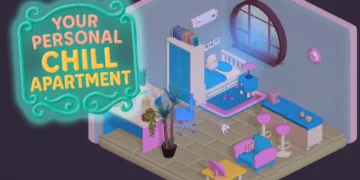































Your Personal Chill Apartment presents itself as a tranquil intersection of personal productivity and creative expression. The concept is straightforward: you are given a single, empty digital room to furnish and personalize. This process is powered by your own real-life accomplishments.
By creating and completing a to-do list within the game, you earn the currency needed to purchase furniture and decorations. The game is a small download, allowing for a quick start to building your own peaceful space.
It aims to be a rewarding sanctuary, a quiet corner of the digital world that you build piece by piece through your daily efforts. The experience is designed to be calm and reflective, a gentle tool for motivation rather than a demanding game. It offers a blank canvas for you to project your own sense of style and order, one completed task at a time.
The Premise of Productivity
At its foundation, this title is a gamified productivity application. Its main purpose is to provide a reward for real-life accomplishments through the act of decorating a personal, cozy space. There is no narrative, lore, or defined player character. The experience is untethered from story; it simply offers a platform for player expression.
A cat provides a brief tutorial, setting a simple and gentle tone from the beginning. The game’s stated function is to be a peaceful digital retreat, a place constructed and earned through the player’s own productivity. It is less a game to be beaten and more a space to be inhabited, shaped by actions outside the software itself. This design choice to omit a narrative is significant.
Unlike a game such as Unpacking, where arranging objects tells a profound story about a person’s life, this game deliberately avoids any form of scripted meaning. The player is not discovering a character; they are using the space for their own purposes, making the room a mirror rather than a window.
The value of this approach depends entirely on what the player seeks. For those wanting a pure sandbox for self-reflection and design, the lack of narrative is a strength. For those who need a narrative hook to remain engaged, the experience may feel hollow.
The Art of a Blank Canvas
The game’s central activity is decorating the room, and the tools provided offer a surprising degree of control. You begin with four empty walls and a catalog of furniture and decorative items. Almost every object can be repainted using a full RGB color tool. A palette allows you to save favorite colors for quick access, streamlining the design process.
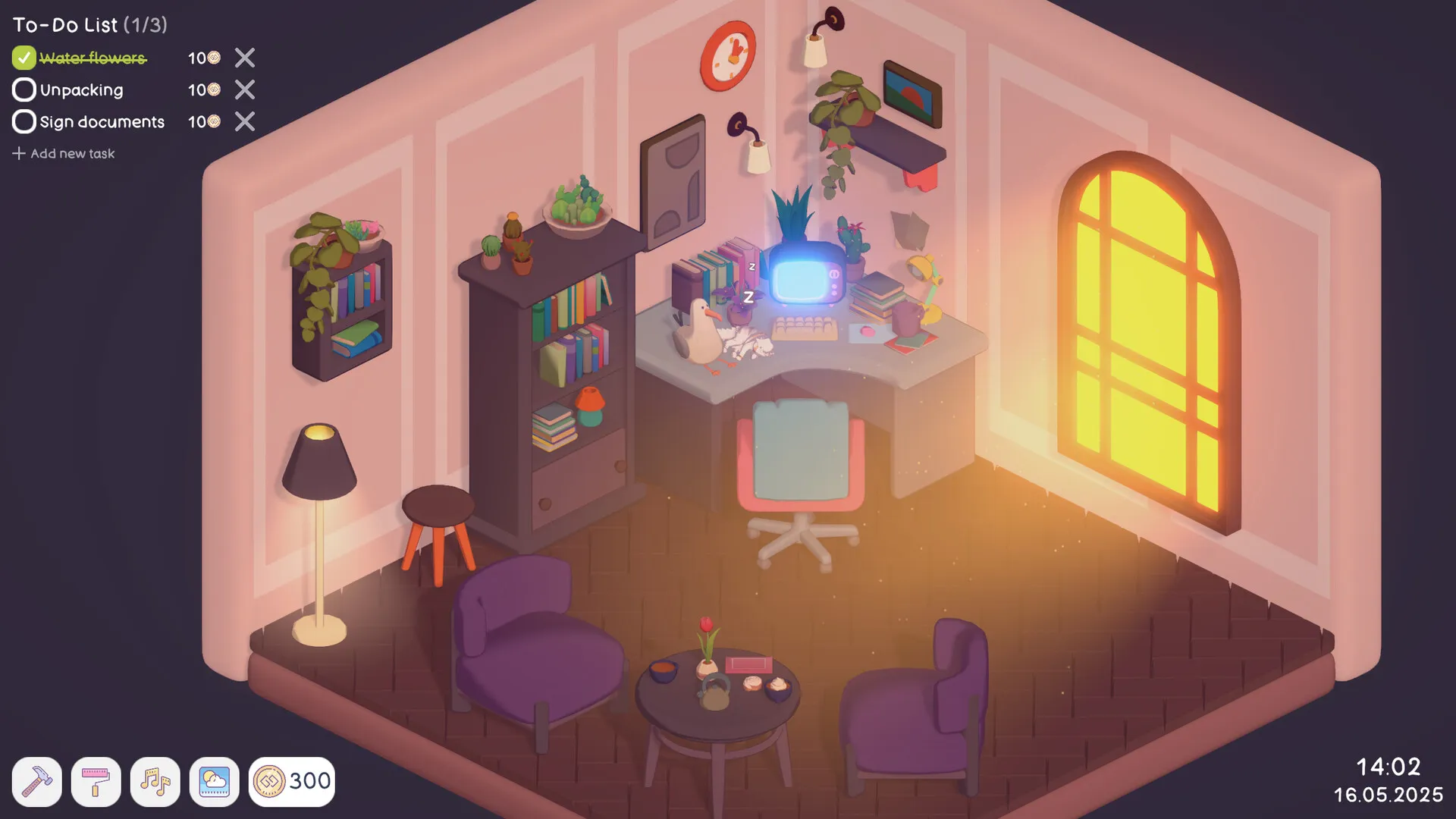
This system has a notable quirk. The absence of a simple light-to-dark slider means achieving specific neutral tones, like a particular shade of beige or brown, requires finding and entering hex codes manually. This is a curious choice, giving professional-level control to a tool in a casual game, yet it makes simple color adjustments difficult for its target audience.
The general aesthetic of the furniture favors a soft, rounded, and “cozy” appearance, fitting the popular style of the genre. A cat is also present in the room, adding to the atmosphere, a quiet companion in your custom-built space.
The isometric perspective gives the player a clear, dollhouse-like view of their creation, reinforcing the feeling of being an outside director of this tiny world. This view is practical for placement and design, allowing for precise arrangement of objects without the camera getting in the way.
An Engine Without Resistance
The mechanics that power the decoration are centered on a self-directed task list. Players create their own to-do items reflecting their real-life duties and can assign a custom coin value up to 999 for each one. Completing the task in real life and checking it off in the game releases the funds. This system, while novel, contains a fundamental design flaw.
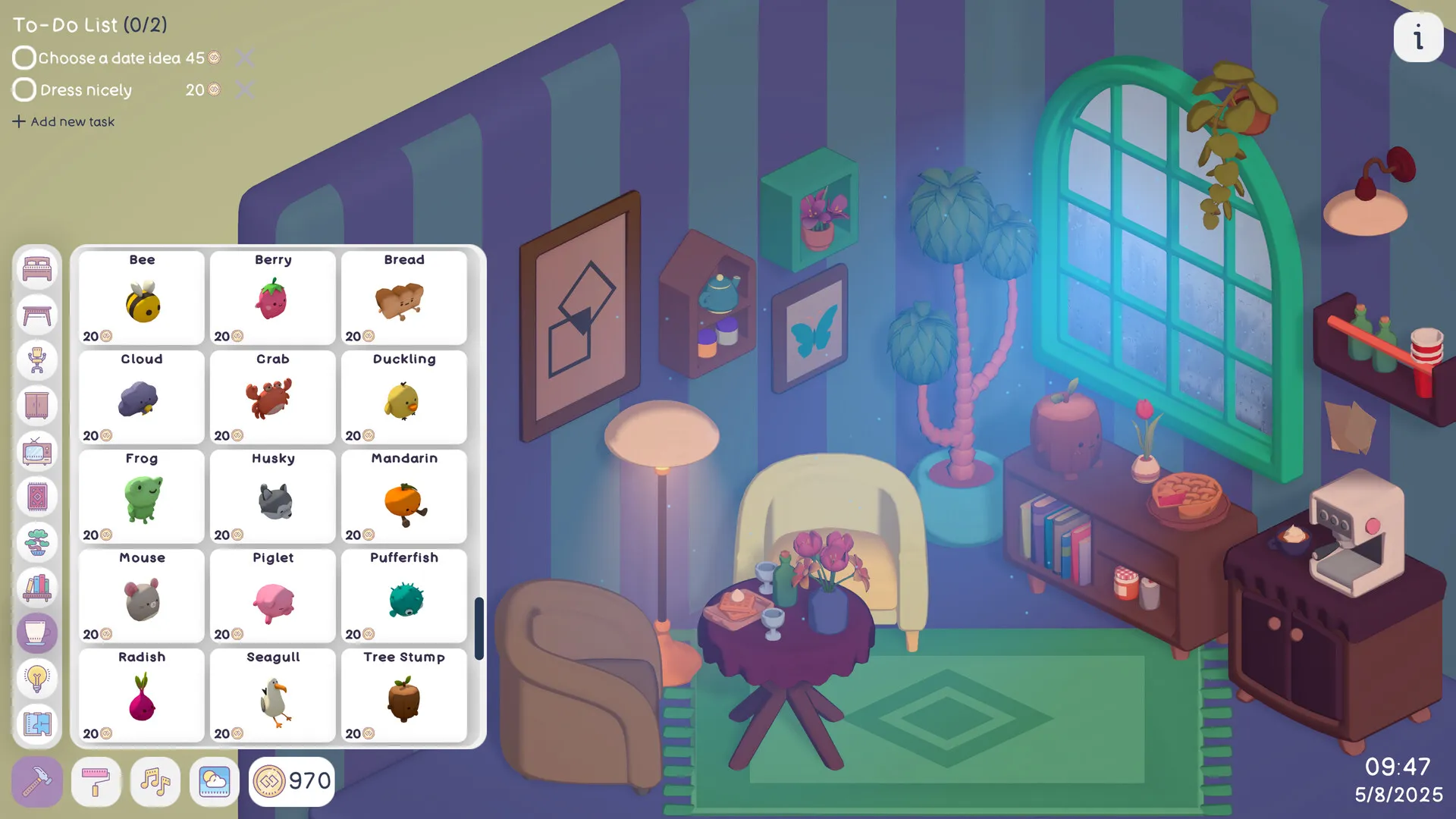
Since the player controls the creation of tasks, the value of those tasks, and their completion, the entire reward loop can be bypassed. One can simply invent tasks and mark them complete to generate infinite currency with minimal effort. This undermines the core motivational hook. The intended connection between real-world effort and in-game reward is severed. This choice effectively removes any economic friction from the game, turning the decoration aspect into a pure sandbox mode.
The choice to exploit this system or play as intended is left to the player, but the consequence of the exploit is the dissolution of the game’s primary premise. Other systems add to the room’s environment. You can change the weather outside from sun to rain or snow, which alters the ambient sounds and the quality of light inside the room. All progress relies on a manual save system, a feature that feels somewhat dated but fits the slow, deliberate pace of the game.
A Polished but Confined Space
Visually, the game is polished and clean, presented from a clear isometric viewpoint. The soft art style works well for the relaxing theme. The dynamic lighting that comes with weather changes is a nice touch, but some filters, particularly for sunrise and sunset, cast an intense neon glow that can obscure the player’s deliberate color choices.
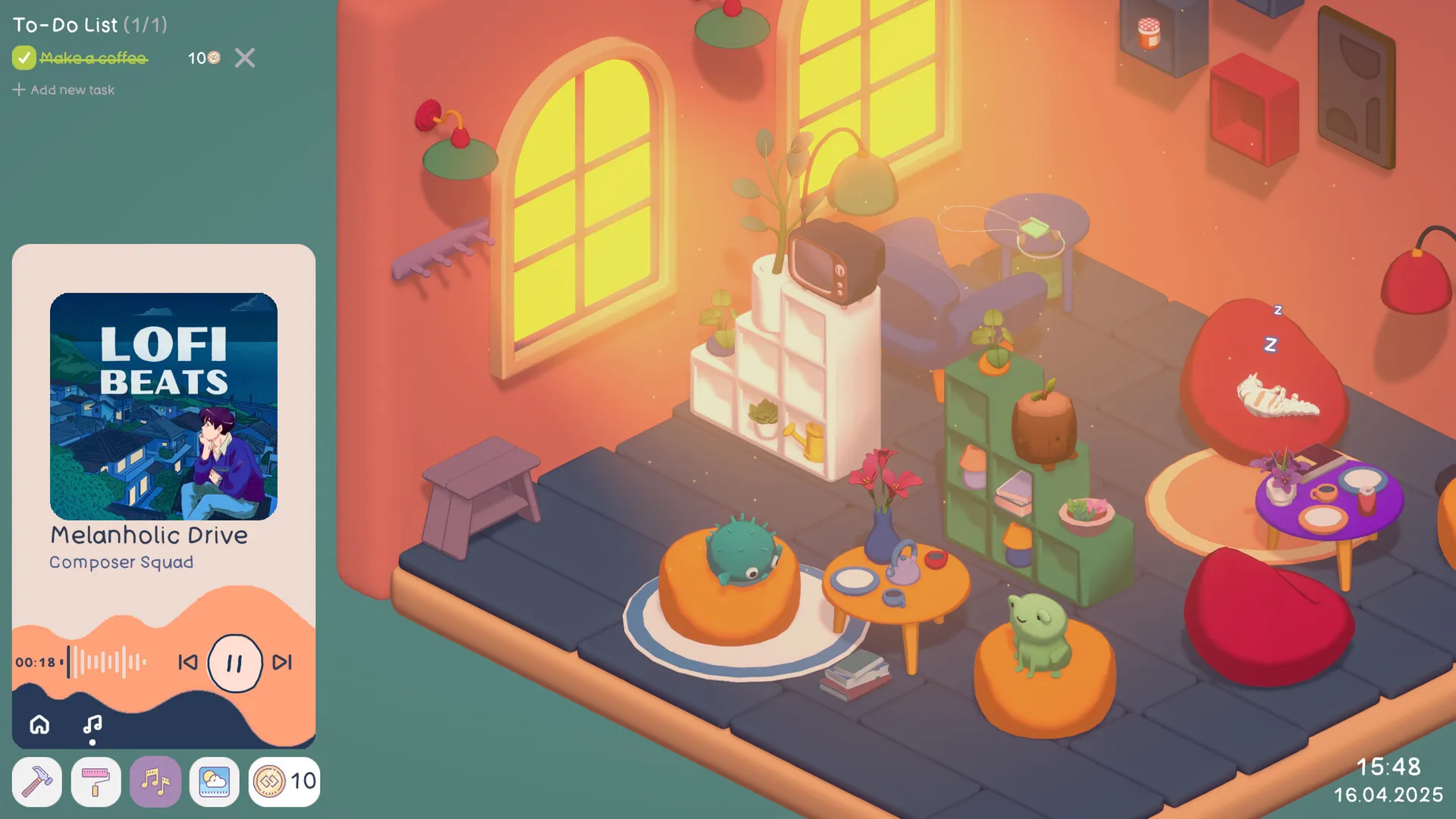
This visual hiccup can temporarily break the carefully constructed cozy atmosphere. The audio presents a mixed experience. The built-in lo-fi soundtrack contains some fittingly relaxing tracks, but other songs are upbeat to the point of being distracting for a productivity tool. You can add your own MP3 files, which is a welcome feature, yet the game strangely lacks a basic in-game volume slider for its music. The most significant limitation is the game’s scope.
The title suggests an “Apartment,” but the play space is restricted to a single room. While there are multiple save slots, each is for a separate, self-contained room. This mismatch between the title and the reality of the game is its largest failing.
There are no long-term goals or progression systems, meaning the experience concludes once you are satisfied with your decoration. The combination of an exploitable economy and a limited play space makes the game feel more like a short, pleasant tech demo than a fully realized experience.
The Review
Your Personal Chill Apartment
Your Personal Chill Apartment is a charming but flawed concept. It offers a polished and relaxing decoration sandbox, but its core productivity loop is easily broken, removing any sense of accomplishment. The experience is limited to a single room and runs out of content quickly, feeling more like a brief, pleasant diversion than a lasting productivity tool. Its potential is held back by a lack of scope and a central mechanic that undermines its own purpose.
PROS
- Clean, polished isometric visuals.
- Extensive color customization for most objects.
- A calm and relaxing atmosphere.
CONS
- The core task-and-reward system is easily exploitable.
- The gameplay is confined to a single room.
- Lacks long-term goals or reasons to keep playing.
- The title is misleading, as you cannot build a full "apartment."