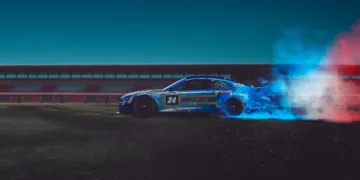































The central premise of American Thunder: NASCAR to Le Mans reads like a philosophical paradox posed at 200 miles per hour. The project is an exercise in categorical defiance: to take a Hendrick Motorsports Chevrolet Camaro, a machine designed for the brutal physics of American ovals, and place it within the rarified, almost sacred, confines of the 24 Hours of Le Mans.
Its entry, facilitated by the experimental “Garage 56” initiative, makes it an official interloper. The film assembles a triumvirate of purpose-built drivers to pilot this anomaly. Jimmie Johnson arrives as the NASCAR legend facing a new typology of speed, Jenson Button as the cerebral Formula 1 tactician, and Mike Rockenfeller as the essential native guide to Le Mans’ arcane truths.
The film quietly discards the traditional quest for victory. Instead, it asks a more existentially potent question: in an arena defined by precision and legacy, can a creature of pure power survive? Can it earn its place simply by enduring?
Anatomy of a Heretic
The film’s true protagonist is the machine itself. The narrative is less a human story and more a document of mechanical transmutation, tracking the Camaro’s violent reshaping of identity. The modifications are presented not as simple upgrades but as fundamental ontological shifts. New brakes, headlamps, and aerodynamic surfaces are grafted onto its frame, altering its very being in a methodical, almost ritualistic, loop of testing, failure, and re-engineering.
The cinematography treats this process with a kind of industrial reverence. In the garage, chiaroscuro lighting cuts through the darkness, illuminating mechanics as they perform their rites over the chassis. The car rests on the stand like a patient undergoing a radical procedure, with slow pans across its bodywork that linger on new seams and foreign components.
During testing sequences at tracks like Sebring and VIR, low-angle tracking shots render the car a brutish, monstrous thing, its presence almost a violation of the landscape. Rack focus shots pull from a driver’s determined face to a critical data display, visually welding the human to the mechanical. The sound design is a critical narrative layer.
Also Read






The guttural, undisciplined roar of the V8 engine is a diegetic disruption, a sonic battering ram that rips through the high-strung, surgical whine of its European counterparts. It is the car’s unwavering declaration of what it is, a raw assertion of its otherness that defines its psychological space.
The Ghosts in the Machine
The human element is presented with a cool, clinical distance. The film portrays the team not as a band of brothers but as a coalition of specialists, human software running complex mechanical hardware. The collaboration is one of chilling professionalism, its tension derived from the engineering problem, not from manufactured interpersonal conflict.

The drivers are less characters and more archetypes. Johnson is the legacy monarch learning the dialect of a new court, his vulnerability in adapting to alien braking points and traffic patterns captured in tight, observational shots. Rockenfeller is Virgil, the native guide leading this American Dante through the treacherous circles of Le Mans.
Button is the control variable, the F1 scientist observing the strange experiment with an analytical eye. One moment of pure, startling performance comes from the pit crew’s victory in the Pit Stop Challenge. It is a sequence of brutal, beautiful efficiency, a five-lug ballet of controlled violence that serves as a jarring reminder of the team’s specific genius.
The film presents their work as a perfected system, a multi-limbed organism executing a flawless routine that stands in stark contrast to the chaos of the 24-hour race. Even the fervent fan reception is framed as a reaction to an artifact. The car becomes a beloved curiosity, a canvas for audience projection.
The Long, Slow Rhythm of Becoming
American Thunder rejects the narrative arc of a thriller for the attritional rhythm of a procedural. Its pacing is a deliberate choice, mirroring the grueling, hypnotic, and often mundane reality of a 24-hour race. The film weaponizes tedium to make a point about persistence, forcing the audience to experience the long wait rather than just the fleeting moments of action.

The film’s tone is one of profound humility, a strange and welcome departure from the expected jingoism. The team’s ambition is presented as a scientific query, not a quest for dominance. The story’s central conflict arrives not as a wheel-to-wheel duel but as an internal, mechanical failure: a broken gearbox. This is the film’s existential crisis, the moment the machine’s mortality becomes undeniable.
The camera work here shifts, becoming more frantic and handheld, reflecting the frantic effort to stave off entropy. The frantic repair sequence is the true climax, a tense passage of applied reason against the void. The car’s eventual finish is not a victory. It is an arrival. The experiment was a success on its own terms, a quiet triumph of process over spectacle.
The documentary American Thunder: NASCAR to Le Mans premiered on June 12, 2025 on Prime Video. It captures the story behind NASCAR’s Garage 56 effort at the 2023 24 Hours of Le Mans, a collaboration to adapt a NASCAR Cup Series race car to compete in the endurance race. The film is produced by NASCAR Studios and Griffin Van Malssen. You can stream the film on Prime Video.
Full Credits
Director: Brad Lockhart
Writers: Griffin Van Malssen
Producers and Executive Producers: Griffin Van Malssen, Jeff Gordon, Tim Clark, John Dahl, Amy Anderson, Tally Hair, Matt Summers
Cast: Billy Crudup, Jeff Gordon, Jimmie Johnson, Jenson Button, Mike Rockenfeller, John Doonan, Jessica Rowe-Hook, John Hindhaugh
Director of Photography (Cinematographer): Andre Labous
Editors: Sol Horner, David Stiles, Jordan Branch, Alex Caisse, Matt Dunkin, Alex Greenberg, Drake Hair, Ryan Hensley, Jon Housholder, Scott Mullich, Brett Ramker, Jeramie Ryan, Jeff Schafer, John Schroter
The Review
American Thunder: NASCAR to Le Mans
American Thunder is less a film and more a clinical study of endurance. It trades spectacle for a hypnotic, procedural rhythm, finding its drama in the quiet resolution of engineering problems. It will alienate those seeking a high-octane thriller. Yet, for viewers patient enough to appreciate its deliberate pace and technical focus, it offers a deeply satisfying look at the intersection of ambition and mechanics. It’s a quiet, intelligent, and respectable piece of documentary filmmaking that succeeds precisely because it refuses to be exciting.
PROS
- A rare look into the technical process and engineering challenges of motorsport.
- Excellent cinematography and powerful sound design create an immersive experience.
- Avoids typical sports documentary clichés and patriotic fanfare, focusing on professional collaboration.
- Its deliberate, procedural pacing successfully mirrors the nature of an endurance race.
CONS
- The slow, methodical rhythm will likely bore viewers expecting a conventional action-filled racing movie.
- The focus on process leaves little room for deep emotional connection with the human participants.
- The film refrains from exploring the broader political or future implications of the Garage 56 project.