


























Ann Lee is not a figure of history, but a fracture in it. Mona Fastvold’s film, The Testament of Ann Lee, understands this. It discards the staid conventions of biography for something closer to a fever dream, an expressionistic opera born from the grime of 18th-century Manchester.
This is no simple recounting of the Shakers’ origin. It is an excavation of the soul that birthed them, charting a tormented course from the claustrophobia of personal trauma toward the open, terrifying promise of a celibate utopia in a new world.
The film is a study in the raw mechanics of conviction, presenting its prophetess as a vessel for a spiritual force so absolute it borders on the inhuman. We are asked not to understand her, but to witness the blaze.
The Convulsive Body
The film’s pulse is found in its sound and motion, a rejection of the polished Broadway musical for something more primal and unsettling. Where one expects melody, the film offers a raw nerve. Daniel Blumberg’s score takes the bones of old Shaker hymns and animates them with a jarring, modern spirit.

The soundscape is a textured thing, built from the shriek of discordant strings, the disquieting chime of metallic percussion, and choral arrangements that feel less like praise and more like a collective howl. The music does not soothe; it abrades, mirroring the internal state of a people attempting to scour themselves clean of sin.
Also Read





This sonic turmoil finds its physical form in Celia Rowlson-Hall’s startling choreography. The historical “shaking” of the believers is translated into a violent, almost convulsive modern dance—a language of restless limbs, clawing fingers, and thrusting bodies that serves as a collective exorcism.
It is a physical vocabulary for the ineffable, a substitute for carnal union that seeks a higher, more painful consummation. At times, viewed from above in a motion recalling a strange Busby Berkeley number, the circular formations of the dancers suggest a human altar. The dance is the film’s core thesis: a desperate, physical reach for the divine, a pursuit of bliss through bodily denial.
The Saint’s Gaze
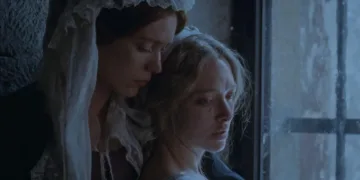
Amanda Seyfried’s Ann Lee is a figure of terrifying containment. Her power is not in what she reveals, but in what she holds back with a placid, unshakable authority. Her performance is anchored in a gaze that projects absolute conviction, her wide, luminous eyes serving as portals to a spiritual certainty the audience can witness but never truly enter.

Her voice, both in the folk-like wail of her songs and the flattened cadence of her Mancunian accent, seems to arrive from a distant, colder time. She is a vessel, and the performance’s great tension lies in its opacity. We are given a saint’s exterior, a serene matriarch whose control is absolute, yet we are denied access to the human chaos that might lie beneath.
The agonizing montage of her four infant children dying one by one is not a scene of psychological breakdown but of alchemical transformation. It is a crucible where flesh is burned away to reveal the spirit, where personal suffering hardens into theological proof.
Her prison song, “I Hunger and Thirst,” captured in a single, suffocating take that pushes in on her face, is her transfiguration. The camera traps us with her, forcing us to witness a voice discovering its awesome power in the void of absolute loss and divine revelation.
Charting a Course from Ruin
The film’s narrative is a pilgrimage from one form of damnation to another. The Manchester of Ann’s youth is a landscape of existential horror, a world of industrial soot, the casual cruelty of her father, and the brusque piety of her husband Abraham’s sexual demands.

Here, life is a cycle of violation and grief, a condition proven by the procession of tiny coffins that marks her early womanhood. The repeated deaths of her children become a philosophical verdict on the act of procreation itself, convincing Ann that the flesh is a curse and celibacy the only path to God. The founding of the Shakers is an act of radical refusal against this biological imperative.
Their transatlantic voyage is a flight from this original sin, an attempt to build a sanctuary from the fundamental stain of earthly existence. Yet the New World offers its own corruptions. The final act, set against the backdrop of a nascent America, depicts the inevitable collision of a pure ideal with a compromised reality.
The Shakers’ egalitarian utopia is met with the hostility of a society founded on a different, more violent set of beliefs. The film shows American idealism as a promise already poisoned by contradiction, a place where pacifist faith is seen as a threat to a liberty enforced by the ignorant mob.
Filming the Ineffable
Mona Fastvold’s craft attempts to give a physical dimension to a spiritual quest. The choice of 70mm cinematography lends an epic, sublime scale to Ann’s internal vision, turning landscapes into soulscapes. William Rexer’s camera creates a stark visual dialectic.

The England sections are trapped in a dim, cluttered, Caravaggio-like gloom, a world of shadows and suffocating interiors with a linen-textured quality to the images. America, by contrast, is rendered in the harsh, clarifying light of nature, a space that is both liberating and unforgiving.
The long, immersive takes, especially during the ecstatic dance sequences, pull the viewer into the vortex of the group’s energy. This visual grandeur is grounded by Samuel Bader’s meticulous production design, which builds an 18th-century world that feels psychologically charged and authentically tangible.
The gradual emergence of the signature Shaker aesthetic, with its clean and useful beauty, feels earned. Over this all lies Daniel Blumberg’s score, its sparse instrumentation and haunting, subtle electronic tones acting as a whisper of modernity, the sound of anachronistic doubt creeping into the sacred hymn, complicating the film’s period-piece purity.
What the Believer Leaves Behind
What is the testament of Ann Lee for an age of disbelief? The film offers no easy answers, seeming to respect the act of belief more than its particular doctrines. It examines the terrifying power of faith as a force that can forge communities and build utopias, even as it isolates the believer in a radical, lonely conviction.

The film treats religion not as a path to salvation but as a profound human drive for meaning, a desperate attempt to impose order on a chaotic world. One can see a parallel between Ann’s spiritual creation and the collaborative, disciplined act of filmmaking—both are attempts to manifest a shared vision against considerable opposition.
The Testament of Ann Lee is a challenging, singular work. It does not invite empathy for its prophetess so much as a kind of awe for the sheer force of her will. It leaves us contemplating the nature of unwavering belief itself: a force that creates worlds while remaining, at its core, an indecipherable, and perhaps unsettling, mystery.
The Testament of Ann Lee, a 2025 historical drama musical film with a 130-minute running time, premiered at the 82nd Venice International Film Festival on September 1, 2025. Filmed on location in Budapest using 70mm film, the movie was seeking US distribution at the time of its Venice debut. It is scheduled to be shown at other film festivals, including the Toronto International Film Festival and the BFI London Film Festival, but a wider release date for theaters or streaming has not been set.
Full Credits
Director: Mona Fastvold
Writers: Mona Fastvold, Brady Corbet
Producers and Executive Producers: Andrew Morrison, Joshua Horsfield, Viktória Petrányi, Mona Fastvold, Brady Corbet, Mark Lampert, Klaudia Śmieja-Rostworowska, Gregory Jankilevitsch, Lillian LaSalle
Cast: Amanda Seyfried, Thomasin McKenzie, Lewis Pullman, Stacy Martin, Tim Blake Nelson, Christopher Abbott, Matthew Beard, Scott Handy, Viola Prettejohn, David Cale, Jamie Bogyo, Shannon Woodward
Director of Photography (Cinematographer): William Rexer
Editors: Sofía Subercaseaux
Composer: Daniel Blumberg
The Review
The Testament of Ann Lee
Mona Fastvold's film is less a historical document and more a cinematic fever dream, a rapturous and unsettling exploration of absolute conviction. Anchored by a commanding, yet deliberately opaque, performance from Amanda Seyfried and realized with breathtaking formal craft, it is a challenging, singular work. The film offers no easy comfort, instead immersing the viewer in the terrifying beauty of a faith that builds a world by rejecting the flesh. It is an audacious and unforgettable cinematic pilgrimage into the wilderness of the soul.
PROS
- Amanda Seyfried delivers a powerful, fully committed central performance.
- Audacious direction that blends musical, historical epic, and character study.
- Stunning 70mm cinematography and meticulous production design create an immersive world.
- The musical and choreographic sequences are raw, innovative, and emotionally resonant.
- A thematically deep and philosophically challenging exploration of faith and utopianism.
CONS
- The narrative's deliberate opacity may leave some viewers feeling emotionally disconnected.
- Its challenging, art-house nature makes it inaccessible for a mainstream audience.
- The second half's slower, more meditative pace contrasts with the energy of the first.
- The central character of Ann Lee remains a deliberately unknowable figure.