

























![Kingdom Hearts Collection [I-III] Review](https://gazettely.com/wp-content/uploads/2026/10/Kingdom-Hearts-Collection-I-III-1-360x180.webp "Kingdom Hearts Collection [I-III] Review: KHII Holds Steady as Newer Entries Fluctuate 40")

The scene is always some variation of American suburban comfort. A clean kitchen island, a bowl of fruit or a plate of cookies, perhaps a casual jacket draped over a chair. Everything is arranged to project an air of harmless domesticity. This carefully constructed stage, however, was a trap. It was the theater for To Catch a Predator, the mid-2000s television event that transfixed a nation.
The program’s premise was brutally effective: lure men suspected of seeking children online into this house, then confront them with journalist Chris Hansen and an array of hidden cameras. It became a cultural sensation, delivering a satisfying, visible form of justice that blurred the lines between news and entertainment.
The show fed a public appetite for moral clarity in a world of grays. David Osit’s documentary, Predators, revisits this phenomenon not to celebrate it, but to meticulously take it apart. The film is a quiet, searching critique of the show’s methods, its ethics, and the unsettling cultural reverberations it left behind. It interrogates the very foundation of the black-and-white worldview that made the original program so popular.
The Unseen Tapes
Osit’s primary method is to peel back the layers of the original production, revealing the vast gulf between the televised spectacle and the unedited reality. Predators uses archival footage and new interviews to show how a complex human event was flattened into a simple narrative of good versus evil. The conflicting perspectives of former participants are particularly revealing.
We meet decoys who look back on their acting roles with a kind of detached amusement, appearing at true-crime conventions to greet Hansen. This is sharply contrasted with the testimony of Dan Schrack, a male decoy still deeply affected by his involvement in an episode that ended with the target’s suicide. The film finds further cracks in the show’s righteous facade through interviews with former law enforcement officials.
These were the men who made the arrests after Hansen’s work was done, yet some now speak of their participation with profound regret, with one calling it a “stain on my soul.” The film’s most potent evidence is raw, untelevised footage from the sting operations. Here, the slick confidence of the broadcast version disappears, replaced by long, uncomfortable hours showing men in states of psychological collapse. The commentary of an ethnographer guides the viewer, pointing out how these moments of humanity were excised to maintain the show’s simple villain narrative.
Echoes in the Feed
The documentary argues that the ghost of To Catch a Predator haunts the modern internet, its formula mutated and amplified by social media. Osit investigates the world of digital vigilantes, followers who have taken Hansen’s methods as their own. We are introduced to figures like “Skeet Hansen,” a YouTube personality who crudely emulates the original stings without the network polish or pretense of journalistic standards.

His operation is messy, chaotic, and transparently for clicks. This new generation of predator hunters demonstrates how the original show’s template has created a culture of public shaming as online content. The film examines the complex motivations driving this behavior. One of Skeet’s main collaborators is a survivor of abuse, and her involvement suggests a powerful need to impose a clear order of crime and punishment onto a trauma that defies easy explanation.
This search for answers connects directly to the filmmaker’s own perspective. As a survivor, Osit positions his entire inquiry as a quest to understand the ‘why’ that the original show so masterfully avoided. He probes the psychological space that To Catch a Predator opened, a space where the spectacle of punishment became a substitute for the difficult work of comprehension.
The Hunter Framed
The film’s final section is its most direct confrontation, an extended interview with Chris Hansen himself. The former host appears entirely convinced of his own heroism, deflecting questions about his tactics and framing his work as a noble crusade. He admits no errors and shows no regret, attributing his actions to a “greater purpose.” It is here that Osit’s direction becomes an act of commentary.

He films Hansen using the same fixed, multi-camera surveillance style that defined To Catch a Predator. The interrogator is placed inside his own apparatus of judgment, his justifications captured from dispassionate, unblinking angles.
The effect is profound, turning the lens back on the creator of the spectacle. The documentary makes clear the real-world harm of this approach by detailing the case of an eighteen-year-old high school student whose life was derailed after Hansen’s team targeted him for a relationship with a fifteen-year-old classmate.
The situation’s legal and social complexities were ignored in favor of a damning, easily digestible segment. Predators does not absolve the men caught in these stings. Instead, it presents a sharp critique of a media environment that prioritizes righteous anger over nuanced understanding, leaving the audience to consider its own complicity in the demand for such spectacles.
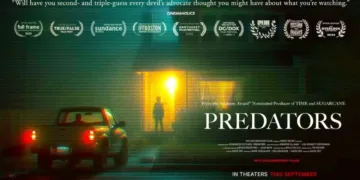
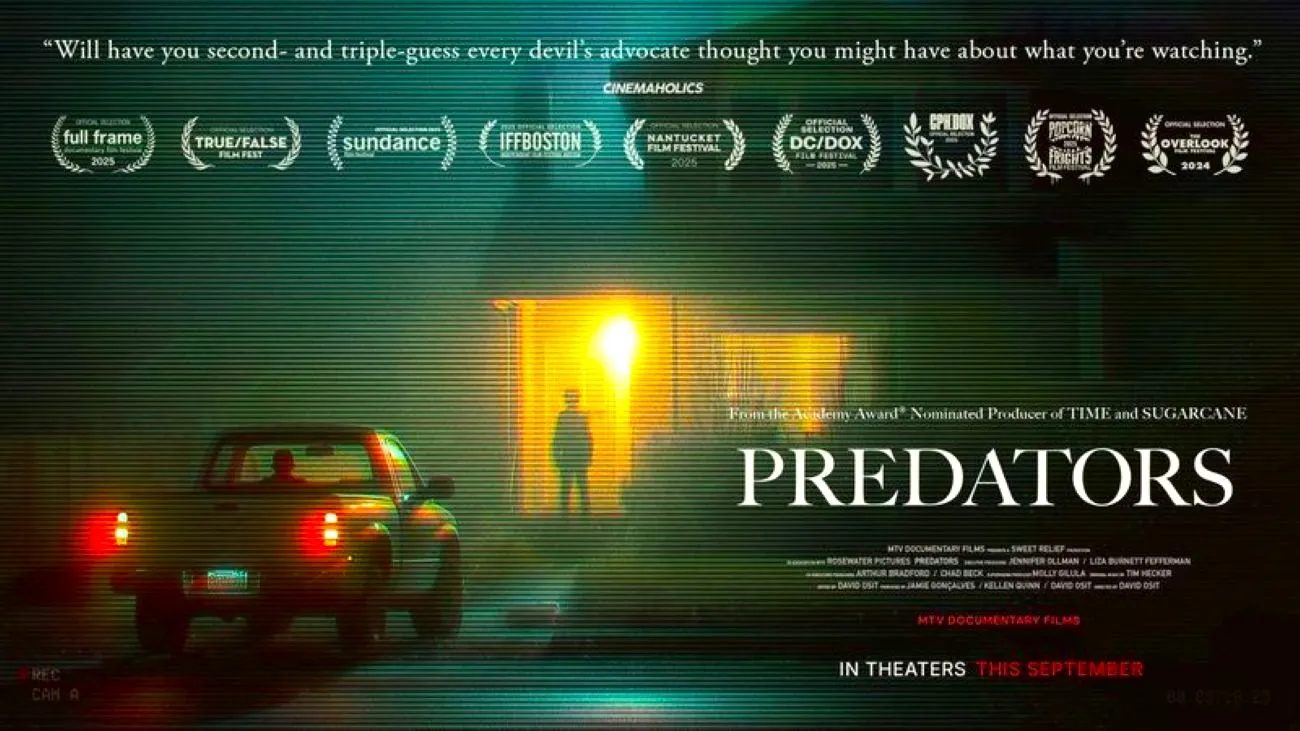
The documentary film Predators (2025) is a chilling, thought-provoking exploration of the rise and fall of the controversial NBC television program To Catch a Predator and the media world it created. Directed by David Osit, the film examines the ethics of turning vigilante justice into a media spectacle, featuring interviews with former decoys and host Chris Hansen. The documentary premiered at the Sundance Film Festival in January 2025. It was released in select theaters on September 19, 2025, by MTV Documentary Films. The film is scheduled to land on Paramount+ with Showtime after its theatrical run.
Full Credits
The Review
Predators
Predators is a meticulous and unsettling examination of a television phenomenon. The film methodically dissects the ethics of vigilante journalism, questioning the cultural appetite for simple moral spectacles. It succeeds not by providing clear answers, but by forcing a difficult look at the line between justice and entertainment. The documentary presents a quiet, intelligent critique that lingers long after the credits, leaving a lasting and disquieting impression on the viewer.
PROS
- A thoughtful and sharp analysis of a significant media event.
- Excellent use of unreleased footage to contrast with the broadcast narrative.
- The structured, three-act approach builds a powerful case.
- The final interview sequence with Chris Hansen is expertly executed.
CONS
- Its deliberate, methodical pace may not suit all viewers.
- The film avoids definitive conclusions, which could frustrate those wanting a straightforward exposé.
- Some may find the filmmaker's late reveal of his personal connection to be a sudden shift in tone.