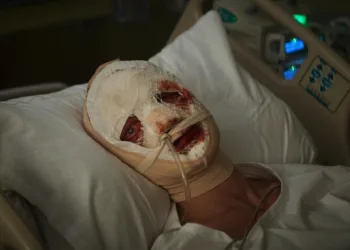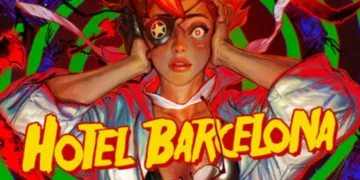

























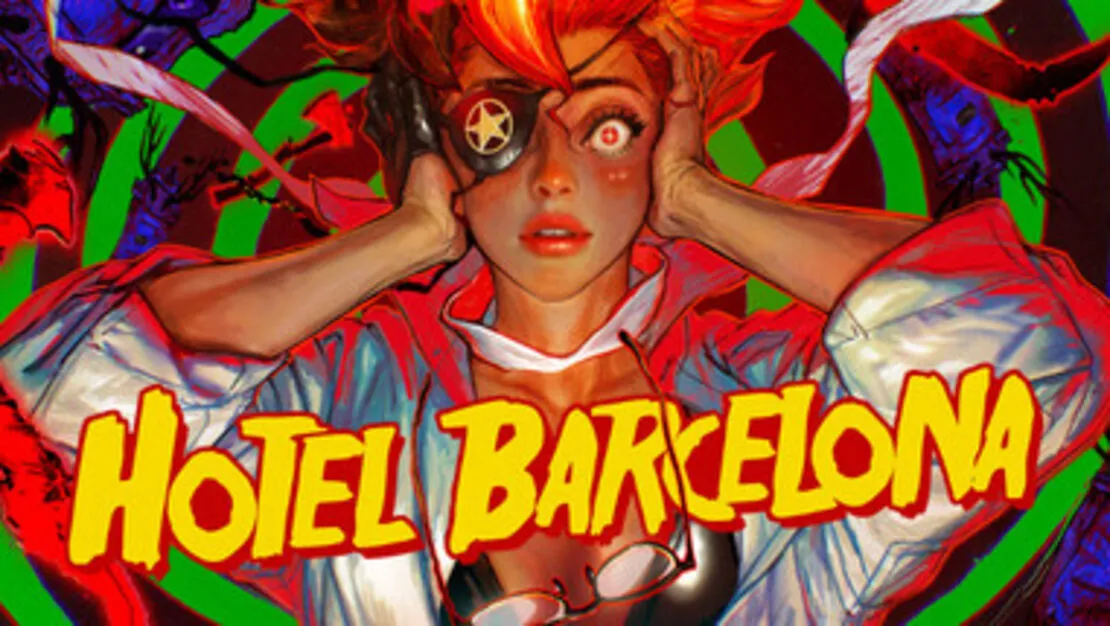

Hotel Barcelona arrives as the creative offspring of two Japanese gaming auteurs whose reputations precede them. Suda51 and SWERY have crafted a 2.5D action roguelite that places players in the boots of Federal Marshal Justine, a character whose body becomes the unwilling vessel for Dr. Carnival, a serial killer with mysterious motives. This unlikely partnership drives the game’s central tension as the timid marshal and violent persona must work together to hunt down the killers residing within the cursed Hotel Barcelona.
The setting draws heavy inspiration from The Shining’s Overlook Hotel, complete with its own unsettling bartender and endless corridors that seem to exist outside normal reality. Located somewhere along the Pennsylvania-West Virginia border, this establishment serves as both prison and hunting ground for Justine’s quest to avenge her father’s death.
The horror movie aesthetic permeates every corner of the experience, from B-movie monster designs to boss encounters that feel ripped from classic slasher films. At roughly six to seven hours for the main campaign, Hotel Barcelona promises a concentrated dose of the developers’ signature weirdness wrapped around a revenge tale that asks whether justice and vengeance can coexist within the same soul.
Combat and Mechanics: Innovation Hampered by Execution
Hotel Barcelona structures itself around familiar roguelite principles, asking players to select stages and battle through interconnected rooms toward climactic boss encounters. The weapon selection system offers variety through melee options like katanas, hammers, and buzzsaws paired with ranged tools including shotguns and flamethrowers. Yet the promise of this arsenal falters when translated into actual combat encounters.
The fighting mechanics suffer from a fundamental disconnect between intention and execution. Attacks lack the visceral satisfaction that makes action games compelling, with delayed inputs creating a persistent sense that Justine responds to commands a half-second after they’re issued. Heavy attacks require wind-up times that feel excessive even within the context of deliberate, weighty combat systems. The buzzsaws chip away at enemy health with all the impact of gentle tapping, while axes swing with the urgency of geological time. This sluggishness extends to ranged weapons, which fire with the authority of cap guns despite their imposing visual designs.
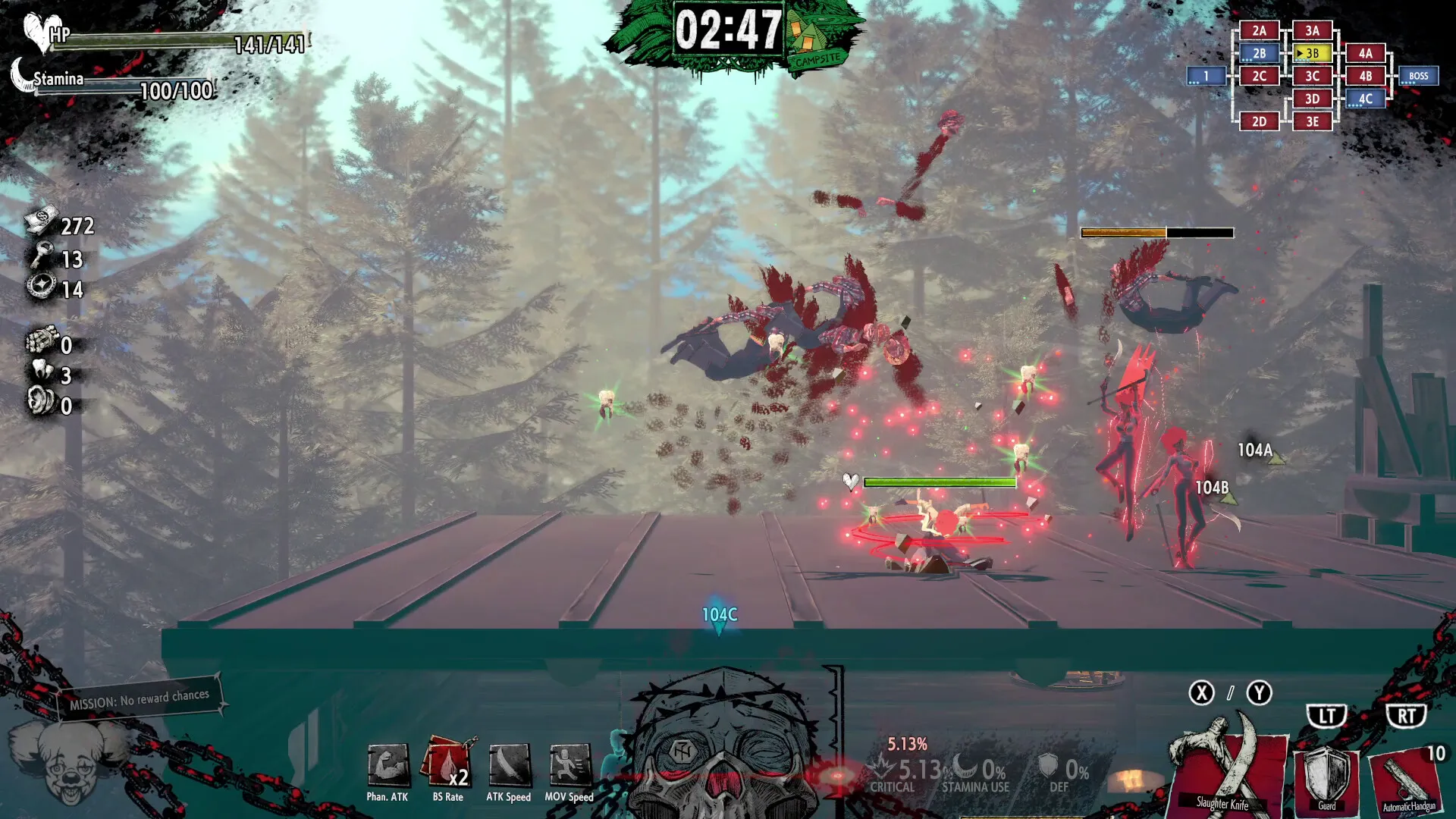
The Blood Splatter Gauge represents the game’s attempt to create momentum within combat encounters. Successful hits fill this meter, unlocking special moves and buffs that can clear entire screens of enemies or deal devastating damage to bosses. The system demands constant aggression, as taking damage, ceasing attacks, or touching water causes the gauge to drain. This mechanic works best when it creates a flow state between player and phantom allies, building toward explosive special attacks that feel earned through sustained pressure.
Hotel Barcelona’s most innovative feature emerges through its Slasher Phantom system, which records previous runs and allows up to four ghostly versions of Justine to fight alongside the current attempt. These phantoms repeat every action from their recorded runs, turning boss fights into collaborative efforts across multiple timelines.
The system transforms failure into strategic advantage, as each death contributes to future success through phantom assistance. Door selection between rooms adds another layer of strategy, offering different buffs and bonuses while determining which phantoms can assist in subsequent areas. Performance issues occasionally mar this clever system, with screen freezes occurring when phantoms load and occasional crashes disrupting the experience.
The Hotel’s Embrace: Progression Within Familiar Walls
The hotel functions as both narrative anchor and mechanical hub, representing the space where Justine awakens after each death to prepare for another attempt at revenge. This central location houses the game’s progression systems within a framework that emphasizes the cyclical nature of her quest. The bartender offers cryptic conversation, the pinball machine provides distraction, and weapon vendors enable tactical preparation for the next descent into horror.
Permanent upgrades create a sense of forward momentum even when individual runs end in failure. The skill tree unlocks new combos, parrying options, and statistical improvements that carry across deaths, while weapons receive substantial stat boosts after defeating bosses. Between these major upgrades, a gambling mini-game offers chances to improve equipment through risk-reward mechanics that feel appropriately punishing given the game’s horror themes. Costume unlocks depend on random chest rewards, adding an element of unpredictability to character customization.
The Bondage restriction system provides an intriguing approach to difficulty scaling. Players can voluntarily disable ranged weapons, melee attacks, or abilities to increase reward yields, with extreme options like instant death from water contact for those seeking maximum challenge. These modifiers work alongside traditional difficulty settings to create a granular approach to challenge that accommodates different skill levels and risk tolerances.
Hotel Barcelona’s difficulty curve reflects its horror movie inspirations through relentless enemy aggression and limited healing opportunities. The phantom system serves as the primary difficulty balancing mechanism, transforming repeated failures into accumulated advantages. This creates an unusual emotional arc where death feels less like failure and more like investment in future success, though the combat’s fundamental issues can make even phantom-assisted encounters feel unsatisfying.
Narrative Threads and Atmospheric Details
The revenge plot provides a straightforward framework for exploring the complex relationship between Justine and Dr. Carnival. Their conversations reveal contrasting worldviews as the shy marshal grapples with housing a violent persona whose methods may be necessary for achieving justice. These moral discussions work best when they feel organic to the situation rather than forced philosophical exchanges, though the dialogue sometimes veers toward cliched territory that undermines the more interesting character dynamics.
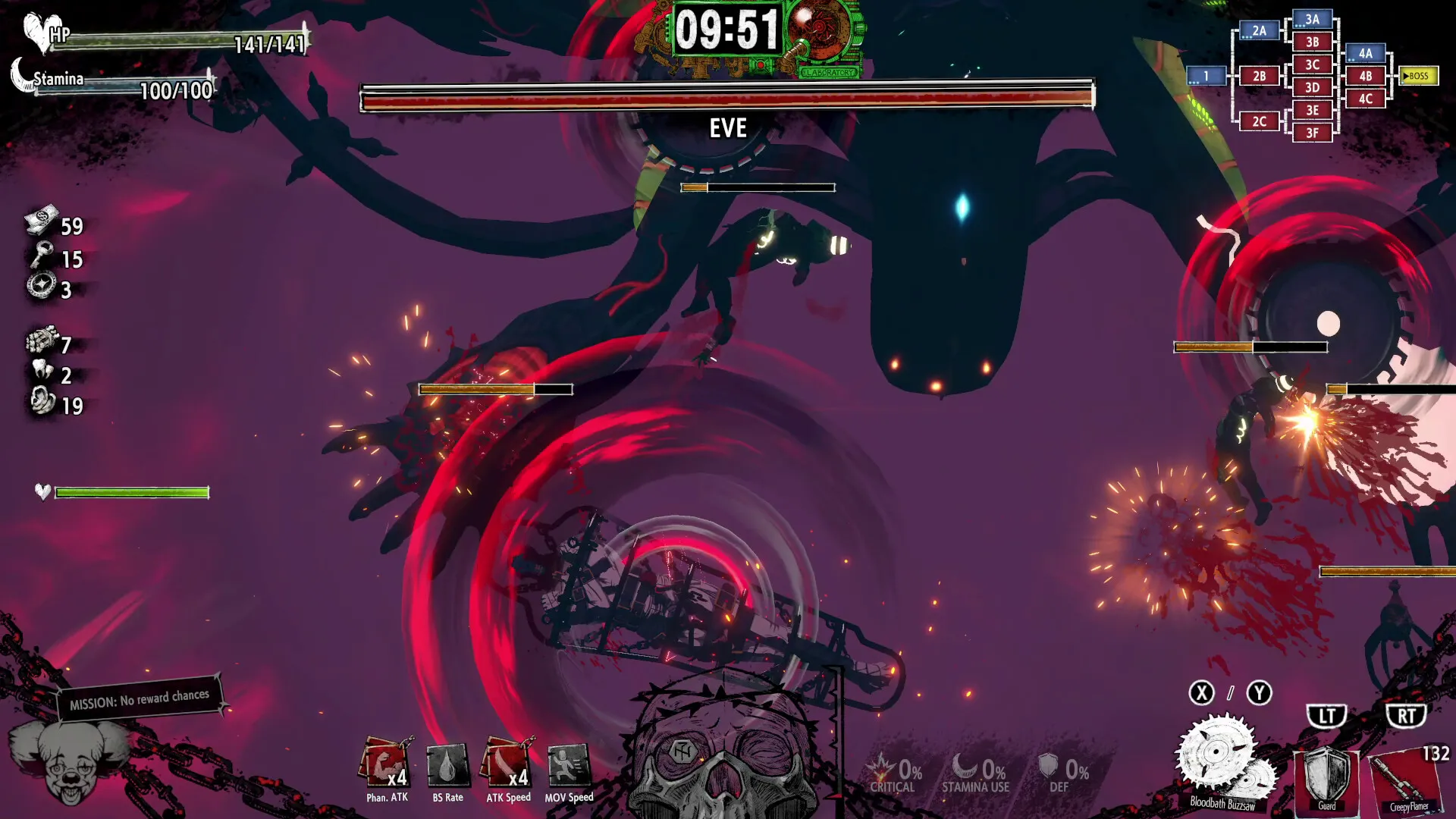
Horror movie references saturate the visual and narrative design, from boss encounters that clearly homage specific films to enemy designs pulled from B-movie creature features. The animated boss introductions provide genuine spectacle during initial encounters, though their impact diminishes through repetition as players face the same opponents multiple times. The Japanese voice acting delivers superior performances compared to the English option, lending authenticity to character interactions that might otherwise feel stilted.
Visual presentation splits between inspired and disappointing elements. The 2D portrait art during conversations captures character personalities with impressive detail and style, while the 3D environments and enemy models suffer from blurry textures that feel dated even by indie standards. This inconsistency extends to the hotel’s design, which promises rich exploration opportunities through its various residents and rooms yet delivers limited interactive content beyond the core progression systems.
The multiplayer invasion system allows players to hunt or assist others in Dark Souls fashion, though this feature remained largely untested during the review period. Secret content and post-credits exploration provide additional hooks for dedicated players willing to dig deeper into the hotel’s mysteries, offering more substantial rewards than the main campaign’s relatively brief runtime might suggest.
Hotel Barcelona succeeds best as a creative experiment that demonstrates the phantom system’s potential while highlighting the ongoing challenges of translating innovative concepts into satisfying gameplay experiences. The collaboration between Suda51 and SWERY produces recognizable hallmarks of both developers’ styles without achieving the transcendent weirdness of their individual masterpieces. Players seeking unconventional approaches to familiar genres may find value in Hotel Barcelona’s unique features, while those prioritizing polished combat mechanics should consider whether the game’s creative ambitions justify its technical limitations.
The Review
Hotel Barcelona
Hotel Barcelona offers genuine innovation through its Slasher Phantom system and atmospheric horror homages, yet stumbles through clunky combat mechanics that undermine moment-to-moment enjoyment. The Suda51-SWERY collaboration produces interesting narrative dynamics between Justine and Dr. Carnival, though the execution feels restrained compared to their individual works. Creative concepts can't fully compensate for delayed inputs, unsatisfying weapon feedback, and technical issues that plague the core experience.
PROS
- Innovative Slasher Phantom system turns failure into strategic advantage
- Strong horror movie atmosphere and references
- Interesting dual-character narrative dynamic
- Solid progression systems with permanent upgrades
- Creative approach to difficulty scaling
CONS
- Clunky, unresponsive combat with delayed inputs
- Weapons lack satisfying impact and feedback
- Performance issues including freezes and crashes
- Limited content for 6-7 hour runtime
- Inconsistent visual presentation between 2D art and 3D models