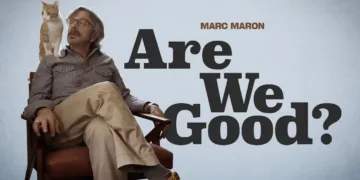



















There is a moment in Marc Maron’s stand-up, a high-wire act of a joke, where he describes seeing his late partner Lynn Shelton’s body in the hospital. As he turns to leave, a thought surfaces with grim absurdity: “Selfie?” The question hangs in the air, a shocking, darkly funny confession of the modern mind’s impulses even in the face of profound loss. Steven Feinartz’s documentary, Are We Good?, is an extension of that moment. It is less a conventional biography of the comedian and more a raw chronicle of the period following Shelton’s sudden death in 2020.
The film positions itself as a study of a man whose entire professional life has been an exercise in metabolizing anxiety and resentment into jokes, who is now confronted with a form of pain that resists easy conversion. It is an unflinching look at the messy, public process of grieving, where the stage, the podcast microphone, and the smartphone screen become the primary tools for navigating the void.
From Pain to Punchline: The Anatomy of a Joke
The documentary’s most insightful passages examine the strange alchemy of comedy, charting the path from a private agony to a public punchline. Feinartz’s camera becomes a quiet observer in the back of small, dimly lit comedy clubs, watching Maron stand before audiences with a handful of notes, testing the weight of his sorrow.
These scenes are not about polished performance; they are about the precarious work of finding a shared language for an experience that feels isolating. The aforementioned “selfie” joke serves as the film’s central case study. We see it move from a stilted, awkward idea to a precisely calibrated bit of dark theater. Its power lies in its layers: it is a confession of a narcissistic impulse, a commentary on our compulsively documented lives, and, finally, a release valve. When the audience laughs, it is a sound of recognition, an acknowledgment that even the ugliest thoughts can be a source of communal relief.
The stand-up stage is not the only place this processing occurs. The film uses footage from Maron’s Instagram Live videos, which function as a sort of digital wake. Broadcast from his home during the COVID-19 lockdown, these transmissions are rambling, unedited, and deeply immediate. They stand in stark contrast to the crafted nature of a comedy set, capturing a rawer state of grief.
The central artistic conflict throughout this process is Maron’s own. He repeatedly questions the validity of his work, worrying whether turning his love for Shelton into material is a form of dishonor. This is not just creative anxiety; it is an ethical quandary about the obligations of an artist who uses his own life as his primary medium.
Also Read




Wounds, Old and New: A Portrait of the Grieving Artist
The loss of Shelton does not happen in a vacuum, and the film skillfully uses it as a gateway to explore the deeper contours of Maron’s psyche. His present sorrow is contextualized by a life of unresolved pains. We learn of his difficult childhood, defined by an emotionally remote father whom his mother would urge him to placate with jokes.

This formative experience casts his entire career in a new light, suggesting a lifelong pattern of using performance as a tool to solicit love from those who withhold it. The documentary’s portrayal of the Maron-Shelton relationship is its emotional anchor. Through archival audio from the WTF podcast and his own heartbroken recollections, she emerges as a stabilizing force, a person in whose presence he felt seen and understood. His quiet admission, “I was better in Lynn Shelton’s gaze,” speaks to a specific kind of loss that transcends romantic partnership; it is the loss of a reflection of his better self.
This acute tragedy runs parallel to a more protracted one: his father’s decline into dementia. The film captures Maron’s shift into the role of caregiver for a man with whom he shares a fraught history. There is a particular cruelty in this timing, forcing him to navigate a sudden, shocking absence while simultaneously witnessing the slow, agonizing disappearance of a person still physically present.
This juxtaposition creates a complex portrait of layered grief. Interviews with colleagues like John Mulaney and Michaela Watkins provide further dimension. They speak to Maron’s evolution from a bitter industry outsider, whose podcast was born of professional desperation, to an unlikely but respected elder statesman of comedy, whose greatest strength became the very vulnerability he once shielded with anger.
The Scrappy Aesthetic of Authenticity
The film’s form is a direct reflection of its subject. Director Steven Feinartz employs an unfussy, raw aesthetic that feels like a visual extension of the WTF podcast’s garage-based ethos. The documentary is a collage of disparate materials: grainy home videos, professionally shot interviews, candid smartphone footage, and simple, illustrative animations.

This scrappy construction avoids the polished sheen of many contemporary celebrity profiles, instead mirroring the chaotic, nonlinear nature of the grieving process itself. The dimly lit comedy club scenes, in particular, contribute to a sense of intimacy, placing the viewer within the small, tentative spaces where Maron’s most difficult work is done. This stylistic choice, however, invites a central question about the nature of the project.
While the film presents an intensely vulnerable portrait, its subject is a man who has built a career on curating his own narrative. One is left to consider whether this unguardedness is truly organic or another form of performance, a meta-commentary on the very act of being documented. The result is not a definitive biography but a powerful artifact of a specific, transformative period. It captures a public figure learning a new, more honest emotional vocabulary in the face of an overwhelming and universal human experience.
Are We Good? is a feature-length documentary following comedian and podcast pioneer Marc Maron as he reflects on his life, career, and personal loss, particularly the death of his partner, filmmaker Lynn Shelton. The film traces his journey through the evolving comedy world while navigating grief and continued creative work. The documentary premiered at the 2025 SXSW Film & TV Festival in March and was subsequently screened at the Tribeca Festival. Utopia acquired the North American distribution rights, with the film scheduled for a theatrical release beginning on October 3, 2025, in New York and Los Angeles, followed by nationwide theatrical events on October 5 and October 8, 2025. It is currently not available on major streaming platforms.
Full Credits
Director: Steven Feinartz
Writers: Julie Seabaugh
Producers and Executive Producers: Steven Feinartz, Julie Seabaugh, Ethan Goldman, Dan Baglio, Damion Greiman, Ryan Bitzer, Tim Rummel, Rob Guillermo, Dan Fried, Toby Nalbandian, Greg Schmidt, Emilio Schenker, Michael Schmidt, Gideon Tadmor, Ariel Weisbrod, Sean Bradley, Ray Maiello, Jason Murphy, Louis Krubich
Cast: Marc Maron, Nate Bargatze, John Mulaney, David Cross, W. Kamau Bell, Caroline Rhea, Michaela Watkins, Laurie Kilmartin, Gary Gulman, Jessica Kirson, Sam Lipsyte
Director of Photography (Cinematographer): Jordan McNeile
Editors: Derek Boonstra, Natalie Ancona, Jenn Harper
Composer: Marlon Lang
The Review
Are We Good?
Are We Good? is an unflinching and deeply intimate portrait of an artist confronting profound loss. Forsaking the polish of typical biographical documentaries, it offers a raw look at Marc Maron's process of turning private pain into public performance. While its intense vulnerability sometimes feels curated, the film succeeds as a powerful, messy, and honest meditation on grief, comedy, and the difficult work of healing. It is a compelling study of how a professional malcontent learns to speak a new emotional language when confronted with the unspeakable.
PROS
- An intensely raw and honest portrayal of the grieving process.
- Provides a fascinating look into a comedian's creative method.
- Anchored by Marc Maron's compelling and vulnerable presence.
- The unpolished, scrappy aesthetic effectively matches the film's emotional tone.
CONS
- The raw, unfussy visual style may not appeal to all viewers.
- Its focus is narrow, functioning more as a character study of a specific period than a comprehensive biography.
- The intimacy occasionally raises questions about whether the vulnerability is curated or completely organic.