






















A single photograph can seem to hold the full weight of a human catastrophe. It freezes time, a fixed shard of agony set against the shifting violence of war. The image is familiar: a road in Trảng Bàng in June 1972, a child named Phan Thị Kim Phúc running from an aerial attack. Her clothes have burned away. Her small frame moves toward the camera, mouth open in a scream the viewer cannot hear, a sound imagined through the contortion of her face.
The picture functions as an icon of rupture, a stark and essential record that revealed the machinery of the Vietnam War to a global audience. For decades, this Pulitzer Prize winning photograph has carried the credit of Nick Út, an Associated Press stringer whose life changed in that instant of exposure. Questions of authorship rarely remain clean when they pass through history and institutional desire.
Bao Nguyen’s documentary The Stringer: The Man Who Took the Photo treats that problem as a wound. It suggests that the praise and honor attached to this image rest on an unstable ethical and historical base. The film unfolds as an investigative inquiry that presses the viewer toward a confrontation with conflict, memory, and the slow poison of a stolen legacy. The case feels cold, buried in archives of suffering where the only stable element is the original pain on the road.
The Bureaucracy of Misremembering
The film presents a central charge that unsettles journalistic history. The most famous war photograph on earth may belong to a man whose name vanished inside a newsroom that prioritized its own prominence. The trail of evidence leads away from Nick Út and toward Nguyen Thanh Nghe, a Vietnamese freelancer whose work was allegedly absorbed into the Associated Press system. That claim shapes the philosophical core of the documentary. The film studies the way powerful Western agencies have used local contributors, drawing on their proximity and vulnerability, then treating their labor as disposable.
Gary Knight, a British photojournalist, moves through the film as a clear and measured guide. His curiosity is patient and methodical. Over two years he presses against a narrative hardened by time and corporate habit, trying to unseat a version of truth that has calcified into orthodoxy. The investigation depends on the testimony of Carl Robinson, a former AP photo editor who worked in Saigon when the film rolls reached the bureau.
Decades after the event he carries a vivid sense of moral weight, a regret that has attached itself to his memory and body. He recalls the arrival of the film and his initial choice to hold back the image because of the child’s nudity, an instant where aesthetic anxiety overrode historical urgency.
Robinson’s story then turns to his superior, Horst Faas, a prominent figure in photojournalism. Robinson recalls that Faas ordered the photograph to carry Nick Út’s name. The intention was simple and devastating. A freelancer’s searing image would circulate as a staff photograph credited to a celebrated AP photographer. Robinson’s willingness to revisit this moment grants the film an intimate sense of confession. He understands his role as a form of quiet complicity and tries to loosen its grip through late, painful acknowledgement.
The documentary presents the misattribution as an act of carefully framed exploitation and describes the idea of a passing clerical error as a distortion. The phrase “benign” exploitation hovers in the air, exposing the cruelty of power imbalances between foreign correspondents and the local photographers whose presence keeps them informed and alive.
The long arc of fame and influence surrounding Út now appears as a monument built beside another man’s obscured contribution. The inquiry begins with the unsettling possibility that Nghe himself may be unreachable. The same system that silenced his authorship seems to have slipped him out of public record. The film shapes itself around the effort to track this absence, a search for a man turned into a ghost who lingers at the margins of another photographer’s legend.
Spatial-Temporal Condemnation
The investigation then shifts from human recollection to material proof. Memory and confession remain fragile, so the film seeks an anchor in physical evidence. That search leads to Nguyen Thanh Nghe in California. His life has moved into quiet surroundings, yet his presence carries immense weight. He speaks with steady, unshaken calm and confirms the essential claim.

He took the photograph, and his credit was taken from him. His restrained, dignified account reinforces Robinson’s technical description of events. Nghe expresses no hunger for celebrity or scandal. He asks for recognition of a historical fact. His voice stands against the formal responses of the Associated Press, which resists the film’s argument and constructs its own defense.
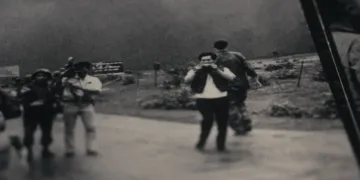
The drama reaches its sharpest point in a process closer to scientific procedure than to any outpouring of feeling. The filmmakers employ a French team of specialists who conduct a computer-based spatial-temporal examination of the events on the road at Trảng Bàng. Their reconstruction attempts to impose measured geometry on a moment born from chaos. The method is painstaking.
The experts gather every accessible photograph, existing film footage, and present day satellite image to generate a digital map of the site. They work to identify the precise position of each photographer, including Út and Nghe, relative to the path of Phan Thị Kim Phúc at the instant of exposure. Shifts in shadow, angle, and distance become clues.
The findings carry the force of an accusation. The analysis indicates that the figure standing far down the road, too distant to produce the exact perspective of the “Napalm Girl” frame, was Nick Út. The same mapping demonstrates that his position aligns cleanly with several other Associated Press images from that day that bear his credit.
This conflict between geometry and legend suggests that Út did not occupy the spot required for the iconic photograph at the decisive fraction of a second. The film presents this evidence with the weight of a scientific judgment. The burden of explanation moves back toward the AP, which continues to reject the documentary’s argument while Út maintains a threat of legal action. The photograph that once seemed to speak only of war’s horror becomes a contested site of meaning. The frame turns into a battlefield of interpretation, a surface where the fight over truth and memory plays out.
The Restoration of Honor
The greatest force in The Stringer grows from the philosophical questions it raises about memory, authorship, and the price of recognition. The famous image helped shift public feeling about the Vietnam War and still stands as proof of how a single frame can shape opinion. The documentary suggests that this symbol of conscience rests on overlooked pain. That pain exists in Carl Robinson’s quiet guilt, in the long years during which Nguyen Thanh Nghe carried an uncredited history, and in the life of Phan Thị Kim Phúc. Her survival and her later work as a peace ambassador form a separate story, heroic and ongoing, yet that story remains bound to the original act of misattribution.
The Stringer reads as a study in historical responsibility. The film feels rapt and urgent, an absorbing inquiry into a failure inside the institutions that claim to protect truth. Its investigative rigor can feel repetitive, and that repetition serves a clear function. The method constructs a wall of evidence aimed at an institutional story that has endured for half a century. The documentary recognizes how difficult definitive proof can be when a narrative has settled deep inside the public imagination. Nghe’s calm, steady certainty, set beside Robinson’s account and the cold precision of the forensic mapping, produces a deeply persuasive argument, a form of truth assembled through patient ethical work.
The lasting power of The Stringer lies in its harsh, careful act of repair. The documentary turns its gaze toward the local stringer whose essential contribution disappeared into the machinery of a global news organization. The film recounts the lives of people whose uncredited risk feeds international reporting and insists that the dignity and rights of such individuals matter even within vast historical movements. The narrative ensures that the legacy of the “Napalm Girl” photograph now carries a permanent complication, one enriched by the presence of the quiet man who finally steps into the frame to claim his name.
The investigative documentary The Stringer: The Man Who Took the Photo delves into the controversial authorship of the iconic Vietnam War photograph, “The Terror of War,” often known as “Napalm Girl.” The film follows a two-year journalistic probe sparked by a former photo editor’s confession that the Pulitzer Prize-winning image may have been deliberately misattributed by the Associated Press. It seeks to locate and acknowledge the Vietnamese freelance photographer, the “stringer,” who the evidence suggests was the true author. The documentary premiered at the Sundance Film Festival on January 25, 2025, and is scheduled for a limited theatrical release starting on November 21, 2025. It will be available to stream on Netflix starting November 28, 2025.
Full Credits
Title: The Stringer: The Man Who Took the Photo
Distributor: Netflix
Release date: January 25, 2025 (Sundance Premiere), November 21, 2025 (Limited Theatrical), November 28, 2025 (Netflix)
Rating: R
Running time: 100 minutes
Director: Bao Nguyen
Writers: Terri Lichstein, Fiona Turner, Gary Knight, Graham Taylor
Producers and Executive Producers: Fiona Turner, Terri Lichstein (Producers), Gary Knight (Executive Producer – based on other sources, though not explicitly listed as EP in all search results)
Cast: Gary Knight, Carl Robinson, Nguyen Thanh Nghe, Nick Út, Phan Thị Kim Phúc, Jon Swain
Director of Photography (Cinematographer): Bao Nguyen, Andrew Yuyi Truong, Ray Lavers
Editors: Graham Taylor
Composer: Gene Back
The Review
The Stringer: The Man Who Took the Photo
The Stringer is an essential ethical and historical excavation. It succeeds as a gripping journalistic thriller, forcing viewers to confront the mechanisms by which historical truths are manufactured and maintained by institutional power. The forensic evidence and human testimony build a case of profound moral weight, questioning the integrity of the photographic legacy. The film’s insistence on restoring honor to the marginalized stringer transforms a simple controversy into a resonant study of exploitation and memory. It is a necessary, discomforting portrait of history’s hidden costs.
PROS
- The structure is a suspenseful, highly effective investigative thriller.
- The film raises profound ethical questions concerning journalistic integrity and the exploitation of local labor.
- The inclusion of Carl Robinson’s testimony provides a crucial, compelling confession of institutional failure.
- The technical forensic analysis is meticulous and provides a highly persuasive challenge to the established record.
- It successfully champions the story of the marginalized Vietnamese stringer, restoring a lost human history.
CONS
- The film begins with a clear bias, assuming the photo credit was stolen, which may polarize viewers.
- The investigation, while thorough, does not deliver a conclusive "smoking gun" due to the passage of time.
- The controversy remains active, with the Associated Press and Nick Út strongly challenging the film’s findings.
- To establish exactitude, some sections of the investigation felt structurally repetitive.