




























A melting snowman slumped beside a towering, ornate entrance greets the audience before a single line of dialogue, a sight that already hints at grandeur dissolving at the threshold of Fackham Hall. The image announces a world where opulence erodes in plain view, even before the film’s twin narrative strands begin to unwind.
This satirical historical comedy, directed by Jim O’Hanlon and drawn from an idea by the Carr brothers (Jimmy and Patrick Carr), fixes its gaze on the painstakingly fashioned, self-serious tradition of British period drama, with clear reference points in Downton Abbey and Upstairs, Downstairs.
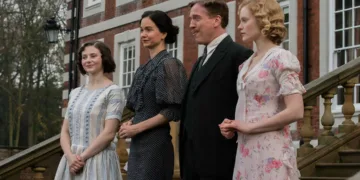
Set in the 1930s, the story unfolds inside the vast English manor that gives the film its title, residence of the aristocratic Davenport family. Their obsession with money and succession collides with the chaotic arrival of Eric Noone (Ben Radcliffe), an amiable pickpocket who slips into the household under the mistaken identity of a new servant.
Upstairs debt and downstairs disorder quickly crystallize into a romantic thread, a forbidden attraction between Eric and the family’s overburdened eldest daughter, Rose Davenport (Thomasin McKenzie). The aristocratic arrangement then shatters when a murder abruptly wrenches the film into a broad Agatha Christie parody.
The Siege of the Senses: A Cultural Assault
Fackham Hall builds its comic identity on attrition, committing to a high joke density that constantly presses against the viewer’s patience. Quantity takes precedence over refinement, and the brisk tempo leaves no real pause; the audience absorbs a continuous flow of gags, where each misfire is swiftly followed by another attempt. The result is a very specific type of viewing experience, a deliberate sensory barrage that feels like a cultural assault staged inside a stately home.
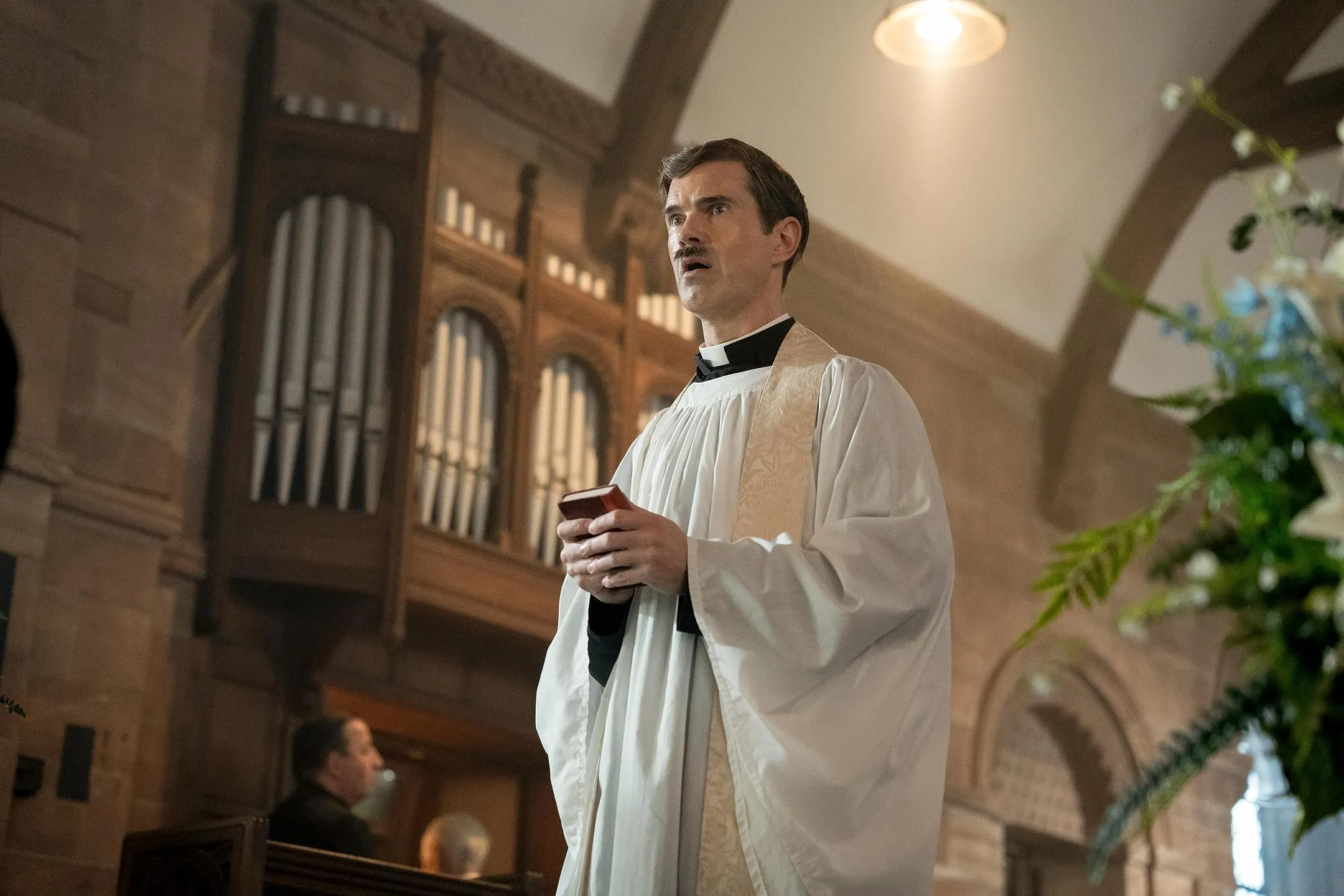
Humor arrives from every direction. Elaborate visual gags and physical comedy sit beside arch wordplay, including a tailor’s shop sign that reads “Tailor Swift,” and the film leans into bodily humor without shame. Running jokes recur again and again, from the coarse mangling of the hall’s name to a priest’s sermon delivered with disastrously misjudged punctuation, each one chipping away at period-drama decorum and undercutting the elevated aesthetic.
Also Read





This strategy yields a glut of groaners and obvious jokes that hit the floor, from stale flatulence gags to a drawn-out, weary spin on the Who’s on First routine. Yet enough material lands to keep the rhythm alive, especially in the fleeting farcical details tucked into the background. Those throwaway flourishes help compensate for the weaker stretches.
The satire draws strength from the writers’ clear and affectionate familiarity with the aristocratic narratives under attack. The plot parody zeroes in on core period drama fixtures: the duty-versus-desire romance, the financial and social pressure of marriage for both succession and solvency (Rose’s push toward marriage with her unappealing cousin Archibald, played by Tom Felton), and the rigid division between upstairs privilege and downstairs labor.
At the midpoint, the film finds fresh energy through a pronounced genre pivot, sliding into a police procedural structured around an Agatha Christie-style murder mystery. The entrance of Inspector Watt (Tom Goodman-Hill), a Hercule Poirot figure whose self-important swagger evaporates the moment his temporary mustache comes off, feels carefully calibrated.
The film’s standout comic sequence arrives in the form of a participatory murder flashback, where the victim assists with meticulous enthusiasm in their own death. The scene delivers a sharp piece of conceptual comedy inside an escalating spiral of silliness. This midfilm transformation functions as a structural joke aimed at the polite, orderly habits of the traditional period procedural.
The Authority of the Straight Face
Fackham Hall’s effect rests heavily on a precise casting philosophy. Instead of stocking the ensemble with stand-up performers, the film recruits actors associated with serious work, performers who would fit seamlessly into a straightforward period piece. Their commitment to formality becomes a core element of the spoof. Comedy arises from an intentional clash between the rigid surface of the performance and the absurdity pressing up against it. The more firmly the actors hold the line, the sharper the distortion becomes.
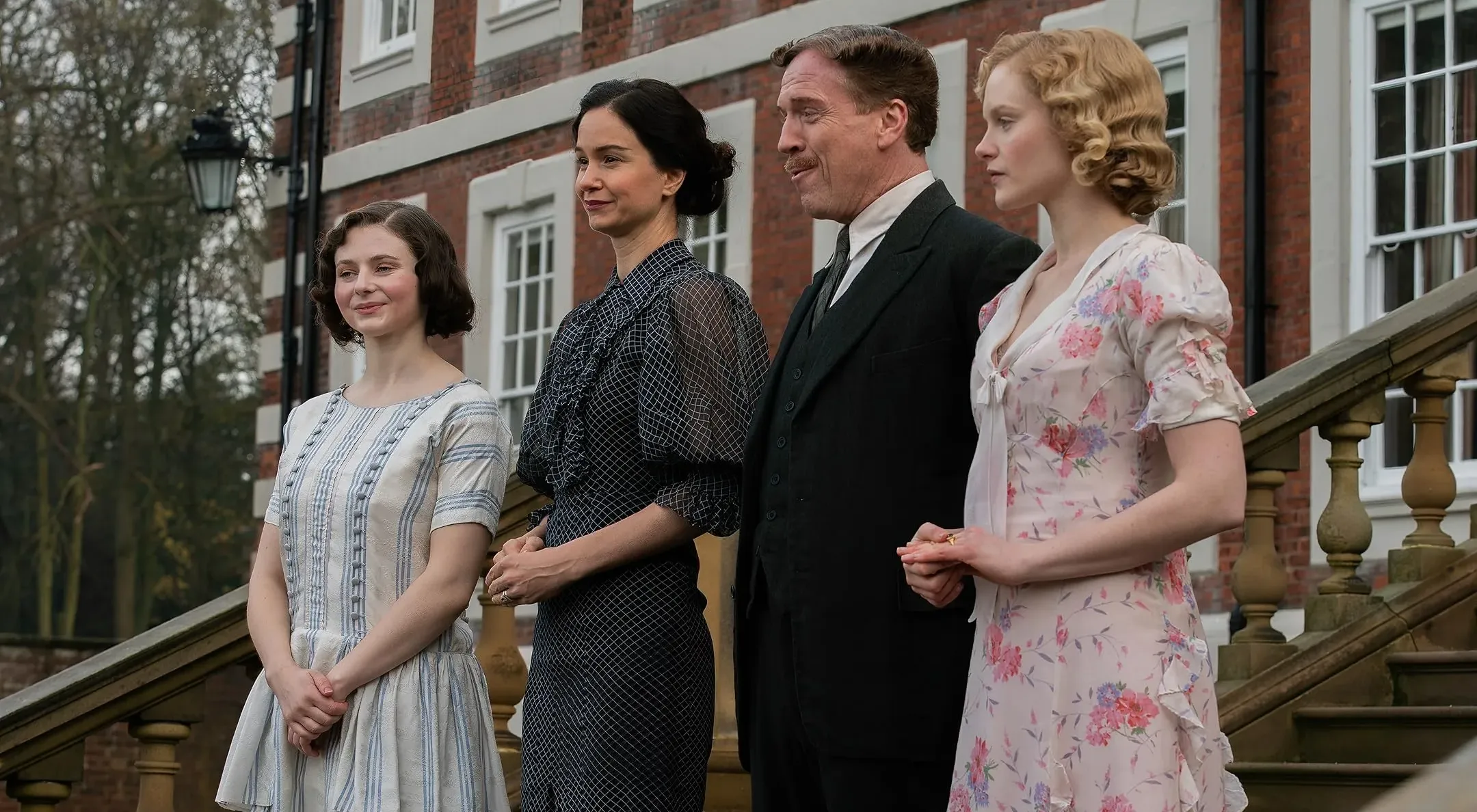
Damian Lewis gives Lord Davenport a deliciously bemused vacancy, playing the dim patriarch with unwavering seriousness while his intricate, sculpted hairstyle functions as a recurring visual joke. Katherine Waterston, as the prim Lady Davenport, matches him with a composed, icy presence; her most ridiculous choices register with greater force because she honors the character’s seriousness rather than winking at the material. Together they echo familiar aristocratic figures, clearly reminiscent of the Grantham mold, and this recognizability gives the satire immediate shape.
The ensemble follows the same deadpan directive. Tim McMullen’s butler, Cyril, and Anna Maxwell Martin’s relentlessly dour housekeeper draw their comic charge from the way they adhere strictly to genre expectations, letting their surroundings and exchanges quietly undermine them. Sue Johnston’s Great Aunt Bonaparte brings an imposing, almost ceremonial authority, a figure who mirrors the revered dowager matriarch archetype while quietly sending it up.
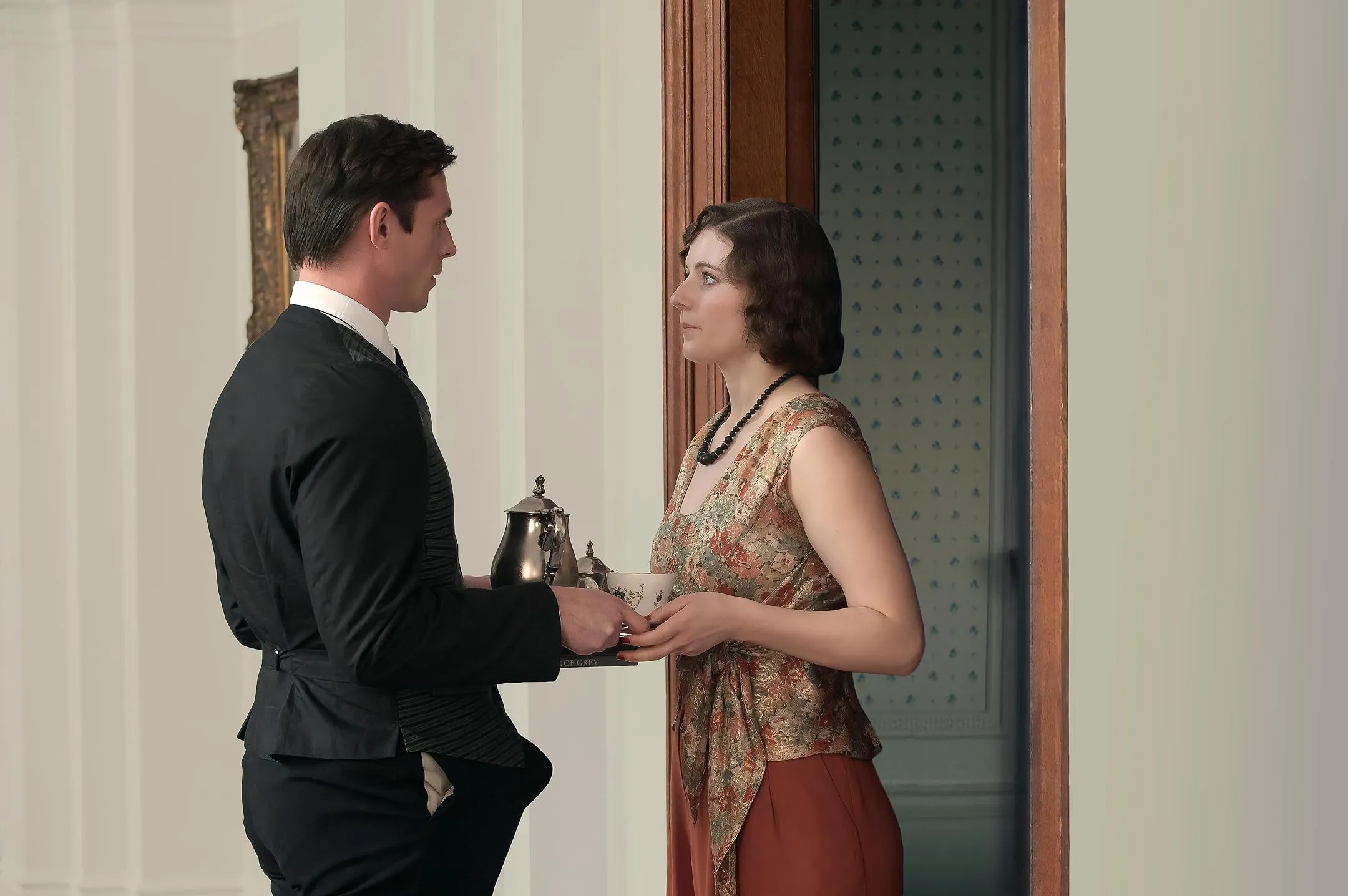
At the center of the story’s emotional stakes sit Ben Radcliffe and Thomasin McKenzie, who carry the central forbidden romance. Radcliffe gives Eric an easy warmth that makes the pickpocket immediately appealing, while McKenzie lends Rose a clear-eyed, unguarded sincerity that marks her as the beleaguered young woman of the house. Their screwball rapport depends on both actors balancing charm with the demands of vigorous physical comedy. This relationship remains the film’s one insistently sincere element, the structural core that keeps the satire grounded. The romantic stakes give weight to the surrounding farce and keep the chaos tethered to something recognizably human.
The Technical Betrayal of Grandeur
From a craft perspective, Fackham Hall carefully mimics the opulence and precision of the prestige period dramas it mocks. Visual authenticity becomes central to the gag. The production needs to look polished and expensive for the sillier jokes to gain traction. Location work at an actual ancestral estate in Liverpool supplies Fackham Hall with a persuasive, stately shell for its fictional manor. Production design attends closely to detail, lining the screen with lush costumes for both aristocrats and servants, carefully arranged period interiors, and corridors filled with gilded surfaces and deep carpets.
These choices, achieved on a fraction of the budget of the usual period-drama heavyweights, create a persuasive illusion. That surface credibility sharpens the absurd moments: the listing, melting snowman by the front door or a chamber ensemble pouring out swooning romantic music in an utterly unsuitable context register as comic intrusions into an environment that otherwise takes itself very seriously. The visual scheme does not act as a punchline on its own; the joke lies in the disruptive content that cuts across this polished presentation.
Sound and narration maintain the same serious mask. Oli Julian’s romantic score and the arch, carefully paced voiceover from Hayley Mills, credited with an “Introducing” tag, uphold the tone of grand historical epic. Jim O’Hanlon treats the camera with the same seriousness.
The cinematography consciously echoes the stately imagery of Downton Abbey and similar series, and the film does far more than simply record actors delivering jokes. O’Hanlon stages visual gags with careful escalation, letting small background details grow into full-fledged foreground set pieces. This approach reveals a precise sense of comic timing and spatial design that squeezes the maximum effect from a script packed with jokes. The camera behaves like an active conspirator in the comedy instead of a passive observer.
Class, Anachronism, and the Legacy of Spoof
Beneath the constant stream of gags, Fackham Hall sustains a story with real dramatic stakes. The Davenport family’s severe financial troubles and the later framing of Eric for murder supply a narrative skeleton strong enough to hold the torrents of humor. This framework prevents the film from dissolving into a loose pile of disconnected sketches.
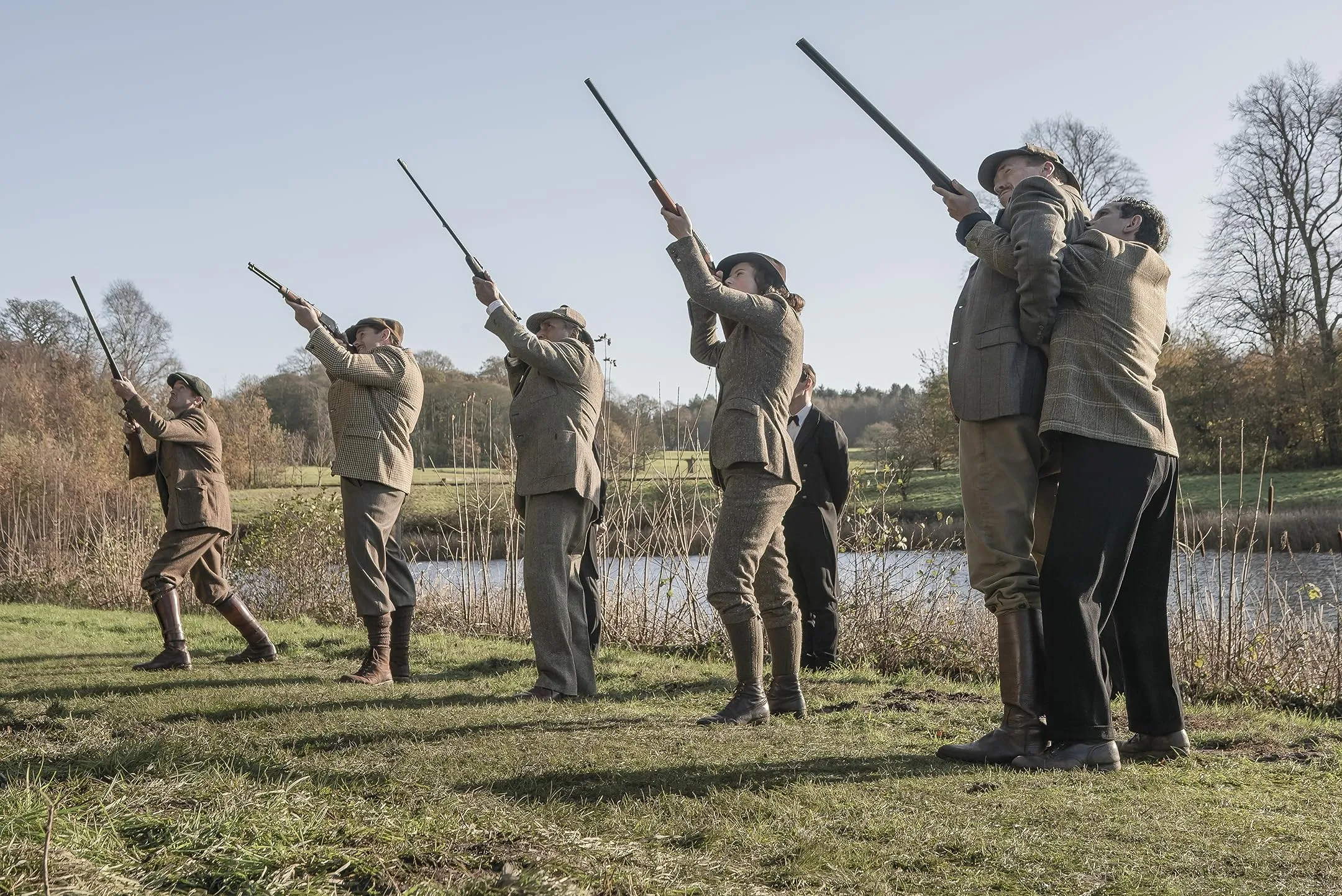
The divide between aristocrats and staff becomes a clear lens on British culture. The illicit connection between Eric, the literal “no one” who lives by his wits, and Rose, the protected young lady, acts as a pointed challenge to the rigid class geometry of the manor and offers a sharp send-up of 1930s social hierarchies.
The film also leans into overt anachronism, importing contemporary references that slice straight through the integrity of the period setting. Some of these touches work neatly, like the quick background visual gags or fleeting pop culture nods such as “Tailor Swift.” Others jar the mood, especially when dialogue strains visibly for a modern tone, as in Great Aunt Bonaparte’s bursts of “meme-speak.” Those strained moments feel like direct appeals to contemporary audiences that momentarily snap the film’s internal logic and period illusion.
Uneven patches aside, the hit rate remains high enough to keep the film lively. Fackham Hall presents itself as an invigorating contribution to screen comedy, standing comfortably beside the classic spoof tradition associated with the Zucker-Abrams-Zucker (ZAZ) era.
The relentless joke density may keep it from achieving the iconic, widely quoted status of Airplane! or The Naked Gun, yet the film still delivers a sustained, loud assault on the rituals and finances of the British upper class. It functions as a sharp cultural send-up of a genre that waited a long time for this level of mockery.
Fackham Hall is a satirical comedy movie that lovingly sends up the world of British period dramas like Downton Abbey. The film premiered at the Venice Film Festival in September 2025 and saw its general theatrical release shortly after. The movie is a collaborative writing effort, including comedian Jimmy Carr and his brother Patrick Carr. It is known for its high joke density and for casting established dramatic actors to deliver the absurd material with a crucial deadpan seriousness.
Full Credits
Title: Fackham Hall
Release date: September 2025 (Film Festival Premiere), Fall 2025 (Theatrical Release)
Running time: Approximately 90 minutes
Director: Jim O’Hanlon
Writers: Jimmy Carr, Patrick Carr, Steve Dawson, Andrew Dawson, Tim Inman
Producers and Executive Producers: Danny Perkins, Kris Thykier, Mila Cottray
Cast: Damian Lewis, Katherine Waterston, Thomasin McKenzie, Ben Radcliffe, Tom Felton, Sue Johnston, Tim McMullen, Anna Maxwell Martin, Tom Goodman-Hill, Hayley Mills, Emma Laird
Director of Photography (Cinematographer): Philipp Blaubach
Composer: Oli Julian
The Review
Fackham Hall
An ambitious, frequently hilarious period spoof that uses brilliant casting and production design to elevate its gag-heavy script. It honors the genre while effectively dismantling its pomposity.
PROS
- Flawless replication of period drama grandeur enhances the satire.
- Utilizes dramatic actors (Lewis, Waterston) for deadpan delivery, maximizing comedic effect.
- Seamlessly transitions from romantic satire to a murder mystery parody.
- Ensures consistent entertainment and compensates for weaker moments.
CONS
- The high density includes numerous obvious or overly base jokes.
- Some modern references feel forced or pander to the audience, briefly breaking the immersion.
- The relentless flow of humor can be exhausting over the runtime.