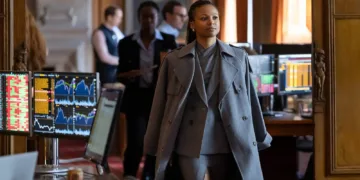






























The narrative leaves the localized pressure cooker of the trading floor and widens its view to a world running on global instability. By placing the story in 2026, the series frames its new reality around the second Trump administration and the lingering fallout of Brexit. That time jump strips away the institutional safety net. The characters operate as free agents in a system without a central hub.
Power no longer gathers in one building. It sits in secure server rooms and private retreats. The season leans into the mechanics of a cat-and-mouse thriller, and one episode at Henry Muck’s estate tilts into gothic horror. The characters move through a closed loop of psychological manipulation. With the Pierpoint office gone, the way these people understand themselves changes. They read as isolated nodes inside a web of digital capital.
The turn toward the corridors of the Labour government sharpens the show’s point about the state’s role as a servant of financial interests. The stakes reach national economies and their stability. Bonus culture still matters, and the same moves ripple outward into the destabilization of entire systems. The genre shift tracks a shift in work itself. What once played as workplace drama now plays as survival inside a fractured economy. The characters inhabit non-places: luxury hotels, airport lounges, temporary rooms designed to look expensive while staying anonymous.
The setting underlines the alienation of the global elite. The script leans into paranoia in a world where proximity fails as a reliable sign of loyalty. The characters scatter across cities and networks, trying to move through an environment that treats them as expendable. The show treats the death of the institution as a lasting change in the social order. It follows wealth as it slides from physical assets to speculative digital bets. Even the season’s structure echoes the solitude of modern remote labor. The new financial world becomes a string of lonely rooms connected by screens.
The expanded scale demands a thick layer of strategy. Survival depends on working through a maze of international regulations and shadow banking. That choice speaks to a television trend where the “workplace” stops being a single address and turns into a chain of transactional encounters. The series drops the comfort of a home base and asks the audience to track characters who behave like nomadic predators. The 2026 financial world it imagines treats wealth as fluid, detached from geography, and the season turns that mobility into constant motion with an undertow of dread.
Predatory Capital and the Digital Frontier
The payment processor Tender functions as a pointed critique of the fintech industry. Whitney Halberstram stands as the architect of the venture, and Max Minghella plays him with a cold, controlled detachment. He embodies the modern executive who reduces human beings to data points.
Also Read






Tender’s ambition to destroy traditional banking runs through its connection to the Siren platform, and that linkage pushes the story toward questions about profit built from the exploitation of private lives. Using UK online safety laws as part of the backdrop, the plot presses corporate accountability into the foreground.
James Dycker adds another angle through the decline of investigative journalism. He struggles to expose the truth about a company that treats non-disclosure agreements like armor. Charlie Heaton gives the role a palpable social awkwardness, which fits the character’s difficulty in challenging a system designed to keep its operations sealed behind legal threats and controlled access.
Haley Clay moves through the company like a shadow. Kiernan Shipka plays her with intensity kept under the surface, a presence that suggests calculation even in stillness. Jay Jonah Atterbury embodies the salacious side of the tech world, and his public downfall underlines how volatile this market can be.
The season watches these figures treat peers like disposable assets, using the fintech setting to stress the dehumanizing texture of digital labor. It points to the gap between the polished startup image and the rot inside. Extraction and surveillance sit under the branding, and the arrival of these new players creates friction with the established characters.
The narrative keeps returning to the idea of tech as performance: spectacle as camouflage for the concentration of wealth. Jennifer Bevan’s presence extends the critique to the political class. She finds herself overwhelmed by corruption inside her own party, while the series depicts a world where law functions as a tool available to the highest bidder.
This emphasis on fintech signals a shift in global storytelling, moving from the tangible assets associated with the 20th century to the algorithmic extraction associated with the 21st. Through the Tender arc, the show examines the relationship between technology and social discourse. Platforms like Siren shape cultural norms while funneling immense wealth to a small set of individuals. The casting choices support that turn, pulling in actors linked with digital-native or genre-heavy projects to anchor a financial drama. The season plays like a thriller about the end of privacy. The digital frontier reads as a lawless space where ruthless behavior sets the terms of survival.
| Name | Role | Motivation |
| Whitney Halberstram | CFO of Tender | Total market control |
| Jim Dycker | Journalist | Exposing Tender’s lies |
| Haley Clay | Assistant | Power and survival |
| Jennifer Bevan | Minister | Managing party corruption |
The Moral Collapse of the Elite
Harper Stern remains the focal point of the show’s ethical vacuum. She runs a short-selling fund built to profit from companies collapsing. Her partnership with Sweetpea and Kwabena signals commitment to a life stripped of empathy. Any remaining traces of her former self have been discarded.

Yasmin Kara-Hanani lives inside a different kind of prison. Her aristocratic world becomes a cage made of social expectations, and her storyline circles the depression and failure of Henry Muck. The arc carries an echo of high-profile figures who enable systemic abuse inside powerful circles. The series presents Yasmin as someone who chooses comfort and status while letting conscience corrode.
The dynamic between Harper and Eric Tao remains actively unsettling. They read like two beings trying to learn the vocabulary of human emotion from the outside. Their scenes expose a hollow center, and both emerge as predatory figures driven by self-preservation and ambition. Social responsibility never gains traction. The disconnection reads as the price of their environment. The series holds back any promise of redemption and treats these characters as the logical products of a system that rewards narcissism. Their choices show social bonds collapsing under extreme capital.
Harper uses her identity as both shield and weapon, mirroring the cruelty she learned from mentors. Yasmin treats beauty and status as currency, locked into a cycle of dependency. The younger characters make the inheritance pattern explicit. They recognize the trauma baked into the industry and still choose to stay. The show sketches a society that has lost its moral direction, and it frames 2026 as a year where the pursuit of more survives as the dominant value.
This moral vacancy pushes against familiar television habits that treat character arcs as paths toward growth. Here, the movement runs toward erosion. The series stresses that representation inside these spaces can carry a steep personal cost. Harper’s trajectory reads as a critique of the “girlboss” story: entry into a toxic system produces toxic outcomes. By showing the self worn down, piece by piece, the season ties its character study to social questions about power, identity, and what neoliberal reward structures do to human connection. The pursuit of power becomes a form of self-annihilation, delivering a cynical but clear-eyed portrait of the culture it depicts.
The Sound and Vision of Rot
The season’s technical choices amplify a sense of cultural decay. Mickey Down and Konrad Kay lean on a visual approach that stays close to physical reaction. The camera lingers on faces, using micro-expressions and fatigue to expose the strain of these lives. Nathan Micay’s score pulls from 1980s textures to build dread, hinting that the present keeps replaying old cycles of greed with updated interfaces. Avant-garde imagery carries the market’s disorientation into the frame. A costume ball lands as direct social critique, with Yasmin dressed as Marie Antoinette, an image that captures the wealthy sealed off from public reality.

The script packs in dense financial terminology to keep urgency high. The emotional stakes remain legible even when the technical mechanics blur into noise. Performances do the work of translating jargon into human cost. The season builds an atmosphere that feels modern and ancient at once, tuned to the anxiety of a world moving toward something bleak.
Strobe lighting in scenes of excess creates a sickly pulse that matches the characters’ chaotic rhythms. The sound design layers in the constant buzz of transactions and data flow, emphasizing how digital their reality has become. The future the show imagines feels cold and empty, with the glamour of high finance serving as camouflage for systemic failure. Direction choices keep returning to the silence after betrayal, catching the instant characters register that money is all they have left. The season closes on a shift that clears space for further damage.
The aesthetic points toward “prestige realism,” where high production values render low moral ground in sharp detail. The Marie Antoinette set piece stands as the clearest example, using historical imagery to comment on present inequality. This visual language changes how financial drama plays: the market becomes a sensory experience of rot and excess.
The season’s potential influence on industry trends sits in that commitment. It argues that audiences will stay with complex, unlikable characters when the world-building feels immersive, and it challenges the industry to stop relying on safe narratives while contemporary social discourse grows messier and harder to ignore.
Industry Season 4 premiered on January 11, 2026, on HBO and is available for streaming on HBO Max in the United States. In the United Kingdom, the season debuted on January 12, 2026, on BBC One and BBC iPlayer. For viewers in India, the high-stakes finance drama is available on JioHotstar. This season follows Harper and Yasmin as they are pulled into a high-stakes cat-and-mouse game involving a new fintech darling, expanding the series’ scope beyond the trading floors of London to a global stage.
Full Credits
Title: Industry Season 4
Distributor: HBO, BBC One, BBC iPlayer, JioHotstar
Release date: January 11, 2026
Rating: TV-MA
Running time: 49–71 minutes per episode
Director: Mickey Down, Konrad Kay, Michelle Savill, Luke Snellin, Isabella Eklöf, Zoé Wittock
Writers: Mickey Down, Konrad Kay
Producers and Executive Producers: Mickey Down, Konrad Kay, Jane Tranter, Kate Crowther, Ryan Rasmussen, Kathleen McCaffrey, Rebecca Ferguson
Cast: Myha’la, Marisa Abela, Ken Leung, Sagar Radia, Kit Harington, Miriam Petche, Kiernan Shipka, Max Minghella, Charlie Heaton, Kal Penn, Toheeb Jimoh, Amy James-Kelly, Jack Farthing, Claire Forlani, Edward Holcroft
Director of Photography (Cinematographer): Daniel Stafford-Clark, Milos Moore, Catherine Derry, Erik Molberg Hansen, Federico Cesca, Martin V. Rush, Fede Cesca, Michael Paleodimos
Editors: Christopher Watson, Mary Finlay, Peter Christelis, Sarah Louise Bates, Richard Ketteridge, Carly Brown, Kyle Ogden, Kyle Traynor, Chris Hunter, Richard Smither
Composer: Nathan Micay
The Review
Industry Season 4
Industry Season 4 succeeds as a brutal examination of the intersection between digital capital and human frailty. It abandons the safety of the office to reveal a world defined by nomadic greed and moral vacuum. While the characters remain deeply unsympathetic, their descent into monstrosity provides a chillingly accurate reflection of a neoliberal society in 2026. The series elevates the financial thriller to a piece of sociopolitical horror, proving that the most dangerous markets are those that trade in human desperation.
PROS
- Sophisticated expansion into global and political arenas.
- Unflinching critique of the fintech industry and neoliberal ethics.
- Exceptional performances from the new and returning cast.
- Masterful use of a synth-heavy score and avant-garde visuals to evoke dread.
CONS
- Deeply unlikable protagonists may alienate some viewers.
- Dense financial jargon remains a barrier to full accessibility.
- Certain late-season plot points lean into operatic excess.