
























![Kingdom Hearts Collection [I-III] Review](https://gazettely.com/wp-content/uploads/2026/10/Kingdom-Hearts-Collection-I-III-1-360x180.webp "Kingdom Hearts Collection [I-III] Review: KHII Holds Steady as Newer Entries Fluctuate 37")




Macon Blair’s The Shitheads opens on a world where salvation appears as a distant lamp through a wet, indifferent night. Two men, cast off by the institutions they once inhabited, take a job driving a wealthy teenager to rehab. Davis loses his place in the church after a misunderstanding tied to a graphic film.
Mark is pushed out at the end of a corporate career. Their passenger, Sheridan, carries a defiant face that hides an absence of empathy. The rural roads fold the story inward until the car itself reads like a cramped confessional. The road’s grit answers the slow erosion of men who have little left to protect.
Wealth and online influence press against the raw demands of working life. The film tests the burden of sitting beside a person who seems morally weightless. The journey becomes an anxiety examined through a highway odyssey.
The Souls of Discarded Men
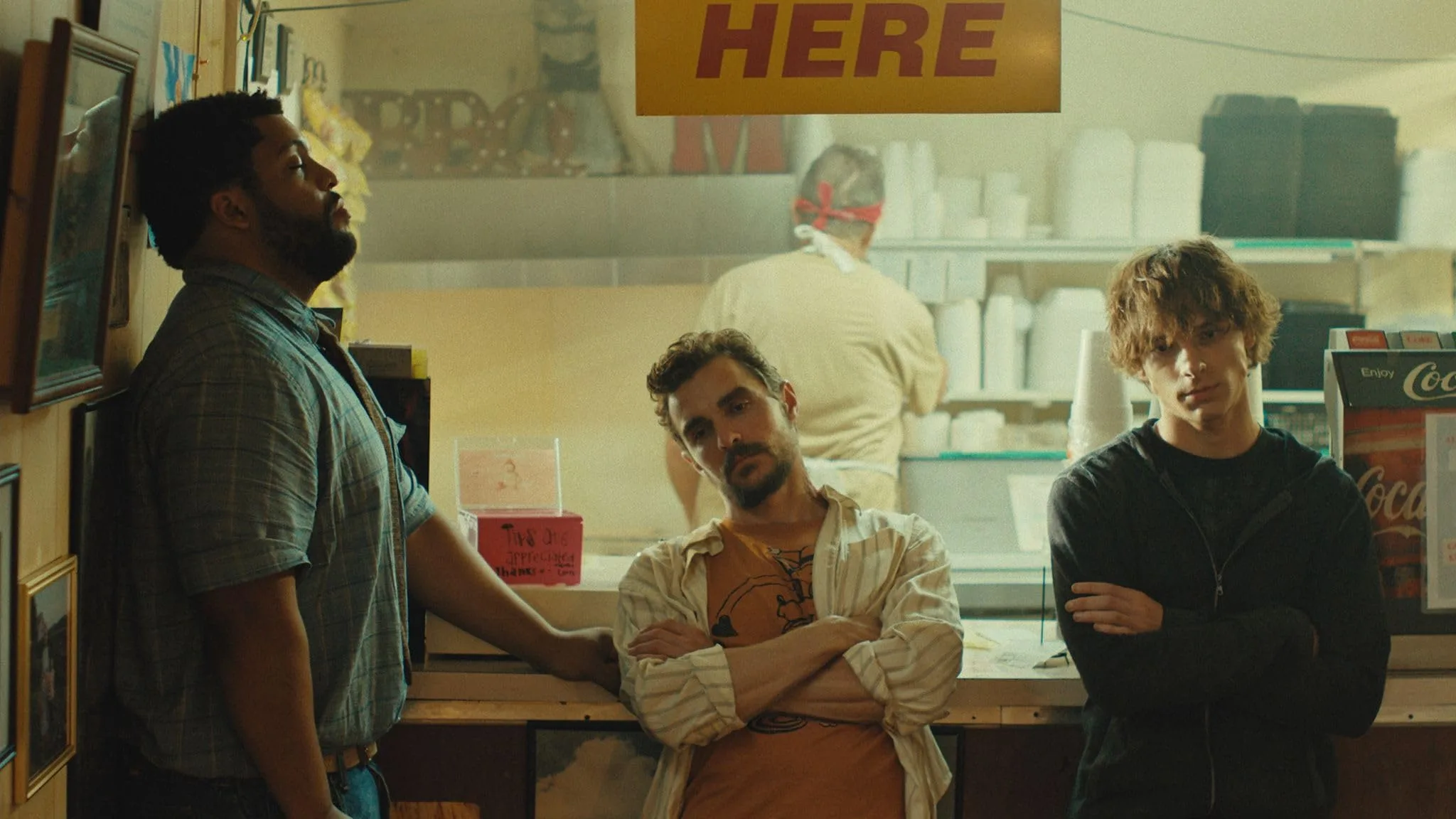
Davis appears as a seeker of grace. O’Shea Jackson Jr. gives him a grounded, heavy dignity. Faith functions for him as a shield that grows cumbersome. He mistakenly screened Antichrist to his congregation. That error becomes a sign of his urgent wish to matter to people who no longer listen. He is a striver without a clear route forward.
Mark stands apart. Dave Franco animates him with a jittered desperation. He uses chemicals to dull reality’s edges. His talk fills the space that would otherwise demand acknowledgement of failure. Both men share a dealer, a small nexus that exposes the decay around them. Their relationship begins in friction and slides into an alliance born of necessity. The film records the working class as a sequence of small, crushing defeats.
Society counts them as failures because it measures worth by production. They retain a messy vitality that their passenger lacks. Jackson Jr.’s gravitas steadies Franco’s instability. Together they feel authentic in their brokenness. They seek reasons to exist while steering a car that threatens to fall apart.
The Void in the Back Seat
Sheridan stands at the cold edge of inherited excess. Mason Thames shapes him with a smirk that lands like an assault. He behaves like a sociopath who turns human suffering into content for a digital audience. He records himself inflicting pain. Family money makes this pastime possible. The tone of the film shifts in a motel when Sheridan targets Irina. Comedy evaporates in that room.
The audience recognizes a monster in the skin of a spoiled child. Tension presses the air until it grows almost visible. Wealth functions as a protective barrier for him against the rules that hold others accountable. He toys with those who guard him because he expects to buy his way through ruin.
The film uses visceral, sometimes repellent moments to strip dignity from its protagonists. A scene of explosive diarrhea operates as both a literal collapse and a metaphorical low point. The physical grossness roots the philosophical horror of Sheridan’s apparent soullessness. He reflects a society that elevates the loud and cruel.
The Fringe and the Forgotten
Irina enters as one made raw by the whims of privilege. Kiernan Shipka brings a fierce energy. She refuses to remain a passive figure. She joins the two men and supplies a moral heat to their frantic mission. She arrives as collateral damage from consequence-free living. The road surfaces a cast of bizarre figures who inhabit the corners polite society ignores.
Koko, played by Peter Dinklage, heads a band of criminals who view Sheridan as a source of cash. Their menace can feel both cartoonish and terrifying. Pricka Bush, a rapper obsessed with werewolves, appears as an internet subculture parody performed by Nicholas Braun. These odd pockets of humanity cluster at the map’s edge.
They present a messy, surreal human geography. The narrative resists tidy scaffolding. It prefers strange encounters that accumulate when travelers abandon the main road. The characters embody a fractured reality in which everyone chases an evaporating dream.
The Shaggy Architecture of Despair
Blair rejects the slick geometry of a conventional thriller. He opts for a hybrid approach that reads like a B-movie bearing a serious heart. Direction resists predictable beats and moves with the ragged energy of the film’s characters. The visual language remains grounded in gritty realism.
Dirt on the car and the motel lights that stutter through night establish a lived-in place. The pacing proceeds with a kind of reckless license, favoring jolts of shock over smooth transitions. That choice will unsettle viewers who expect a standard arc. The film glances back at drug-laced comedies of earlier eras and layers in a strain of existential dread.
The open road becomes a visual emblem for the emptiness of the characters’ horizons. The protagonists’ messy vitality stays central even as the plot wanders into absurdity. Directorial intent privileges rawness over polish.
The Cold Weight of the Hierarchy
The film carries a bitter social argument. It lays bare the distance between those who must work to survive and those who live above consequences. For Davis and Mark a single misstep can mean total ruin. Sheridan can commit horrific acts and remain shielded by family status. That inequality powers the film’s darkest sequences.
Pursuing decency turns into a radical choice in this context. Davis attempts to redeem Sheridan’s soul. This effort grows more quixotic as the boy’s true nature emerges. The characters move inside a systemic cage. A wrong turn deposits them in a gutter of despair that admits no easy exit. The story refuses to provide a simple redemption.
Sheridan remains a “shithead” because his world allows that condition to persist. That absence of growth underscores the unfairness of the social order. The film posits that the working class can preserve empathy as their only recourse. The hierarchy endures. It remains cold and indifferent to the struggles beneath it.
The Shitheads is a pitch-black comedy-thriller that made its highly anticipated world premiere at the Sundance Film Festival on January 23, 2026. Directed by Macon Blair, who previously won the Sundance Grand Jury Prize, the film follows two down-on-their-luck “bozos” hired to transport a spoiled, borderline sociopathic rich teen to a rehab facility. What begins as a simple job quickly devolves into a chaotic, drug-fueled odyssey across the American landscape. Currently, the film is making its festival rounds and seeking wider theatrical or streaming distribution following its warm reception in Park City.
Full Credits
Title: The Shitheads
Distributor: Gramercy Park Media (Production), WME Independent (Sales/Distribution Seekers)
Release date: January 23, 2026
Rating: TV-MA / R (Content includes pervasive language, drug use, and violence)
Running time: 98 minutes
Director: Macon Blair
Writers: Macon Blair, Alex Orr
Producers and Executive Producers: Alex Orr, Brandon James, Dave Franco, Ford Corbett, Nathan Klingher, Macon Blair, Jeremy Saulnier, Mark Fasano, Joshua Harris, Jatin Desai, Greg Freidman, Danny McBride, Jody Hill, David Gordon Green
Cast: Dave Franco, O’Shea Jackson Jr., Mason Thames, Peter Dinklage, Kiernan Shipka, Nicholas Braun, Killer Mike, Grace Junot, Najah Bradley, Eric Goins, Tim Ware, Lynn Wanlass
Director of Photography (Cinematographer): Guillermo Garza
Editors: Dane McMaster
Composer: Will Blair, Brooke Blair
The Review
The Shitheads
The Shitheads offers a jagged reflection of a world where empathy remains a luxury for the dying. It captures the frantic energy of the desperate. It confronts the hollow void of inherited wealth. The tonal shifts fracture the experience. Still, the grounded performances of Jackson Jr. and Franco preserve a sense of human truth. It is a bleak, messy odyssey that finds its meaning in the wreckage of a highway dream.
PROS
- Lead actors provide sincere portrayals of desperation.
- Brave tonal shifts challenge the viewer.
- Lived-in visual aesthetic feels authentic.
- Effective use of gross-out elements to mirror social decay.
CONS
- The narrative momentum slows in the second act.
- The antagonist remains an abrasive void of humanity.
- Sudden mood changes might alienate audiences.
- Supporting characters often feel like caricatures.







