























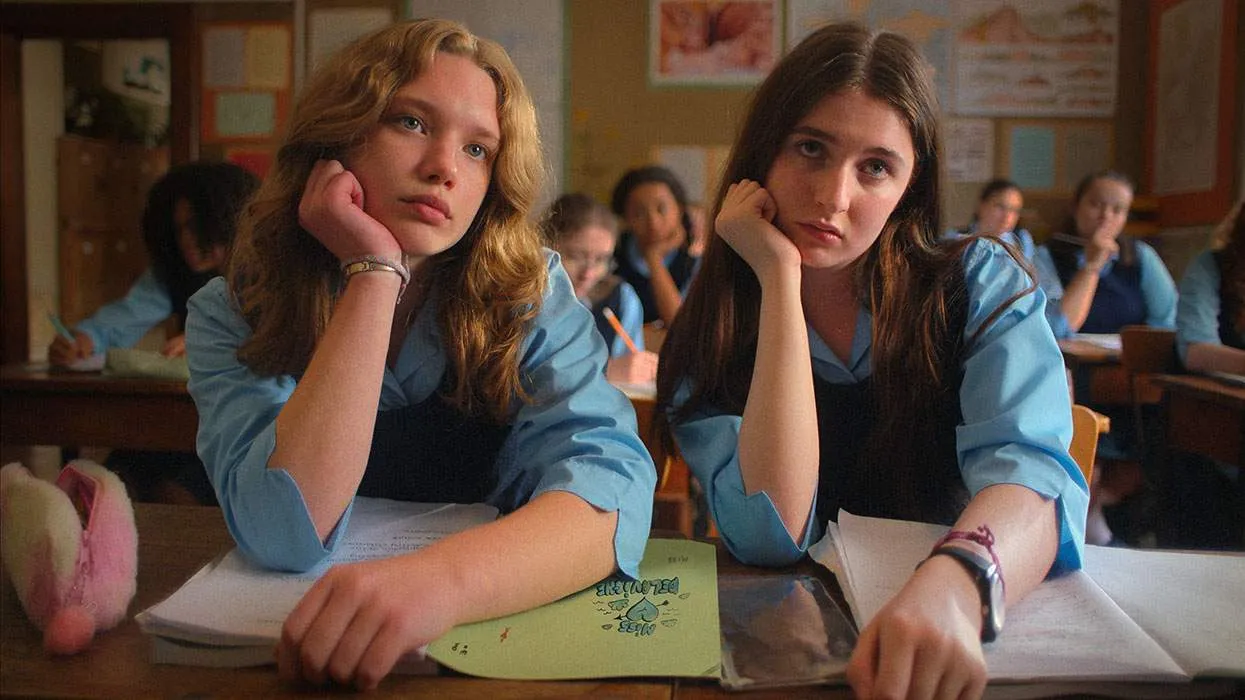

Molly Manners plants her debut feature inside the limestone compression chamber of an elite English boarding school at the turn of the millennium, and the timing feels picked with something close to medical care. Pull the story out of the smartphone era and the film gets to run an experiment: trap teenagers in close quarters with no digital exhaust to vent into, and watch how every look, rumor, and omission acquires a physical temperature.
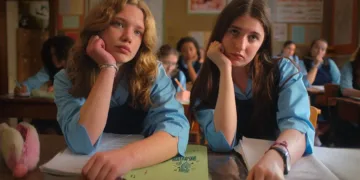
Minna and Flic move through school with a kind of academic militancy, curating themselves for future Oxbridge interviews, then confronting an awkward line item missing from their files: lived experience, the messy thing that refuses quantification. The period choice amplifies the claustrophobia. Without social media, a snub lands on skin, and a secret travels mouth to ear, not screen to screen.
They name the deficit “worldliness,” and they say it with the heavy diction of a finishing-school pamphlet, almost Victorian in its self-seriousness. Their fix is to treat desire like a skill they can manufacture. They start a project of staged passion and pick Miss Delavigne, the unassuming geography teacher, as their chosen object.
A school production of A Midsummer Night’s Dream sparks the scheme. Shakespeare’s forest of misrule becomes their template for a controlled fall into irrationality. The plan reads like an attempt to colonize feeling through intellect, a kind of sociological LARP (the phrase fits, even if it sounds like a joke you’d regret making in public) in which the girls rehearse maturity until the performance begins to harden into identity.
The The Hierarchy of the Gaze
Galaxie Clear plays Minna with an alarming ease, the magnetism of someone already fluent in the art of being watched. She rules Year 10 like a small monarch, a Sun King with a school tie, and the radiance slowly turns caustic.
As Minna angles toward the familiar prizes of popularity and male attention, she starts to expose the predatory logic inside “alpha” adolescence. She carries herself with a physical certainty that shrinks the room around her, and Clear lets that trait land as seductive and ugly in the same breath. The performance understands the narcissism baked into the fantasy of being the “main character” inside a shared social life.
Marni Duggan gives Flic the opposite charge: brittle, diligent, quietly furious. Flic does the emotional heavy lifting in the friendship and still ends up reduced to a supporting role in Minna’s private drama. Duggan captures a resentment that feels native to the sealed ecosystem of boarding school, where tiny shifts in attention register like regime change. Her face holds suppressed fury and longing at once, and she often looks at Minna with a stare that edges toward devotion. Miss Delavigne becomes her refuge, an intellectual sanctuary that reads as genuine and desperate at the same time.
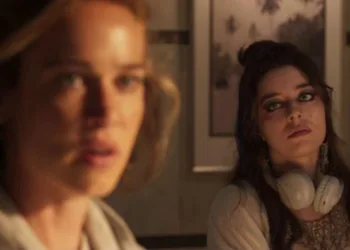
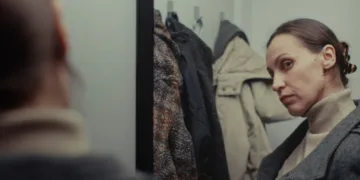
Alice Englert plays the teacher with a nervy detachment, a woman who has no idea she’s been drafted as a romantic icon by two bored teenagers. The awkwardness has real depth. It keeps pointing to the chasm between adolescent fantasy and adult reality, a gap that never closes no matter how elaborate the girls make their game. Englert sidesteps the “cool teacher” idea and gives us someone private to the point of pathology, protective of her own interior life.
Phoebe, played by Aoife Riddell, functions as the “Social Untouchable,” the living proof that every exclusive pair leaves someone outside the circle. She haunts the corridor edges like a discarded thought the story refuses to erase. Her eagerness stings, partly because it exposes the raw vulnerability Minna and Flic have been pruning out of themselves with such discipline. The film keeps her nearby as a reminder that social hierarchies need casualties to feel real.
Pastels, Pathos, and the Mannerist Frame
The film’s visual grammar changes as the year progresses, and the shift carries its own argument about adolescence: early scenes can look like a promise, later scenes like an indictment. Andrew Commis begins with a light, pastel-soaked palette, the kind of brightness that suggests the sunny certainty of early youth.
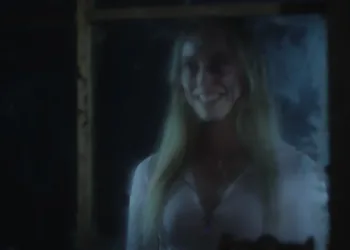
The school grounds approach a Pre-Raphaelite image, an “aesthetic of the idyll” that almost dares you to trust it. As the Worldliness project rots from the inside, the cinematography slides into shadowed, gloomier hues. The tone tilts away from coming-of-age comedy and starts brushing up against psychological thriller territory. The frame tightens, and the body becomes its own locked room.
Miriam Battye’s script helps that descent through dialogue with sharp, staccato timing, carrying the scent of her work on Succession. The girls speak with a kind of lexical savagery, using intelligence like a blade and treating emotion like something to dissect. They pick at their own feelings and other people’s flaws with clinical chill, as if precision might immunize them against pain.
Joe Randall-Cutler’s editing builds a rhythmic “female mind-meld” early on: synchronized notebooks, lockers, routines, the little ceremonies that make two people feel like one unit. The patterning establishes unity so the fracture hits harder. This controlled “mannerism” (yes, the pun seems intentional, and yes, it risks looking too composed) ends up reflecting the rigid structures the girls keep insisting they want to outgrow.
Sound keeps building bridges the image keeps burning. Boccherini’s refined strings collide with the psychedelic ache of “Crimson and Clover,” and the clash does something useful: it frames heartbreak as a repeatable human event, not a period detail. Early-2000s fashion can date itself; the sonic sensation of longing stays familiar. The film lives in a space that feels hyper-specific and oddly unmoored from the calendar, like a memory recolored and sharpened over time.
Terrain of the Terminus
Minna and Flic’s friendship eventually buckles under the weight of its own codependency. The school play becomes the cleanest metaphor the film could ask for. Minna gets cast as Titania, ethereal and exalted, while Flic is assigned a mound and later the literal ass, Bottom.
The choices function as institutional confirmation of their social positions, a formal stamp on what the girls already sense in every glance around the dining hall. Boys enter the story and the ecosystem gets contaminated, turning collaboration into competition for relevance. Here the film names an “erotics of envy,” a condition where wanting what the other possesses becomes so intense that the boundary between love and hate dissolves.
The cruelty leaves me split. Part of it reads as a visceral study of envy poisoning a bond; part of it lands with such exacting beauty that the ugliness turns strangely hypnotic. The girls suffer indignities that would sound trivial in a different setting, yet here they register like tectonic shifts.
Their sexuality appears as messy, unmapped terrain, with desire and performativity blurred into the same gesture. Flic’s growing fixation on Miss Delavigne becomes a private counter-map, a geography Minna cannot seize by force of charisma. It is her “extra geography,” a personal topography of hills and valleys in which she gets to be the sole cartographer (a small power, still a power).
The title points to the literal trip to the teacher’s cottage, and it also points to the extra-curricular emotional labor adolescence demands. It frames survival as fieldwork: study the land beyond the textbook, take notes, make mistakes, bruise a little. When they reach the cottage, they confront adulthood as something no project can confer. It reads as rough terrain, indifferent to ambition, something each person crosses alone. The film leaves them with the knowledge that some maps get drawn later, in retrospect, and that the “best friendship” of youth can become the first country a person learns to flee.
Extra Geography is a British coming-of-age dramedy that made its world premiere at the Sundance Film Festival in the World Cinema Dramatic Competition on January 23, 2026. Directed by Molly Manners and written by Miriam Battye, the film is an adaptation of a short story by Rose Tremain. Set in an all-girls English boarding school during the early 2000s, it follows two inseparable best friends who embark on a calculated project to fall in love with their geography teacher to gain “worldliness.” As of late January 2026, the film has recently concluded its festival screenings and is currently seeking wider theatrical distribution; viewers can expect news regarding streaming and cinema release dates later this year.
Full Credits
Title: Extra Geography
Distributor: HanWay Films, STUDIOCANAL, Brock Media
Release date: January 23, 2026
Running time: 94 minutes
Director: Molly Manners
Writers: Miriam Battye, Rose Tremain
Producers and Executive Producers: Sarah Brocklehurst, Wendy Griffin, Farhana Bhula, Philip Burgin, Charles Dorfman, Tom Harberd, Benji Strange, Marlon Vogelgesang
Cast: Marni Duggan, Galaxie Clear, Alice Englert, Aoife Riddell, Shvorne Marks, Jairaj Varsani, Cody Mitchell, Zac Hurren, Gabriel Nagy, Allison Saxton, Iyla Sundarsingh McKaig
Director of Photography (Cinematographer): Andrew Commis
Editors: Joe Randall-Cutler
Composer: Arthur Sharpe
The Review
Extra Geography
Extra Geography is a sharp, often painful mapping of the "erotics of envy" that defines adolescent codependency. While its stylized, "Succession-lite" dialogue occasionally borders on the clinical, the central performances from Clear and Duggan ground the artifice in raw, recognizable friction. It captures the specific tragedy of realizing that a best friendship is not a permanent destination, but a temporary territory one eventually outgrows. It is a bracing, intellectually dense debut that favors psychological precision over easy sentimentality.
PROS
- Exceptional, nuanced performances from newcomers Galaxie Clear and Marni Duggan.
- A visually striking evolution from pastel idealism to gloomy psychological realism.
- Witty, "lexical savagery" in the script that avoids typical coming-of-age clichés.
- A poignant, unsentimental exploration of the power imbalances in female friendships.
CONS
- The "arch" and presentational directing style can occasionally feel emotionally detached.
- The plot point regarding the teacher feels inorganic or surreal to some viewers.
- Secondary characters, while well-acted, often feel underutilized compared to the leads.