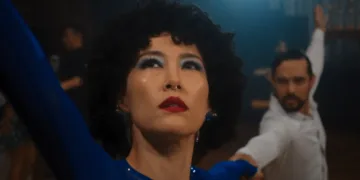



























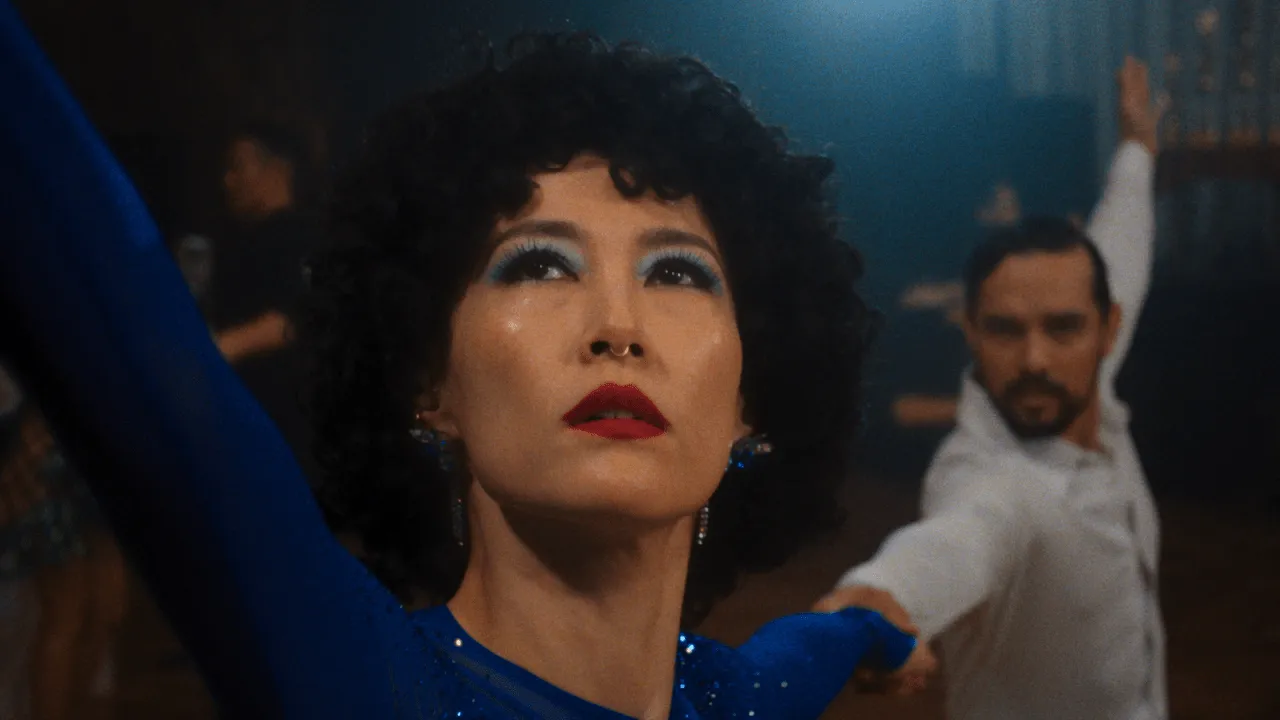

The Tokyo ballroom dancing scene runs on sequins, discipline, and posture that looks almost architectural. Haru and her Mexican husband, Luis, live inside that culture, working the amateur Latin senior circuit with a shared rhythm that reads as devotion and routine in equal measure. The film builds their partnership as the pillar holding up Haru’s sense of self, so Luis collapsing mid-competition lands like a structural failure rather than a plot twist.
After his death, the story pivots away from the glare of the floor and into the muted air of Haru’s self-imposed shutdown. She stays inside for nine months, and her bubble-permed “fro” becomes a blunt visual cue for stasis: a choice to remain fixed in the moment where life stopped making sense.
That long pause matters because the script refuses the familiar drama cadence of quick recovery beats and tidy breakthroughs. It watches what grief looks like when time keeps moving and the person refuses to move with it. The first real pressure on that stillness comes from family. Haru’s conservative sister, Yuki, and her foul-mouthed cousin, Hiromi, decide mourning has hit its end date.
They drag her back to the studio with the force of people who know gentleness will get ignored. Haru’s re-entry into the dance world is framed as disorientation. She returns to a space built for pairs, only to find herself trying to locate the rules of a life that no longer contains her partner.
The Architecture of Memory and Mascots
Grief here takes the shape of magical realism, and the film uses that approach as a storytelling shortcut with teeth. Haru is visited each night by a giant stuffed crow called the “Kawaii Karasu,” a physical stand-in for Luis that shows up in her home like a permanent guest. The crow plays as a cuddly, oversized mascot, and it dances with her in the living room. That choice shifts the language of loss away from speeches and toward presence. The film lets sorrow occupy space, bump up against furniture, and demand attention in the same rooms where ordinary life is supposed to resume.
Haru’s home supports that idea by functioning like a carefully arranged museum of the life she and Luis built together. Sarapes sit alongside an extensive vinyl collection and the medals from their competitive years. Each object pins her to a past that feels more solid than the present, and the mise-en-scène turns memory into set design you can walk through. This is character work delivered through props, and it keeps Haru’s interior life legible even during stretches when she says little.
Also Read





The story also frames her life as a lived cultural patchwork that brings real friction once death introduces logistics and ritual. Luis’s father insists on returning Luis’s body to Mexico for burial. Haru holds tight to her belief in traditional Japanese cremation. That clash is not treated like a debate to be “won.”
It plays as the kind of conflict that grief tends to amplify: two value systems, two forms of care, two versions of what respect looks like. Haru’s attachment to 70s fashion and analog records extends the same idea. She dresses and listens in a way that signals a refusal to join the present tense, and the film makes that refusal visible without requiring her to narrate it.
The Kawaii Karasu becomes the cleanest expression of the film’s method. The crow eliminates the need for heavy explanation by translating sorrow into a surreal companion that shares the house with the souvenirs, the silence, and the routines Haru cannot release.
Performative Healing and Romantic Complications
Rinko Kikuchi carries the film through a performance built on physicality. Her Haru communicates through posture, timing, and the small decisions bodies make under stress. The performance holds the weight of loss in her stillness, then punctures it with bursts of goofy, impulsive physical comedy. That oscillation does important narrative labor. It keeps Haru from becoming a static emblem of mourning, and it allows the film to show how grief can coexist with messy, human reactions that arrive without permission.
Haru’s forward motion begins with Fedir, a charismatic dance instructor played by Alberto Guerra. The film uses his arrival as a structural hinge: a new partner enters the frame, and the story tests what Haru does with attraction, attention, and the chance to be seen again. Haru falls for him quickly, and that speed reads less like romance and more like hunger for contact after months of isolation.
The script complicates that return by giving Haru a string of questionable choices. She tells Fedir that Luis is still alive, a lie that becomes her way of managing Fedir’s tangled romantic situation. His life includes an open marriage, and Haru struggles to make sense of it. That gap in understanding is not played as a cute cultural misunderstanding. It becomes fuel for bad decisions. The deception sets off a messy pursuit driven by jealousy, impulse, and raw need, and the film treats those behaviors as symptoms of a mind scraping for stability.
Hiromi provides the story with the friction it needs to keep Haru honest. She stands out as the character willing to say the blunt thing, armed with a kind of New York-seasoned wisdom that pushes Haru toward action even when the action is chaotic. The supporting dynamic matters because the film positions healing as something that happens in company, through irritation and argument as much as comfort.
The scenes between Haru and Fedir are staged with little sentimentality. Their connection reads like a collision of lust, professional admiration, and a craving for distraction that feels urgent in the wake of loss. That mix makes the relationship feel fragile and human, shaped by imperfect motives that the film has no interest in sanding down.
Cultural Fusion and Stylistic Shifts
Josef Kubota Wladyka shifts away from the grit of his previous thrillers and leans into a tone that holds whimsy and emotional weight in the same hand. That shift tracks with what the film wants formally: a domestic drama that accepts surreal intrusions as part of daily life. The direction treats the magical elements with the same plain sincerity it gives the quiet scenes at home, and that consistency keeps the film from feeling split between modes.
Language becomes part of the design. The film moves through Japanese, Spanish, and English, letting characters drift across tongues as naturally as they drift across moods. That trilingual flow mirrors Haru’s lived reality, and it reinforces the sense that her marriage with Luis created a home assembled from multiple cultural materials. The linguistic movement also shapes rhythm. Conversations carry pauses, switches, and small recalibrations that echo Haru’s attempt to recalibrate herself.
Dance functions as more than decoration in the narrative engine. The sequences play as kinetic releases for feelings the characters cannot articulate cleanly. Movement becomes dialogue, especially in a story where silence has real weight. One sequence on a Tokyo commuter train uses practical effects to transform an ordinary commute into an illusory performance.
The film stages the fantasy with a tactile quality, as if imagination has its own stage crew. Another moment nods to the iconic lift from Dirty Dancing, filtered through Haru’s own perception. That framing matters because the reference becomes part of her subjective experience rather than a wink to the audience.
Music controls the emotional pacing as Haru shifts between internal states. The soundtrack moves from Latin rhythms to analog pop, tracking the push and pull between the dance world that formed her marriage and the private world of memory she has curated at home. Wladyka avoids a clean, linear shape for recovery. Haru stumbles, spikes into erratic energy, then falls back into uncertainty.
The structure aligns with that pattern, favoring character psychology over neat genre mechanics. It is a film that keeps returning to the same question through different forms: how a life built around partnership rewrites itself after the partner is gone, and how the story can show that rewrite without pretending it happens in a straight line.
Ha-chan: Shake Your Booty! made its world premiere on January 22, 2026, at the Sundance Film Festival, where it quickly became a standout title, earning director Josef Kubota Wladyka the Directing Award in the U.S. Dramatic Competition. Following its successful festival run, Sony Pictures Classics acquired the worldwide distribution rights to the film. While it is not yet available on streaming platforms, it is expected to have a theatrical release later this year through Sony’s distribution network.
Full Credits
Title: Ha-chan: Shake Your Booty!
Distributor: Sony Pictures Classics
Release date: January 22, 2026 (Sundance Film Festival Premiere)
Running time: 122 minutes
Director: Josef Kubota Wladyka
Writers: Josef Kubota Wladyka, Nicholas Huynh
Producers and Executive Producers: Kimberly Parker Zox, Mao Nagakura, Josef Kubota Wladyka, James Hausler, Rinko Kikuchi, Kenji Ito
Cast: Rinko Kikuchi, Alberto Guerra, Alejandro Edda, YOU, Yoh Yoshida, Damián Alcázar, Charley Flyte, Soji Arai, Chelsea Gonzalez, Derek Mio
Director of Photography (Cinematographer): Daniel Satinoff
Editors: Benjamin Rodriguez, Jr.
Composer: Nathan Halpern
The Review
Ha-chan: Shake Your Booty!
This film is a rhythmic exploration of loss that succeeds by embracing the surreal. While the tonal shifts between absurdist humor and deep mourning are occasionally jarring, Rinko Kikuchi’s expressive performance provides a steady pulse. It avoids the safety of the standard crowd-pleaser, opting instead for a messy, trilingual, and visually inventive look at how we carry our ghosts. Even when the plot meanders, the sincerity of its tribute to the resilience of the human spirit makes it a standout.
PROS
- Rinko Kikuchi’s nuanced physical performance.
- Unique blend of Japanese and Latin cultures.
- Imaginative use of magical realism and symbolism.
- Energetic and creative dance choreography.
CONS
- Occasional pacing issues in the second act.
- Tonal shifts may feel abrupt to some.
- Certain plot threads regarding finances are ignored.
- The "open marriage" subplot is somewhat underdeveloped.