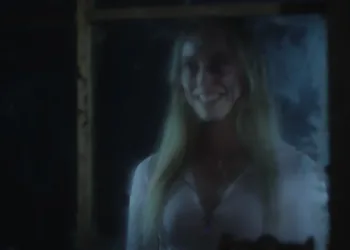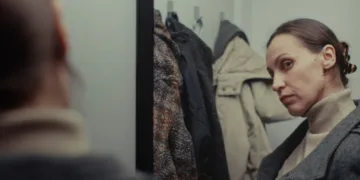


























Prime Video opens with a scene engineered to feel like a headline ripped from the anxiety of the present day. Boston police enter a high-end apartment and find a body dissolved in a bathtub, reduced by chemical dissolution to something unrecognizable. From there, the series rewinds fifty-six days to a grocery store meeting that reads like the start of a contemporary urban fable about class, desire, and self-invention.
Ciara Wyse arrives with the pressure of working life written into her circumstances: she works in IT and sleeps in a cramped attic. Oliver Kennedy sits high above that reality, a wealthy architect backed by old money and the quiet confidence that comes with it. Their attraction sparks fast, and they move in together within a week, a decision the show treats as the first crack in the façade. The suspense grows out of that speed. Romance becomes a risk factor, and intimacy becomes evidence.
The series tracks their relationship through a strict timeline as the police investigation unfolds in the present. Each memory from the romance carries a matching forensic trace, turning private gestures into future exhibits. Deception defines the bond from the first moments, with both leads hiding their intentions and shaping the truth to fit the person they want to be seen as. The sterile high-rise apartment works like a theatrical set for a relationship built on performance, control, and misread signals. The result is a slow, deliberate unspooling of how an ordinary encounter can end as a crime scene, and how quickly people accept a story that flatters them.
The Dual Timeline Structure and Mechanics of Suspense
The storytelling runs on a split design that echoes the fractured way streaming audiences often consume a series. One thread traces the fifty-six-day countdown of the relationship. The other stays within a single day of police work.
The show uses this arrangement to feed misdirection at a steady pace, letting present-day forensic discoveries reframe earlier romantic beats with a new sense of threat. Day markers do heavy lifting here. Each timestamp functions like a warning label, reminding viewers that time is shrinking and that the ending has already happened, even if the characters behave like it has not.
The removal of the pandemic setting from the original novel is presented as a deliberate recalibration. The story’s pressure no longer comes from a global emergency. It comes from personal decisions and the ways people justify them. With no external lockdown to explain sudden cohabitation, the characters manufacture their own logic for moving too fast. That shift pushes responsibility onto them, and it makes their choices feel like a portrait of modern isolation that people opt into, then defend as romance.
The series also withholds the identities of the victim and the killer through careful control of information. Viewers watch through two unreliable narrators, and the show treats truth as unstable, shaped by who controls the story at a given moment. That approach aligns with a trend in digital storytelling where certainty keeps slipping, and each new piece of data forces a new interpretation. The pacing depends on these pivots, keeping the bathtub remains in the foreground as a question that contaminates every affectionate moment.
This structure also changes what a “procedural” means. The romance carries the same weight as the investigation, and the ticking clock binds them together. The series uses that clock to stress how fragile a connection becomes when it rests on false premises and curated selves. With isolation framed as choice, the toxic bond feels intentional, built day by day with a kind of grim care.
The Psychology of Deceit: Lead Character Profiles
Dove Cameron plays Ciara Wyse with a deliberate split between surface and strategy. She presents herself as a naive newcomer to Boston, then reveals a quieter, sharper presence underneath: a watcher who studies and records. Ciara uses a false name and keeps a secret notebook tracking Oliver’s habits, turning observation into an instrument of control.

Her performed vulnerability becomes her entry point into his life, and the series uses that performance to speak to a shift in how thrillers portray female agency. Ciara’s agency reads as calculated and predatory, packaged in a familiar cultural script that expects women to be harmless, especially when they look like they need saving.
Avan Jogia plays Oliver Kennedy as someone imprisoned by status and whatever he carries behind it. Oliver has hidden trauma and leans on heavy sedatives to keep functioning. His wealth protects him from certain consequences, yet it also intensifies his paranoia, feeding the sense that his life is both curated and under threat. His rapid attachment to Ciara springs from fear of his own history, and the show frames that fear as a vulnerability that privilege cannot buy its way out of.
Their relationship plays as a power struggle with class embedded in the smallest exchanges. Ciara’s working-class background creates friction that Oliver tries to erase with expensive dates, as if money can translate experience into comfort. They weaponize therapy-related language against each other, using the vocabulary of healing as leverage. That therapy-speak points to a social shift in dating culture, where emotional tools circulate widely and can be deployed as tactics, especially in relationships driven by image management and control.
The chemistry between Cameron and Jogia is built from that tension. Their physical connection registers as less important than the mental contest: who sets the narrative, who gets believed, who gets to rename the other person’s feelings. The casting of two former child stars adds a meta edge to the story’s fixation on persona. Public identity becomes another mask in a series already crowded with masks, hinting that everyone is trained, in one way or another, to perform a version of themselves that sells.
The show also studies how socioeconomic privilege can hide dangerous instability behind polished surfaces. Oliver’s high-rise life functions like a cage he designed for himself, sleek and controlled, yet isolating. Ciara’s arrival becomes a systematic dismantling of that structure, as if she’s testing how much of his stability is architecture and how much is denial.
Their scenes argue that authentic connection collapses when secrets become currency and trust becomes a negotiation. The script refuses simple hero framing. Both characters read as flawed, driven by survival and revenge, and that moral greyness reflects the streaming-era preference for protagonists who invite judgment and empathy in the same breath.
The Forensic Investigation and Boston Setting
Detectives Karl Connolly and Lee Reardon operate as a skeptical counterbalance to the central romance. Dorian Missick and Karla Souza play the partnership with the fatigue of people who have watched too many tragedies repeat, and their scenes bring dark humor into a case that begins with a grotesque spectacle.

The bathtub discovery is treated as a forensic nightmare, with the chemical destruction of the body pointing toward a methodical mind and a willingness to turn science into erasure. The procedural elements move with restraint, using Boston as more than backdrop and letting the city’s mood seep into the work.
Boston’s architecture becomes visual shorthand for class separation. Oliver’s apartment is minimalist luxury, cold and impersonal, an environment that reads like wealth trying to remove all traces of mess. The contrast with Ciara’s starting point, a termite-infested attic, is blunt and physical, framing class as lived space rather than abstract talking point. High-end real estate turns into a character in its own right, representing sterile insulation and the illusion that money can keep the world outside the door.
Supporting figures deepen the motive web around the leads. A persistent journalist follows Oliver, aiming to expose his past. Oliver’s mother signals the emotional distance associated with the upper class, a reminder that wealth can train people to treat feeling as inconvenience. These characters expand the social frame without leaving the mystery behind, grounding personal obsession in a broader picture of reputation management and inherited power.
The investigation progresses slowly, then peels back the rot beneath the city’s clean surfaces. The detective thread also carries an industry-facing critique, aimed at the entertainment machine’s fixation on beautiful corpses and sanitized brutality. The show draws attention to the labor of truth-seeking: the work of processing a scene, sifting facts, and resisting the seductive simplicity of a story that feels resolved too early.
Connolly and Reardon’s partnership feels lived-in and credible, and their personal struggles echo the loneliness that shapes the lead characters’ choices. Their presence keeps consequences close, functioning as a constant reminder that the romance cannot float above reality without eventually crashing into it.
Themes of Obsession and Erotic Thriller Conventions
The series situates itself in the erotic thriller tradition and aims to update its familiar moves. Physical intimacy becomes a mechanism of deception, using sex as leverage and misdirection. The meet-cute is reworked into something predatory, reflecting a cultural skepticism about romance narratives that reward speed and call it fate. The show treats obsession as a modern condition: the urge to possess, to rewrite, to control, and to treat another person as a project that proves something about the self.
Unresolved trauma sits beneath that obsession, shaping how characters justify extreme acts of violence or control. The series links that drive to the social performance demanded in dating and in class mobility, where people learn to sell a story about who they are, then panic when the story starts to crack. Socioeconomic privilege is central here. It offers cover, letting characters present respectability as camouflage, even as instability grows underneath.
The visual approach supports the moral split created by the timelines. Early romance scenes carry warm tones, giving the relationship an inviting glow that encourages viewers to understand the rush. Investigation scenes shift into cold, clinical blues, turning the same environment into a place of extraction and judgment. Set design reinforces the gap between perception and reality, making the apartment feel like a controlled display case that cannot hide what happens inside it.
The series favors psychological tension over action beats, signaling a streaming-era taste for thriller pacing that runs on implication, suspicion, and the slow redefinition of what each scene meant. It raises a blunt question about relationships built on lies and the possibility of any path toward truth inside that structure.
The choice to leave pandemic themes behind, in favor of timeless human flaws, suggests where future trends may go: thrillers that treat isolation as personal choice, and that frame the “perfect couple” myth as a cultural danger sign rather than a fantasy worth chasing. By the final stretch, the narrative keeps circling back to reinvention and its cost, pushing the audience to look past beauty and wealth and to consider what it means to consume violence as entertainment.
The psychological thriller series 56 Days premiered today, February 18, 2026, exclusively on Prime Video. Based on the acclaimed novel by Catherine Ryan Howard, the story unfolds in present-day Boston, deviating from the book’s original pandemic setting to focus on a high-stakes game of intimacy and secrets. The narrative follows Ciara Wyse and Oliver Kennedy, who move in together shortly after a chance meeting in a grocery store. Their whirlwind romance is juxtaposed with a grim discovery fifty-six days later, when a body is found dissolved in a bathtub in Oliver’s apartment. As detectives Karl Connolly and Lee Reardon investigate the gruesome scene, the series unspools the layers of deception and hidden identities that defined the couple’s relationship from the very beginning.
Where to Watch 56 Days Online




Full Credits
Title: 56 Days
Distributor: Amazon Prime Video
Release date: February 18, 2026
Rating: TV-MA
Running time: 45 minutes
Director: Alethea Jones, Shana Stein, Lauren Wolkstein, Jessica Yu
Writers: Karyn Usher, Lisa Zwerling, Brandon K. Hines, Janet Lin, Michael Broady, Alexandra Cunningham
Producers and Executive Producers: Karyn Usher, Lisa Zwerling, James Wan, Michael Clear, Rob Hackett, Sandrine Gros d’Aillon, Danielle Bozzone, Sharon Lopez, Catherine Ryan Howard
Cast: Dove Cameron, Avan Jogia, Dorian Missick, Karla Souza, Megan Peta Hill, Patch Darragh, Kira Guloien, Celeste Oliva, Jesse James Keitel, Matt Murray
Director of Photography (Cinematographer): Nathaniel Goodman, Tobie Marier-Robitaille
Editors: Maxime Lahaie, Véronique Barbe
Composer: Nathan Barr
The Review
56 Days
56 Days provides a cynical look at modern connection. It trades the pandemic origins of its source for a cold analysis of class and identity. The central mystery remains effective through its dual timeline. While the romance lacks deep emotional weight, the performances of Dove Cameron and Avan Jogia provide enough magnetism to sustain interest. It serves as a stark reminder that every high-rise paradise can hide a chemical nightmare. It is a stylish yet hollow exercise in deception.
PROS
- Magnetic lead performances by Dove Cameron and Avan Jogia.
- Effective use of the dual timeline structure to build suspense.
- A visceral and memorable opening scene.
- Sharp critique of socioeconomic privilege and class friction.
CONS
- Limited emotional depth within the central romance.
- Predictable procedural elements in the police storyline.
- Occasional lapses in logic regarding character surveillance.