













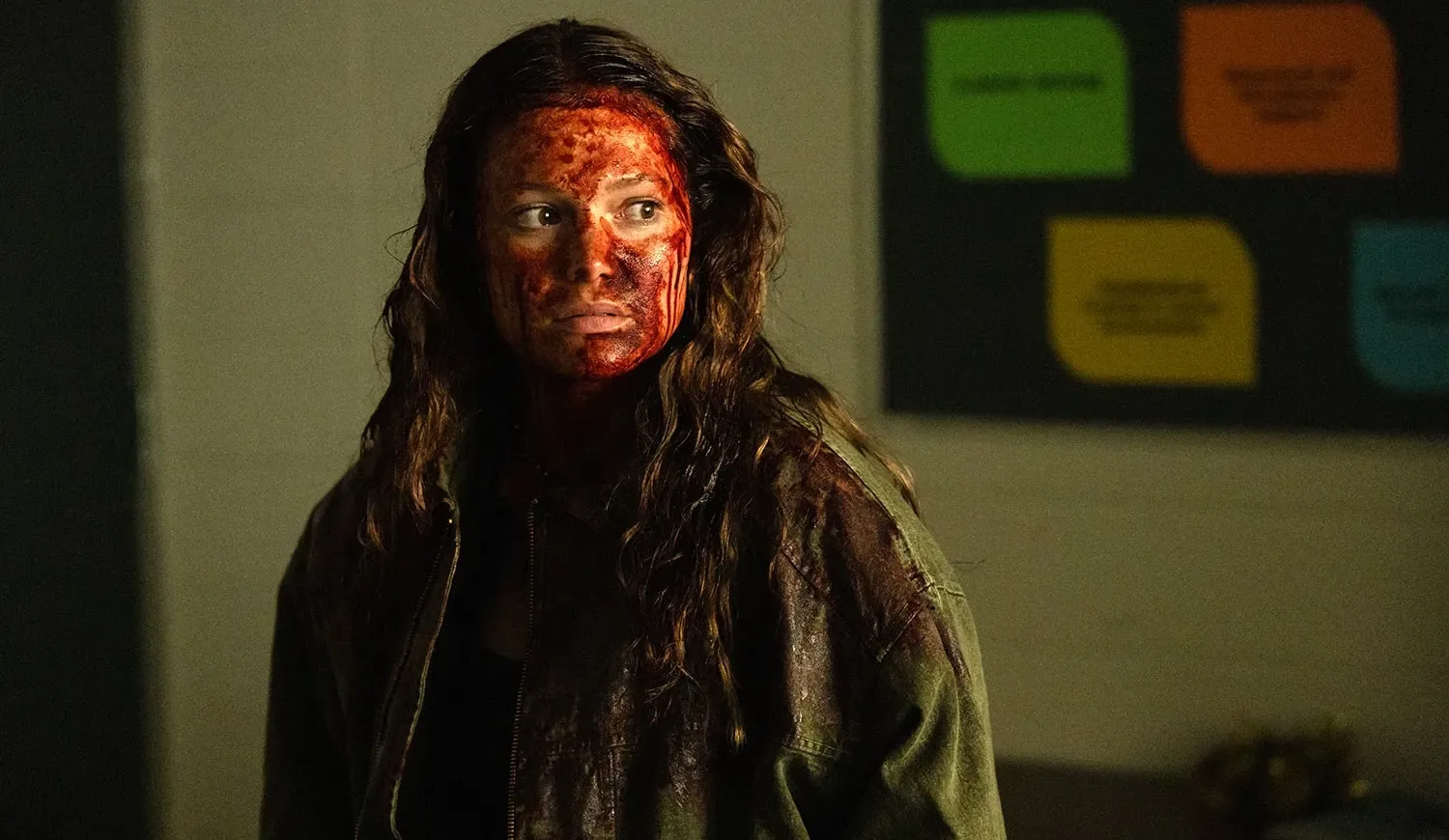

The bathtub in Cortez functions as a grim threshold, a place where Sloane Price holds herself in suspended animation. Her plan to exit the world is measured down to the moment, calibrated with the care of someone trying to control the last decision available.
Adam MacDonald frames that timing with a cold, clinical irony: the world breaks first. Violence erupts in this 1990s Canadian town and crashes straight through what had been a private ritual of despair. Televised warnings never arrive. The realization does not unfold gradually. Analog quiet gets punctured by the frantic speed of the infected.
These predators move with jagged, unnatural kineticism, turning quiet suburban streets into something unrecognizable. The film’s sense of place stays tactile, anchored in physical media and the loneliness of a pre-digital age. When Sloane retreats into the local high school, the shift offers containment, not comfort.
Confinement changes shape. She gets pushed into a collective struggle for a life she had already discarded in her mind. A building built for social performance becomes a claustrophobic fortress, and the architecture of adolescence gets repurposed for the grim labor of barricading.
The Friction of Shattered Identities
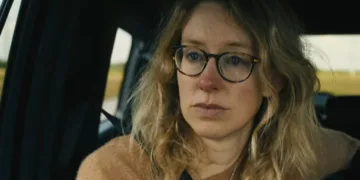
Inside the school’s hallways, teenage hierarchy survives the collapse, warped under siege pressure. Sloane sits at the focal point of that distortion, defined by profound numbness. The narrative treats her depression like a physical weight that drags through each scene, present as sensation and posture, not as a tidy problem waiting for a solution.
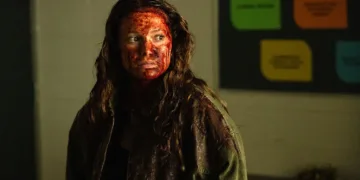
Her history with an abusive father and the void left by her sister Lily shape her internal terrain. Olivia Holt plays this with a stillness that refuses easy cues. Sloane remains hard to reach. The performance reflects trauma as an ongoing condition that keeps breathing after the event that caused it.
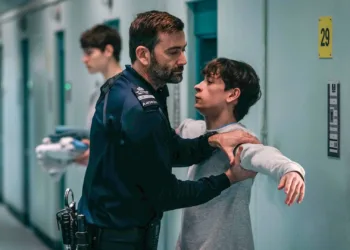
The survivors around her embody different methods of endurance at the edge of collapse. Cary operates as the group’s pragmatic engine, making decisions with cool, detached logic. The film links that posture to leadership, and leadership reads like emotional insulation, a way to keep feeling at a manageable distance. Rhys brings visible kindness into the room, and guilt shadows his actions with a weight that matches the threat outside.
The twins, Trace and Grace, carry grief in its rawest form, their presence keeping the vanished world close and immediate. Mr. Baxter, their English teacher, complicates the group with a subtle predatory discomfort that comes from something entirely human. He signals how thoroughly the adult world fails as sanctuary. Authority looks hollow in empty classrooms, and the usual assurances attached to adulthood fall apart under fluorescent light.
The friction inside the group stays rooted in small, grinding realities. These people were strangers before the blood hit the snow. The siege turns every gesture, every decision, every glance into an act with consequences, and the film watches those consequences accumulate in the corners.
Aesthetic Dissonance and the Architecture of the Siege
MacDonald’s directorial eye finds beauty in carnage through sharp visual contrast. Vivid red blood against stark, pale Canadian snow creates an aesthetic of high-contrast violence that lingers in the mind like an afterimage. Inside the school, the film leans into deceptive serenity.
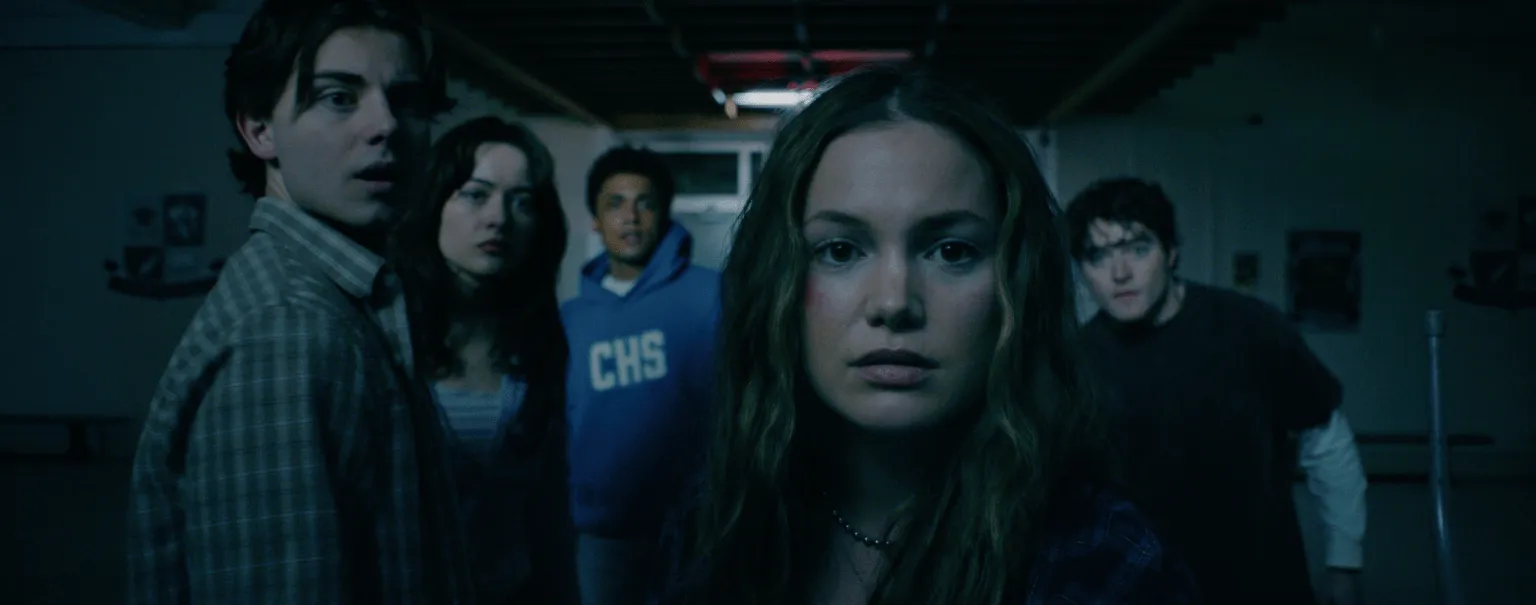
Natural light pours through windows, catching dust motes and illuminating the mundane remains of student life. The pastoral calm inside the building clashes with the screams at the perimeter, and that clash becomes its own kind of dread. The school turns into a microcosm where the familiar becomes uncanny. Locker-lined hallways and empty cafeterias stop functioning as spaces of transit and start reading like tactical terrain.
The first act’s structure intensifies that displacement. The film bounces between the immediate chaos of the outbreak and the stagnant tension of the barricaded school, fracturing the usual forward march of survival horror. That fragmentation mirrors the survivors’ psychological state: the past hurts, and the future opens as blank space. Time inside the building goes slippery.
Days blur into a continuous loop of checking locks and listening to the dead. The pacing carries the boredom of waiting and the dread of listening, then snaps into violent momentum when action arrives. Those bursts feel invasive against long stretches of quiet. The silences remain spacious, forcing the audience to sit in the same emotional stasis as the characters, trapped inside a building that keeps insisting on normalcy through its layout and light.
The Refusal of Heroic Catharsis
The film’s closing inquiry turns toward the validity of survival when hope has been drained out of the equation. Genre convention often treats catastrophe as a clean mechanism for self-discovery, an event that forges meaning through pressure. This story refuses that comfort. Sloane never becomes a triumphant warrior.
Her internal struggle stays messy and unresolved, shaped by old wounds that do not evaporate because the world is ending. The apocalypse offers no clarity. It removes distractions and leaves the existing misery exposed at full scale. That commitment to emotional honesty becomes the film’s defining quality, and it sharpens its cultural critique: the end of the world does not guarantee revelation, and suffering does not transform into purpose on schedule.
Adolescence appears here as literal horror, a “test” with stakes raised to extinction. The transition to adulthood arrives through the absolute removal of safety. The characters move through a landscape where maps have been burned and guides have become dead or dangerous. MacDonald’s script chooses subtraction over escalation.
It strips away easy answers and holds the line against a resolution that repairs Sloane into something reassuring. The ending registers as continued existence, not victory. The characters remain inconsistent and flawed, and the film protects that instability because traditional heroics would erode it.
A critique sits beneath the carnage: survival gets treated as a moral good by default in so much genre storytelling, and this film presses on that assumption until it starts to crack. It asks what remains after the desire for life has already been exhausted, then leaves the question hanging in the cold air of Cortez, where the snow keeps absorbing red and the school keeps standing like a monument to the performances it used to demand.
This Is Not a Test is an apocalyptic survival thriller based on the popular young adult novel by Courtney Summers. After a successful festival run in late 2025, including a premiere at the Brooklyn Horror Film Festival, the film is set to make its wide theatrical debut on February 20, 2026. Distributed by Independent Film Company and Shudder, audiences can watch the film in theaters upon its release, with a streaming premiere on the Shudder platform expected to follow shortly after.
Where to Watch This Is Not a Test (2026) Online









Full Credits
Title: This Is Not a Test
Distributor: Independent Film Company, Shudder
Release date: February 20, 2026
Rating: R
Running time: 102 minutes
Director: Adam MacDonald
Writers: Adam MacDonald, Courtney Summers
Producers and Executive Producers: Cybill Lui, Adam MacDonald, Courtney Summers, Luke Taylor, Michael Sklut, James Huntsman, Ian Goggins
Cast: Olivia Holt, Froy Gutierrez, Carson MacCormac, Luke Macfarlane, Corteon Moore, Joelle Farrow, Jeff Roop, Missy Peregrym, Chloe Avakian
Director of Photography (Cinematographer): Christian Bielz
Editors: Pamela Bayne
Composer: Lee Malia
The Review
This Is Not a Test
This Is Not a Test is a stark exploration of emotional paralysis that uses the zombie genre as a violent backdrop for personal collapse. While the supporting cast lacks the depth afforded to its lead, the film succeeds through Olivia Holt’s restrained performance and Adam MacDonald’s keen eye for atmospheric tension. It deliberately avoids the comfort of easy heroics, opting instead for a gritty, unvarnished look at the intersection of trauma and survival. Despite its reliance on certain genre staples, its commitment to emotional honesty ensures that the horror remains grounded in a recognizable human struggle.
PROS
- Olivia Holt delivers a powerhouse performance defined by subtle, brittle restraint.
- The cinematography captures a hauntingly beautiful contrast between gore and the winter landscape.
- The initial outbreak sequence provides a chaotic, tactile sense of global collapse.
- The narrative avoids the trap of forced, inspirational character growth.
CONS
- Supporting characters feel like archetypes rather than fully realized individuals.
- The non-linear structure in the first act can momentarily dilute the tension.
- Certain plot points, such as the predatory adult trope, feel derivative of lesser genre works.
- The pacing inside the school occasionally drags under the weight of its own stillness.