


















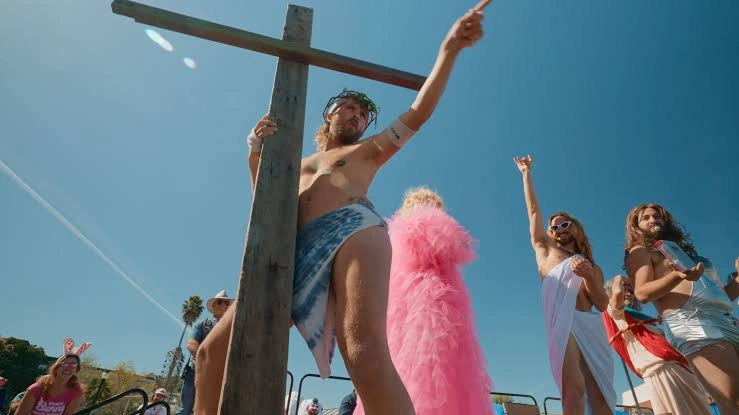

A loincloth, a fake beard, a pole, and a cross can turn Dolores Park into a theological argument before anyone has said a word. Jennifer M. Kroot’s Hunky Jesus understands that its title event is funny because it is excessive, and political because that excess happens in public.
The annual Easter celebration staged by the Sisters of Perpetual Indulgence in San Francisco brings thousands together for drag numbers, the Foxy Mary contest, and the titular search for the hunkiest Jesus. It looks, at first glance, like sacrilege in glitter.
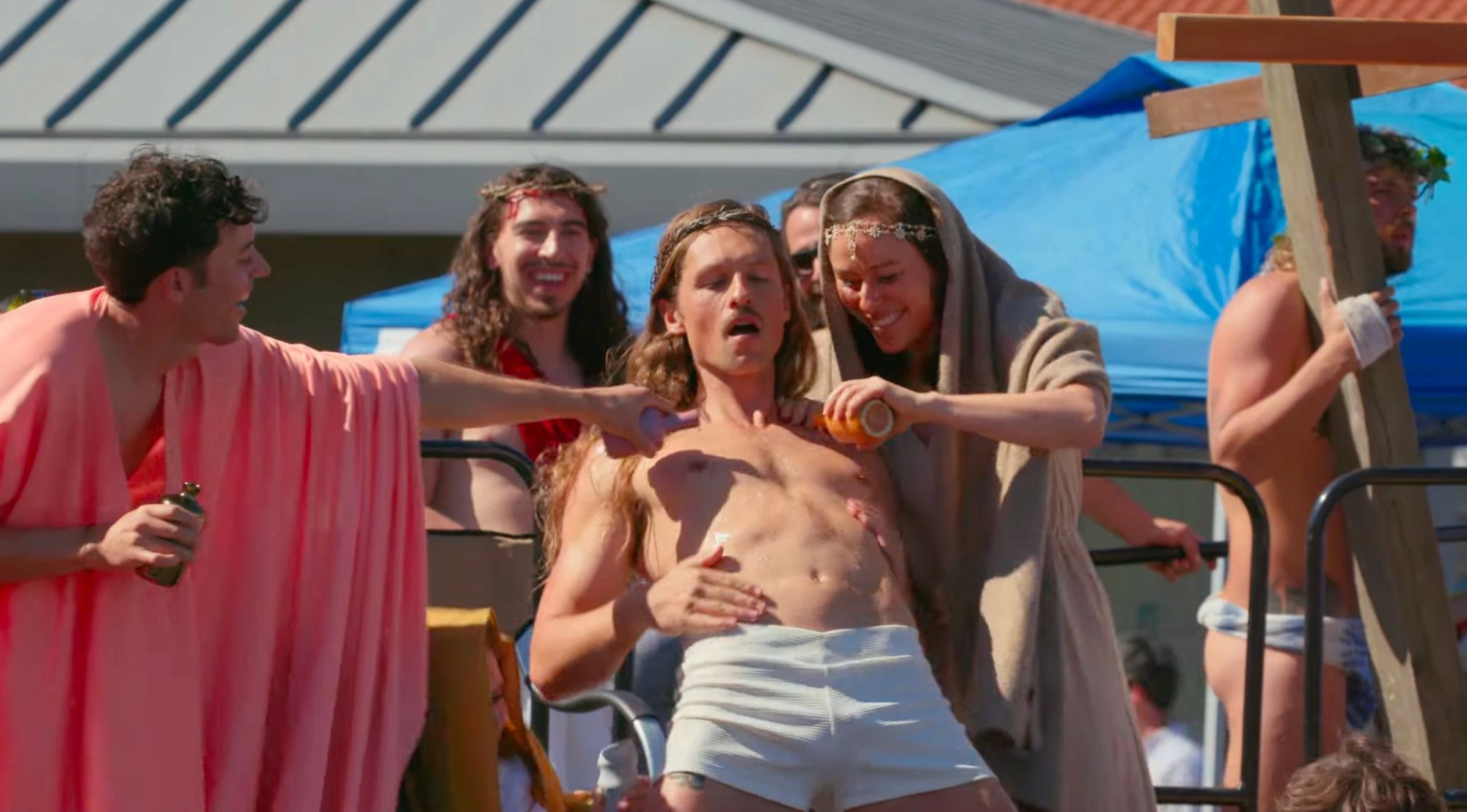
George Takei’s narration gives the film a genial guide through material that could have been framed as provocation alone. Kroot has no interest in sanding down the event’s sexual charge. Contestants writhe, pose, joke about being nailed, and treat Christian iconography with the kind of bodily freedom that many churches have spent centuries policing. The film’s first strong move is to let the carnival remain a carnival. It does not ask the Sisters to become respectable before granting them seriousness.
That matters because the event belongs to a specifically San Franciscan history, shaped by street performance, queer activism, Catholic imagery, and the city’s long habit of turning public space into argument. A similar event in another culture would carry a different voltage. Here, Easter becomes a civic ritual for people who were often told they had no place in religious ritual at all.
The Nuns Behind the Joke
Kroot structures the film around the 2023 gathering, then moves backward through archival footage, interviews, and cheeky animation to trace the Sisters from their 1979 origins. The founding image has a folkloric simplicity: queer men walking through San Francisco in nuns’ habits, using borrowed religious costume as satire, shield, and invitation. The outfit is the joke. The outfit is also the door.
Sister Roma, Grand Mother Vish-Knew, Sister Dana Iniquity, Sister Flora Goodthyme, and Honey Mahogany give the documentary its human texture. Their names sound like punchlines, yet their stories carry the weight of institutions that failed them.
Also Read





Several speak about growing up inside Catholic, Presbyterian, or Amish Mennonite worlds where queer identity was treated as a sin, a sickness, or an exile notice. Accounts of conversion therapy, suicidal thoughts, family rejection, and spiritual rupture are placed beside footage of public laughter, which gives the joy a harder edge.
The film is strongest when it shows the Sisters translating camp into labor. During the AIDS crisis, they offered information, companionship, and advocacy to people left frightened and alone. Later work includes charity fundraising, refugee donation drives, wigs for cancer patients, protests, and community support. In another national cinema tradition, such work might be staged through solemn martyrdom. Kroot’s subject resists that grammar. Service here arrives in whiteface, sequins, and a pun so filthy it practically files paperwork.
Faith in Costume
The film’s richest argument comes from its comparison between religious ceremony and drag performance. Both rely on costume, repetition, symbolic gesture, music, role-play, and a community prepared to believe in what it is seeing. A nun’s habit signals devotion in one setting and satire in another, yet the visual language is shared. Kroot lets that shared language sit on screen without overexplaining it.
The controversy around the event is treated with enough attention to keep the film from becoming self-congratulation. Clips of angry commentators and church figures show the familiar charge: the Sisters mock faith, sexualize Christ, and turn Easter into spectacle.
Father Daniel Godfrey of the University of San Francisco becomes one of the film’s most useful voices because he does not fit the easiest polemical category. He recognizes the Sisters’ joy and care while expressing discomfort with the sexualized imagery around Jesus.
That discomfort is not dismissed, and the film benefits from letting it breathe. “You don’t own Jesus. You don’t own Easter” becomes the Sisters’ cleanest counterargument, yet Kroot’s documentary suggests something subtler than ownership. It asks who gets access to sacred symbols after those symbols have been used to shame them. The Foxy Mary contestants, some shaped by the political grief around Roe v. Wade, sharpen that question. Mary drag here is comedy, protest, and reclamation in the same costume change.
Joy With Loose Edges
Kroot’s camera loves the crowd, sometimes too much. The Dolores Park footage catches a field of bodies cheering, flirting, voting, and laughing, with costumes and banners turning the frame into a living collage. The film gains rhythm when it cuts from that present-day celebration to stories from the AIDS years or the Sisters’ charity work, since those shifts show why the party has lasted. The contest is not the whole ministry. It is the part with better lighting and fewer grant applications.
The weaker passages arrive when the documentary stays too long in celebration mode. A certain amount of stage footage is necessary; after a while, another cheer from the crowd adds little to what the previous one already gave us. Kroot also lets the Sisters’ own institutional mythology become heavy in spots, which is a slightly odd problem for a film full of fake eyelashes and sacred thirst traps.
Still, the looseness feels tied to the subject’s unruly nature. A tidier documentary might have betrayed the mess, and the mess is part of the point. The Sisters have built a cross-border language of camp, care, and resistance that now reaches chapters far beyond San Francisco, yet the film keeps returning to the local texture of Dolores Park: grass, sweat, jokes, music, bodies, chosen family. The global idea begins in a very specific field, on a very specific Easter, with a crowd ready to crown a Jesus who knows how to work a room.
The American independent documentary feature Hunky Jesus celebrated its world premiere as the Opening Night Gala film at the BFI Flare: London LGBTQIA+ Film Festival on March 18, 2026. Directed by acclaimed documentarian Jennifer M. Kroot, the movie is currently making its way across the global festival circuit with notable summer screenings at major events like Frameline50 in San Francisco and the Provincetown International Film Festival. The unscripted narrative takes audiences behind the scenes of San Francisco’s colorful Easter Sunday tradition hosted by the Sisters of Perpetual Indulgence, weaving the competition’s joyous energy with a deeper history of the legendary drag nun order’s tireless grassroots activism, social justice reform, and community service.
Where to Watch Hunky Jesus (2026) Online
Full Credits
Title: Hunky Jesus
Distributor: Tigerlily Pictures
Release date: March 18, 2026
Running time: 85 minutes
Director: Jennifer M. Kroot
Writers: Documentary film (unscripted/no credited writers)
Producers and Executive Producers: Brian Benson, Gerry Kim, Jennifer M. Kroot, Robert Holgate
Cast: George Takei, Sister Roma, Honey Mahogany, Sister Vish Knew, Sister Bella Donna Summer, Sister Dana Van Equity, Sister Barbara Battista, Donal Godfrey
Director of Photography (Cinematographer): Frazer Bradshaw, Jason Joseffer
Editors: Alex Albers, Bill Weber
Composer: Michael Hearst
The Review
Hunky Jesus
Hunky Jesus is funniest when it trusts the outrageous surface, and strongest when it shows the care work beneath the glitter. Jennifer M. Kroot sometimes lets the Dolores Park celebration run longer than the film can sustain, yet her portrait of the Sisters of Perpetual Indulgence finds real cultural force in costume, satire, charity, and chosen family. The film understands San Francisco as a stage where faith can be reclaimed with a fake beard, a dirty joke, and a crowd willing to believe.
PROS
- Energetic Dolores Park footage
- Strong Sister interviews
- Sharp faith-and-drag parallels
- Rich activist history
- George Takei’s warm narration
CONS
- Repetitive contest footage
- Occasional mythmaking heaviness
- Some ideas need deeper pressure
- Loose structure in places