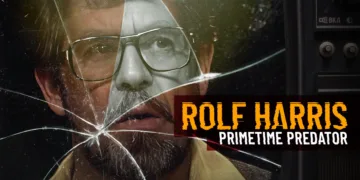





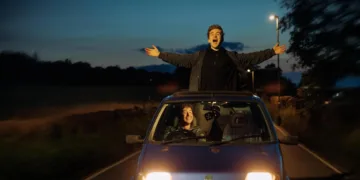

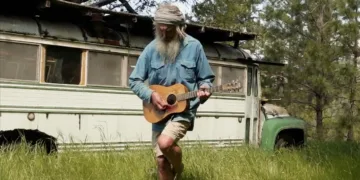











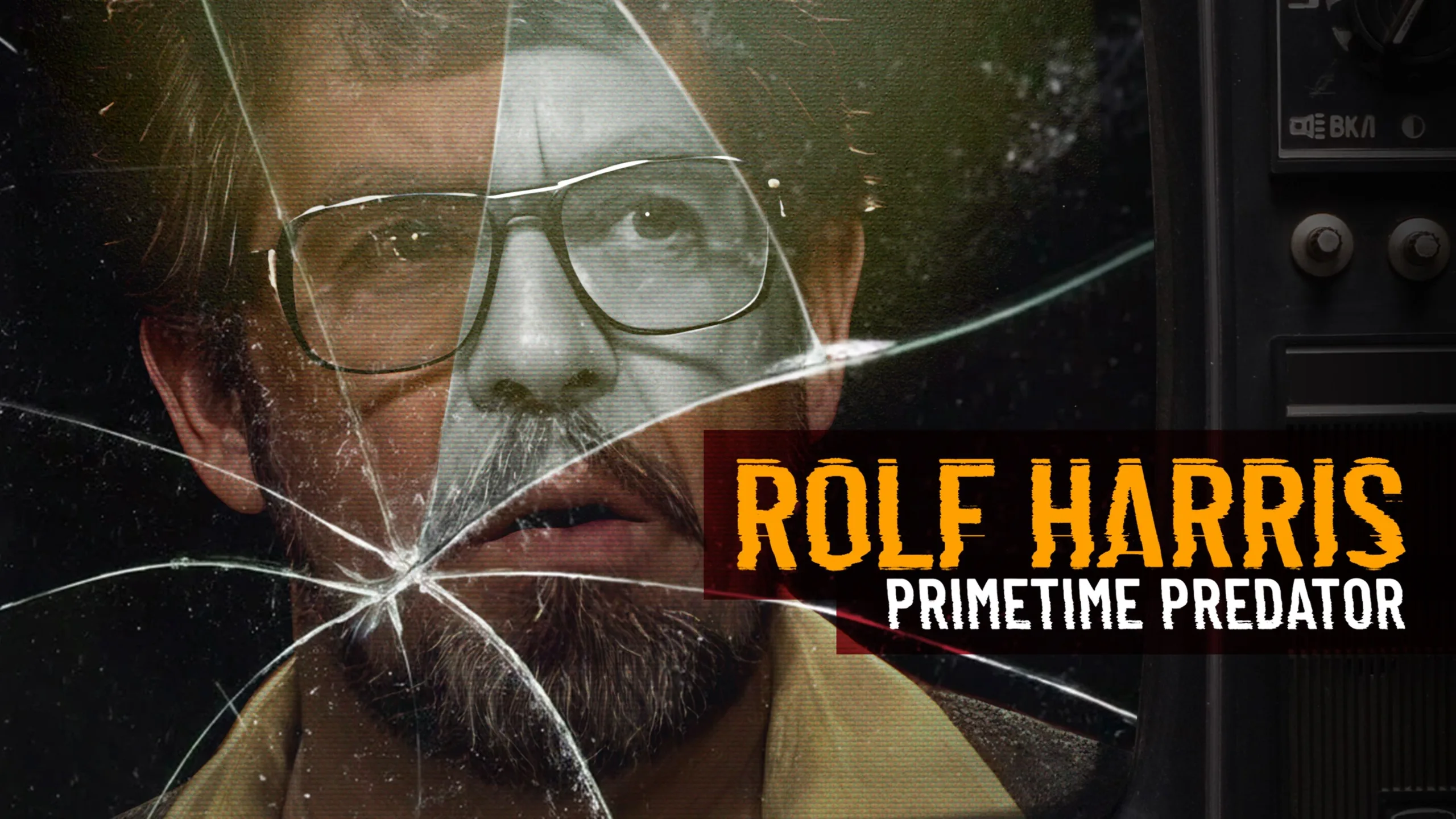

Broadcast archives do much of the prosecuting here. Rolf Harris: Primetime Predator, directed by Nick Sweeney, understands that its most disturbing material is often the footage Harris left behind in plain sight: the wobble board, the novelty songs, the clownish stage routines, the art demonstrations, the children gathered near him while adults smiled from the margins.
The two-part documentary follows the Australian entertainer from light-entertainment fixture to convicted abuser, tracing the persona that made him famous and the protections that made him dangerous. Harris was arrested in 2013 during Operation Yewtree, the investigation launched after the Jimmy Savile scandal, and was convicted in 2014 on 12 counts of indecent assault against four female victims aged between eight and 19. He received a sentence of five years and nine months, served three years, and died in 2023 at 93. The facts are grim. The film’s real work is structural: it asks how a man this visible could remain this protected for so long.
The Cover of Harmlessness
Harris’s public act was built from calculated silliness. “Tie Me Kangaroo Down, Sport” made him a novelty-song star. “Jake the Peg” turned a false leg and a double entendre into family entertainment. The wobble-board version of “Stairway to Heaven” helped return him to public affection in the 1990s, sending him to Glastonbury as a nostalgia act adored by adults who had watched him as children.
Sweeney’s documentary is sharpest when it treats that harmlessness as a mechanism. The film does not need to overstate the point. A clip from Jim’ll Fix It shows Harris alongside Jimmy Savile, assuring him that a child is safe in his “capable hands.” When she moves, Harris tells her to stay and “enjoy it.” The moment plays differently now, of course, but the documentary’s argument is colder than hindsight. The warning was there, broadcast to a nation, and still folded into entertainment.
That is the pattern the film keeps exposing. Harris hosted Kids Can Say No!, a 1985 Australian child-safety campaign, while abusing children. Women at the BBC were reportedly warned not to be alone with him because of his “octopus” tendencies. That phrase is ugly in a precise way. It suggests knowledge without action, risk management without responsibility. The institution did not lack information. It lacked a reason, or the will, to value vulnerable people over a lucrative performer.
Testimony and Damage
The survivor interviews give Primetime Predator its weight, and the film handles them with necessary steadiness. It does not turn pain into spectacle. It lets the women name what happened, what was ignored, and what followed after the cameras and courtrooms moved on.
Also Read



Tonya Lee, who was assaulted at 15 during a theatre tour, speaks with the kind of clarity that comes after years of having to rebuild language around harm. Her account is not framed as one incident in a celebrity case file. It is treated as a rupture that continued into adulthood. Chris, recalling herself at 11 in Darwin, says she wishes she had been taught to push people away. That line lands because it carries a child’s misplaced burden into an adult’s sentence. She is describing failure around her, yet the grammar of regret still points inward.
The documentary returns repeatedly to the same social failure: children were not believed, reports were not taken seriously, women working in studios were left to manage male behavior themselves, and Harris’s fame turned accusation into an obstacle course. The film does not pretend every missed chance was identical. A parent’s disbelief, a police officer’s indifference, and a producer’s warning whispered in a corridor are different kinds of failure. Put together, they form a system efficient enough to protect Harris for decades.
The courtroom material is used sparingly and well. Prosecutor Sasha Wass’s recollection of Harris’s own testimony is devastating because it reveals the scale of his confidence. He did not merely deny. He seemed unable to hear himself the way others could hear him.
The Australian Silence
The series has a clear Australian reason for existing. Harris was convicted in the UK, yet the Australian accounts around him remained far less publicly settled. Several Australian claimants came forward, but no charges were laid in his home country. The documentary treats that absence as part of the story rather than a legal footnote.
Kathy Lette’s description of Australian cultural exports in Britain as the “gum leaf mafia” gives the film one of its useful frames. Harris was not just famous; he was familiar in a national way, packaged with larrikin charm and exported eccentricity. The boy from Bassendean became a British television constant. Familiarity did what it often does in abuse stories: it made people mistake recognition for safety.
Sweeney’s structure is familiar, almost painfully so: career recap, archive footage, survivor testimony, institutional complicity, courtroom aftermath. The film is not formally adventurous. It does not need to be. A flashier shape would risk turning the case into a stylistic exercise, and this material has already suffered enough from people treating performance as cover.
Harris served three years and died at home in a luxury riverside mansion, having offered no meaningful public remorse. Rolf Harris: Primetime Predator cannot correct that imbalance. What it can do, with grim discipline, is lay out the machinery that allowed charm to become camouflage. The delay is part of the crime scene.
The true-crime documentary miniseries Rolf Harris: Primetime Predator premiered on June 9, 2026, making its debut on ABC TV and the streaming network ABC iview in Australia, with international distribution handled by Amazon Prime Video UK. The two-part unscripted series is available to stream on these platforms depending on your region. The investigative narrative chronicles the sudden rise and ultimate downfall of the disgraced Australian entertainer, featuring deeply personal testimonies from survivors to expose how decades of systemic unchecked power, celebrity privilege, and intense nostalgia shielded his long history of abuse from public scrutiny.
Full Credits
Title: Rolf Harris: Primetime Predator
Distributor: ABC, Amazon Prime Video UK
Release date: June 9, 2026
Rating: TV-MA
Running time: 52 minutes per episode
Director: Nick Sweeney
Writers: Nick Sweeney, Kerrie Ritchie, Fiona Evans
Producers and Executive Producers: Karina Holden, John Smithson, Kerrie Ritchie, Fiona Evans, Kirrily Brentnall
Cast: Rolf Harris
Director of Photography (Cinematographer): Northern Pictures Production Crew
Editors: Arrow Media Post-Production Team
Composer: ABC Sound Department
The Review
Rolf Harris: Primetime Predator
Rolf Harris: Primetime Predator is grim, careful, and structurally familiar for a reason: this story now has a template because so many institutions kept handing predators the same tools. Its strongest material is the archive footage, where Harris’s public act curdles in real time, and the survivor testimony, which gives the film its spine. The documentary cannot deliver catharsis. It can document the machinery, name the failures, and refuse to let charm pass for innocence again.
PROS
- Devastating archive footage
- Clear survivor focus
- Strong institutional critique
- Careful two-part structure
- Specific Australian angle
CONS
- Familiar documentary format
- Limited formal surprise
- Heavy reliance on known public history
- No real catharsis possible