










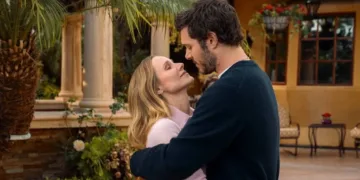











Hallmark romances often save their loudest conflict for the final twenty minutes; here, the relief is that nobody panics on schedule. Two for Tee gives Tee and Will the kind of relationship that could be mistaken for low drama, until the small choices start doing the emotional work.
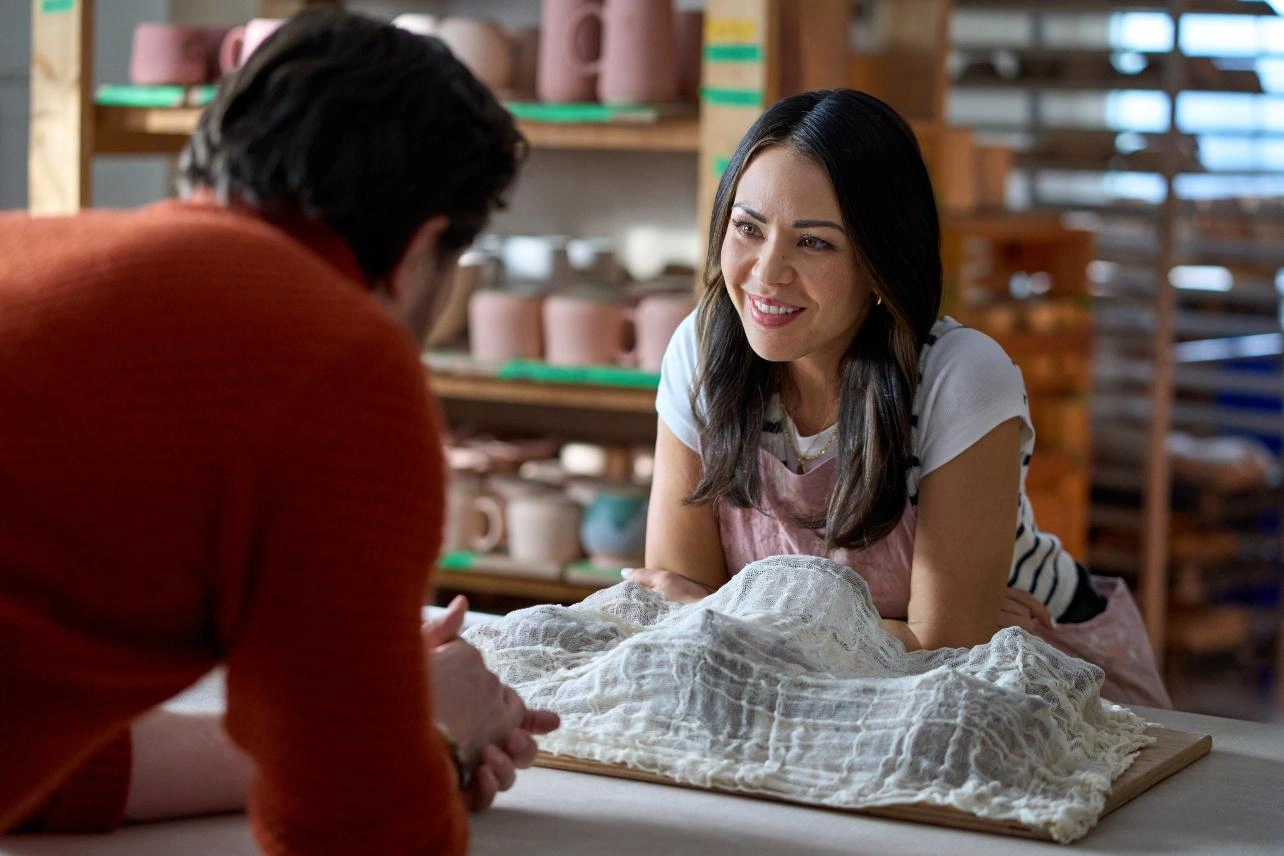
Directed by Michael Robison, the film stars Janel Parrish as Tee, a Chinese American pottery artist who teaches classes at The Learning Tree community center and co-owns a second-hand store, The Retro Metro, with her cousin Theo. Chris McNally plays Will, a single father who arrives at the center looking for handyman work and ends up fixing the broken fan in Tee’s pottery studio. That repair is a small beat, but it tells us a lot. Will listens, remembers, and follows through. In a movie this gentle, dependability counts as flirtation.
Their first scenes together have the easy rhythm of people who like being in the same room before they know what to call it. Tee’s senior pottery students immediately turn into matchmakers, which could have been too cute by half, but the film uses them as a chorus of community affection. When Tee later learns that Will has a daughter, Natalie, the script briefly opens the door to misunderstanding. Then it closes it. Will explains that he is divorced, Natalie’s mother is still present in her life, and the movie moves on. I appreciated that more than I expected.
Clay, Tea, and Inheritance
Tee’s art gives the film its strongest spine. She wants her pottery shown in a local gallery, but when she shows Ken the gallery owner photos of her work, he tells her the pieces are good without showing enough of the artist behind them. It is a familiar critique in an artist story, yet Two for Tee grounds it in something specific rather than treating creativity as a motivational poster.
The key scene comes through Tee’s mother, Leigh Anne, during a conversation over tea. Leigh Anne explains the family teapot, made by Tee’s great-grandfather from a porous clay that holds the flavor of a specific tea and deepens with each use. That detail is exactly the kind of thing a movie needs when it wants art to feel tactile. Pottery is not just a hobby here. The shape, clay, and history of the teapot push Tee toward work that carries her Chinese heritage in the material itself.
Parrish plays Tee’s insecurity with a nice balance. She does not collapse when Ken rejects her first pitch. She absorbs it, takes it personally, and then gets curious. That distinction matters. In the scenes where Tee begins making teapots inspired by her family’s history, Parrish lets the character’s confidence return through focus rather than speeches. Her hands at the wheel tell the story before the dialogue catches up.
Lillian Lim gives Leigh Anne a warmth that never turns sugary. Her best material involves the cousin she left behind in China after choosing to stay in America with her husband. Tee tracking down that cousin’s email could have felt like a convenient side plot, but Lim makes the eventual phone call before the open house land because she has already shown us the quiet ache behind Leigh Anne’s practical cheer.
A Community With Useful People In It
The Learning Tree community center could have been plain backdrop, the place where Hallmark characters gather because someone needs a bulletin board and a folding table. Robison and the writers treat it as a working social space. Tee teaches pottery there. Will finds work there. Natalie’s school dance later needs it after a burst pipe cancels the original venue. Liz, the center manager, is not written as a scold or a bureaucratic obstacle. She is a tired person trying to keep the doors open with a budget that keeps shrinking.
That is where the film’s save-the-center plot works best. The city council threat is familiar, and yes, the solution is tidy. Still, the open house has a pleasing clarity because each character gets a job. Theo, played by David Kaye, digs up information that helps Tee make specific appeals to council members. The pottery students bring personality to the campaign instead of sitting around as background encouragement. Natalie’s dance turns the center’s value from an abstract civic good into something immediate and practical.
Kaye gives Theo the right lightness. His jokes do not yank the movie into sitcom mode, and his support of Tee’s gallery hopes keeps him from becoming the designated quip machine. Alex MacIsaac also does smart work as Natalie, especially in the slow-dance practice scene, where her anxiety about the school dance lets Tee and Will act like a family unit before anyone says anything too grand about love.
Soft Stakes, Clear Feeling
Two for Tee does have limits. The romance is so conflict-free that viewers who want sparks, longing glances held for an extra beat, or a serious emotional hurdle may find the love story too mild. Ken’s rejection of Tee’s new work for commercial reasons adds a sharper note, then the San Francisco gallery call softens the blow almost right away. The film wants comfort, and it rarely risks making that comfort difficult.
For this kind of Hallmark movie, though, the craft is in keeping several gentle threads from tangling. Robison moves between the pottery studio, The Retro Metro, Sunday dim sum, city council, and Natalie’s dance worries without making the film feel crowded. Each thread points back to the same question: what helps a person feel rooted? For Tee, the answer is partly Will, partly her mother, partly clay, partly the place where she teaches others how to make something with their hands.
That is why the film’s cultural details matter. Subtitled conversations between Tee and Leigh Anne, the family teapot, dim sum, chicken feet, and non-English music cues are small choices, but they give Tee’s world texture. They make the romance feel placed rather than assembled.
Two for Tee is light, sweet, and neatly resolved, sometimes to a fault. It also understands that coziness works better when the characters have actual lives to protect. Tee’s hands shape the clay, Will fixes the fan, Natalie learns a slow dance, and Leigh Anne waits for a call from the past. The movie is at its best when it lets those gestures sit.
The heartwarming romantic drama television film Two for Tee premiered on the Hallmark Channel on March 21, 2026, kicking off the network’s seasonal “Spring Into Love” programming event, and is available for streaming on Hallmark+ and Amazon Prime Video. The story follows Tee, a talented Chinese American pottery artist who discovers deeper ties to her ancestral traditions through her craft while crossing paths with a charming new community center handyman named Will. Together, the pair team up alongside local residents to rescue the neighborhood hub from an imminent shutdown, discovering an unexpected romance along the way.
Where to Watch Two for Tee (2026) Online





Full Credits
Title: Two for Tee
Distributor: Hallmark Channel, Hallmark+
Release date: March 21, 2026
Rating: TV-G
Running time: 84 minutes
Director: Michael Robison
Writers: Matt Johnson, Justine Wentzell-Chang, Betsy Morris
Producers and Executive Producers: John Cassini, Charles Cooper, Genessa Davis, Michael Shepard
Cast: Janel Parrish, Chris McNally, David Kaye, Lillian Lim, Alex MacIsaac, Tahina Awan, Garry Chalk, Beth Fotheringham, Enid-Raye Adams, Daniel Bacon
Director of Photography (Cinematographer): Hallmark Production Crew
Editors: Hallmark Post-Production Team
Composer: Hallmark Music Team
The Review
Two for Tee
Two for Tee works because its comfort has shape. Tee’s rejected gallery pitch, the family teapot lesson, Will fixing the studio fan, and Natalie’s dance worries all feed the same gentle idea: people grow when a place gives them room. The romance is light on friction, sometimes too light, yet Janel Parrish and Chris McNally make that calm feel like a choice instead of a shortcut. For a Hallmark spring romance, this is carefully made, culturally attentive, and easy to like.
PROS
- Warm Parrish and McNally chemistry
- Strong mother-daughter material
- Specific pottery and tea details
- Supportive community ensemble
CONS
- Very low romantic tension
- Familiar save-the-center plot
- Gallery arc resolves neatly
- Soft stakes throughout