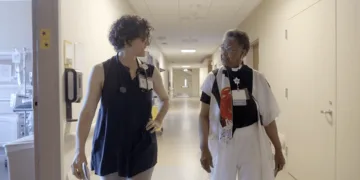




























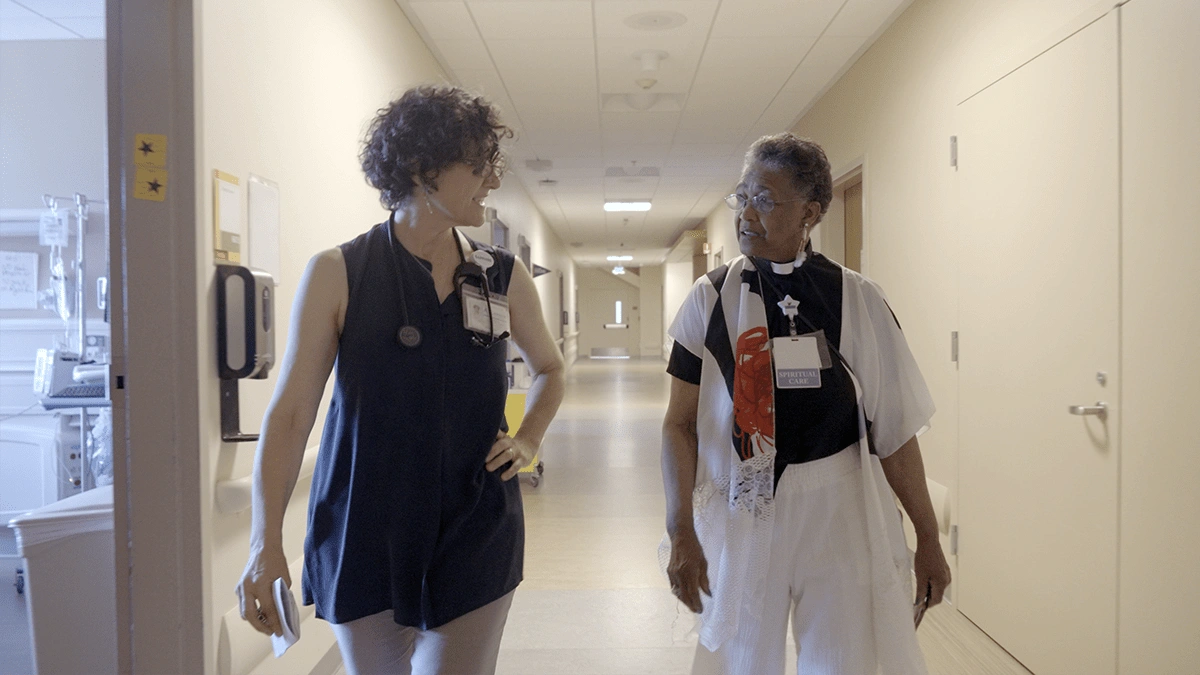

Jessica Zitter’s camera enters Oakland’s Wilma Chan Highland Hospital Campus with a rare and unstable kind of access: the access of a physician filming her own practice. The Chaplain & the Doctor follows Zitter, a white Jewish palliative care doctor, and Betty E. Clark, an 80-year-old Black chaplain and grief counselor, as they work with patients whose needs keep exceeding the categories assigned to them. Pain arrives with childcare bills. Fear arrives with medical racism. Grief arrives before death. A hospital chart has no elegant box for any of this.
The film’s most forceful argument comes through Naomi Thomas, a patient with severe lupus who has fasted for a biopsy, waited for hours, and then learns that the radiologist needed for the procedure is not available. Her anger is exact because the failure is exact.
She has not been given care, information, or respect for her time. Clark recognizes the practical barrier beneath the medical delay: Naomi needs childcare money so she can return. Zitter and Clark each contribute $150. The gesture is tender, but the scene is larger than its tenderness. It shows a public hospital improvising mercy where infrastructure should have existed.
Listening as Treatment
Clark is the film’s moral center because she understands listening as labor. She does not turn suffering into a lesson or a soft-focus virtue. With patients, her presence has weight because it is practical before it becomes spiritual. She hears Naomi’s frustration without treating it as a mood to be managed. She understands that a sickle cell patient’s reluctance to request pain medication is shaped by the shame of being viewed as an addict. The film names racial bias through these encounters, not through lecture.
Zitter’s own medical ideals are shaped by a childhood among doctors who could switch into clinical mode so completely that emotion vanished from the room. Her desire to be a different kind of doctor is sincere, and the film is honest enough to show sincerity failing under institutional habit.
In the Naomi sequence, Zitter appears evasive before Clark pushes the conversation toward the patient’s actual need. That moment gives the documentary much of its bite. Reform here is not a slogan. It is the uncomfortable instant when a doctor must stop explaining and start hearing.
The pairing works because neither woman treats the other’s discipline as ornamental. Zitter learns that chaplaincy is not decorative comfort placed beside medicine after the real work is done. Clark, too, refuses a false split between soul and body. Her care for the spirit includes pain, money, fatigue, and the humiliations that follow people into hospital rooms.
Faith Without Performance
The film’s richest cultural material sits in the interfaith space between Zitter and Clark. Clark is Christian, connected to church life and shaped by a Black religious tradition that knows both public joy and private injury. Zitter is Jewish, visibly engaged with her own practice, and marked by the trauma of being in Israel during the attacks of October 7, 2023. Their relationship could easily have been reduced to a polished image of harmony. Instead, its power comes from the lack of conversion drama.
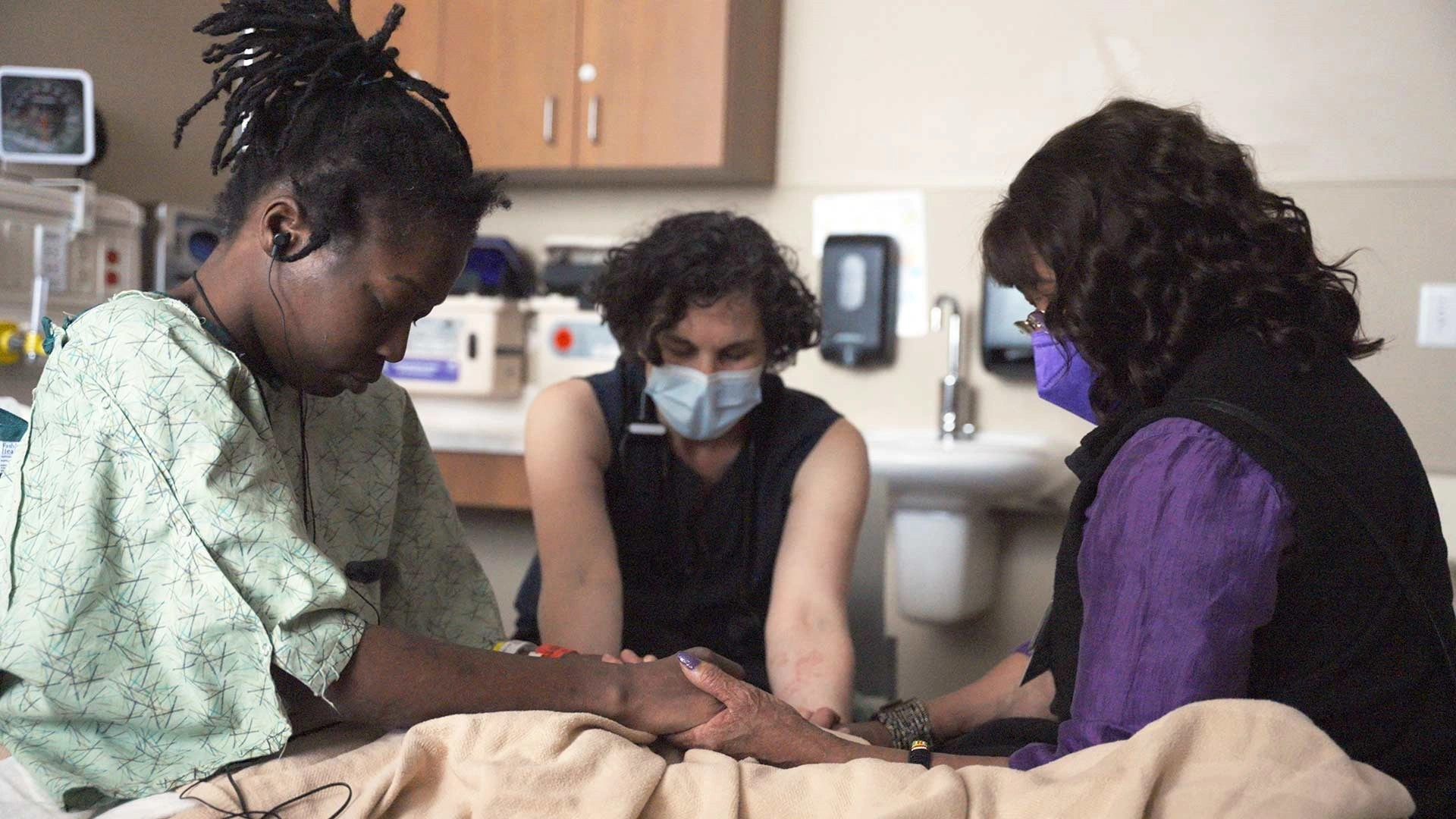
They participate in each other’s rituals without demanding sameness. Zitter prays with Clark. Clark receives Zitter’s shaken return from Israel with an embrace that is personal, spiritual, and almost bluntly useful. No one turns pluralism into branding. In a culture that often asks religion to appear either as conflict or as lifestyle décor, their shared practice feels quietly radical because it remains tied to service.
The private scenes deepen this without overdecorating it. When Clark faces her own health crisis, Zitter becomes advocate and friend rather than a colleague observing from a safe distance. Clark’s 80th birthday party, full of purple clothing and communal noise, gives the film a vision of care away from monitors and corridors. The body being celebrated there is not a patient’s body or a worker’s body. It is a life surrounded by people who know what she has carried.
The Problem of the Camera
The Chaplain & the Doctor is moving, but its authorship creates a tension the film does not fully confront. Zitter is not simply filming Clark. She is filming herself discovering, failing, learning, suffering, and being comforted. That position changes the ethical temperature of nearly every scene. The documentary often feels observational, as if an outside filmmaker has embedded with two remarkable women. The credits clarify what the film’s texture has already made complicated: one of those women controls the frame.
This does not make the film dishonest. It makes it politically uneven. Clark supplies much of the emotional intelligence and much of the embodied knowledge. She tends to patients, steadies colleagues, and shares her own history, including the legacy of Jim Crow and medical mistreatment.
Yet Zitter holds the authorship. The childcare scene makes that imbalance visible in miniature. Both women give the same amount of money, but the equality of the number may hide an inequality of burden. The film notices inequity inside the hospital, then leaves its own internal power arrangement less examined.
That limitation matters because the documentary sometimes treats individual compassion as if it can stand in for system critique. The model of palliative medicine joined with chaplaincy looks persuasive in these rooms, especially when patients who have been dismissed begin to speak with less fear. Still, the film offers little detail about how this partnership compares with standard practice, how it might be scaled, or what material support chaplains need to avoid becoming the conscience of an underfunded system.
What remains is a tender, imperfect record of care under pressure. Its deepest insight belongs to Clark’s method: the patient must be met as a whole person before the institution breaks them into symptoms, risks, costs, and delays. Its blind spot belongs to the camera that knows how to honor that truth, yet cannot quite turn the same scrutiny on itself.
The deeply moving independent documentary The Chaplain & the Doctor debuted at the Minneapolis St. Paul International Film Festival in April 2025 before launching its wider, highly anticipated national theatrical screening and impact tour on May 14, 2026. Audiences can attend live screenings and panel discussions at select community theaters, medical colleges, and cultural institutions nationwide, with online access coordinated through Reel Medicine Media. The real-life narrative profiles an unexpected alliance at a safety net trauma center in Oakland, California, where an 80-year-old African American chaplain and a white Jewish palliative care physician unite to challenge racial bias, confront professional hierarchies, and bring deep spiritual compassion to a broken healthcare system.
Full Credits
Title: The Chaplain & the Doctor
Distributor: Reel Medicine Media
Release date: April 10, 2025 (Minneapolis St. Paul International Film Festival Premiere), May 14, 2026 (United States National Screening Tour Release)
Running time: 85 minutes
Director: Jessica Zitter
Writers: Jessica Zitter
Producers and Executive Producers: Jen Gilomen, Niema Jordan, Catherine King, Jacqueline Olive, Corey Kennard, Brian Walker, Mark Zitter
Cast: Betty Clark, Jessica Zitter
Director of Photography (Cinematographer): Jen Gilomen
Editors: Jacob Bricca
Composer: Reel Medicine Sound Ensemble
The Review
The Chaplain & the Doctor
The Chaplain & the Doctor is strongest as a portrait of care practiced against institutional indifference. Betty Clark’s listening gives the film its moral clarity, while Jessica Zitter’s dual role as subject and filmmaker creates a productive discomfort the documentary never fully examines. Its patient scenes are piercing, especially Naomi Thomas’s delayed biopsy and the sickle cell pain-medication exchange, but its healthcare argument stays narrower than its material demands.
PROS
- Betty Clark’s humane presence
- Strong patient encounters
- Rich interfaith dynamic
- Honest moments of medical failure
CONS
- Zitter’s authorship feels underexamined
- Limited system-level analysis
- Clark receives less narrative control
- Reform argument remains thin