











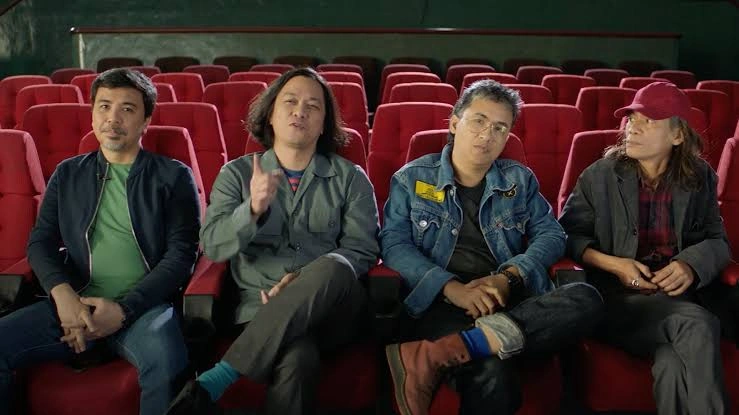

Maria Diane Ventura frames a national rock myth from unusually close range, close enough to hear the old affection and close enough to miss what sits outside the room. Eraserheads: Combo on the Run has the privileges and hazards of proximity. Ventura produced the band’s 2022 “Huling El Bimbo” reunion concert, was formerly married to frontman Ely Buendia, and briefly appears as an interview subject. Access is the film’s key light. Distance is its missing fill.
The documentary tracks the Eraserheads from their University of the Philippines Diliman beginnings to their early 1990s ascent, 2001 breakup, 2008 reunion, and 2022 return. It also knows where the emotional money is. The footage around “Huling El Bimbo” is treated less like a career milestone than a séance with ticketing logistics: four men re-entering a shape they once outgrew, watched by fans who never stopped living inside the songs.
Post-EDSA Static
The origin story is irresistible because it is so plain. Buendia, then a film student, put up a campus ad after an earlier band fell apart. Drummer Raimund Marasigan, bassist Buddy Zabala, and guitarist Marcus Adoro answered. Their name came from David Lynch’s Eraserhead, which gives the band’s own mythology a faintly comic aura: a Filipino pop institution born from a cult nightmare.
Ventura gives enough history to orient newcomers, but she often lets Philippine political memory sit in the background like an unlit alley. The band’s post-EDSA rise matters because their irreverence did not land in a vacuum.
After the 1986 People Power Revolution ended Ferdinand Marcos’s rule, the country was still renegotiating what public expression could sound like. To outside ears, a song such as “Pare Ko” may register as shaggy, melodic college rock with a little profanity. In that moment, its off-color slang and everyday male frustration had bite.
The film needed a stronger contrast here. A few seconds of the safer mainstream pop the Eraserheads disrupted would have sharpened the point. “Toyang,” “Maling Akala,” “With A Smile,” and “Minsan” became generational songs because they found drama in ordinary speech, cheap food, friendship, romance, and embarrassment. The documentary states the significance. It does not always stage the collision.
Confession Under Low Light
The film’s best passages arrive when the four members speak separately about the long corrosion inside the band. The interviews have a forensic quality, not because Ventura grills them with severity, but because the men keep returning to tiny failures that hardened into structure.
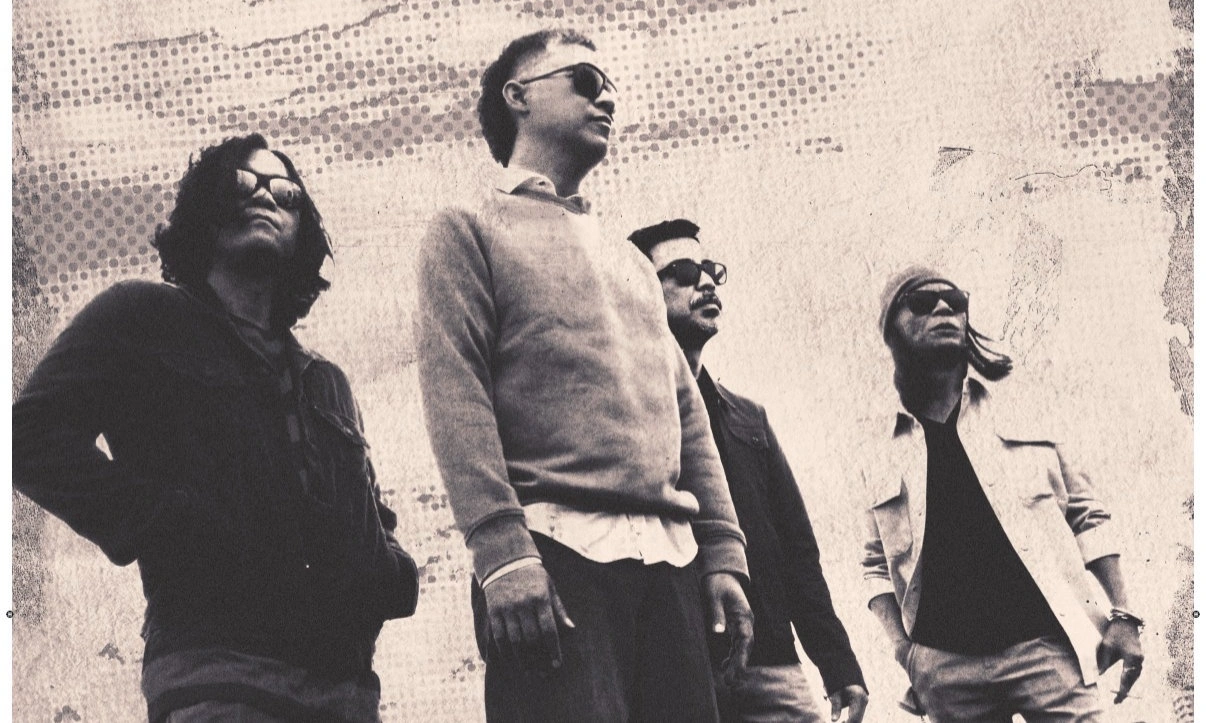
Buendia describes the pressure fame placed on his private life. Marasigan appears as the one trying to keep the machine intact. Zabala’s comments about Adoro’s erratic playing carry the dry fatigue of someone who has replayed the argument in his head for years.
What emerges is a study of masculine silence, Filipino rock edition. The men describe a generation that did not talk easily about hurt, so hurt became arrangement, schedule, studio practice. By the time Carbon Stereoxide was being made with members not always present together in the studio, the band had turned into its own split-screen composition. Instruments still met on the track. People did not.
That detail is more damaging than any shouted accusation. The Eraserheads were still producing sound, yet the room had emptied. Ventura understands the visual implication of that absence, even when the film’s talking-head format stays conventional. A band is supposed to be four bodies negotiating time together. Here, editing becomes pathology.
The Door Left Shut
The documentary’s honesty falters around Marcus Adoro. Ventura acknowledges abuse allegations and his strained relationship with his daughter, singer-songwriter Syd Hartha. Adoro is given space to say he sought help. The voices of those harmed are absent, and the imbalance is hard to ignore.
This is where access becomes shadow. The film is careful, sometimes movingly so, with the band’s internal wounds. It gives old resentments air. It lets the members name disappointment, ego, fatigue, and repair. The Adoro material gets a smaller chamber, and the camera seems reluctant to keep the door open. For a film built around confession, that hesitation matters.
A documentary does not have to become a legal brief to ask harder questions. It can remain a band portrait while refusing to let reconciliation absorb every injury in its path. The Eraserheads’ internal peace is one story. Harm outside the rehearsal room is another. Ventura’s film lights the first with patience and leaves the second in partial silhouette.
Reunion Light
The 2022 “Huling El Bimbo” concert gives Combo on the Run its emotional architecture. The reunion followed Buendia’s viral “Pag tumakbo si Leni” reply and arrived after Ferdinand “Bongbong” Marcos Jr. won the presidency.
The timing gave the event a charge the documentary touches, then moves past too quickly. Pandemic exhaustion, political division, and nostalgia all press against the stage, but the film prefers the private angle: four old collaborators testing if they can stand near each other without flinching.
The late footage has real force. The members eat together, sing karaoke, travel, and appear almost startled by their own ease. Over images of touring and fellowship, “Balikbayan Box” turns “Umuwi na tayo” into something tender and unstable. Home, in this film, is not a place. It is the temporary suspension of old grievances.
Buendia’s quiet correction near the end cuts cleanly: “We were never not friends. We just had a falling out.” It is not absolution. It is a small lamp in a dark hallway.
The documentary Eraserheads: Combo on the Run initially premiered in the Philippines in March 2025, later gaining a North American theatrical release through Abramorama on April 24, 2026, before launching its global streaming debut on Netflix on May 30, 2026. Audiences around the world can view this expanded cut on Netflix with an active subscription. The archival film charts the rise, tumultuous breakup, and historic 2022 reunion concert of the legendary alternative rock band Eraserheads, illuminating the untold personal stories behind the group that completely redefined Pinoy rock music during the 1990s.
Where to Watch Eraserheads: Combo on the Run (2025) Online


Full Credits
Title: Eraserheads: Combo on the Run
Distributor: Abramorama, Warner Bros. Pictures, Netflix
Release date: March 21, 2025 (Philippines), April 24, 2026 (North American Theatrical Release), May 30, 2026 (Global Streaming Premiere)
Rating: PG / M
Running time: 102 minutes
Director: Maria Diane Ventura
Writers: Maria Diane Ventura, Aldus Santos, Chuck Gutierrez
Producers and Executive Producers: Francis Lumen, Maria Diane Ventura
Cast: Ely Buendia, Raimund Marasigan, Marcus Adoro, Buddy Zabala
Director of Photography (Cinematographer): Hilarion Banks
Editors: Chuck Gutierrez, Hilarion Banks, Adrian Arcega
Composer: Earl Drilon, Atlas Glaas
The Review
Eraserheads: Combo on the Run
Maria Diane Ventura’s documentary has the intimacy of a room lit from inside, and the blind spots of a room with locked doors. It sees the Eraserheads most clearly when the members describe silence, resentment, and repair, from the cut-and-paste ache of Carbon Stereoxide to the softer body language around “Huling El Bimbo.” Its political framing and Marcus Adoro material stay underlit. For fans, the shadows have feeling. For newcomers, some rooms remain sealed.
PROS
- Candid band interviews
- Strong reunion footage
- Rich fan-facing emotion
- Sharp look at male silence
- Moving late-stage reconciliation
CONS
- Thin political framing
- Adoro allegations underexamined
- Limited outsider perspective
- Assumes too much context