





























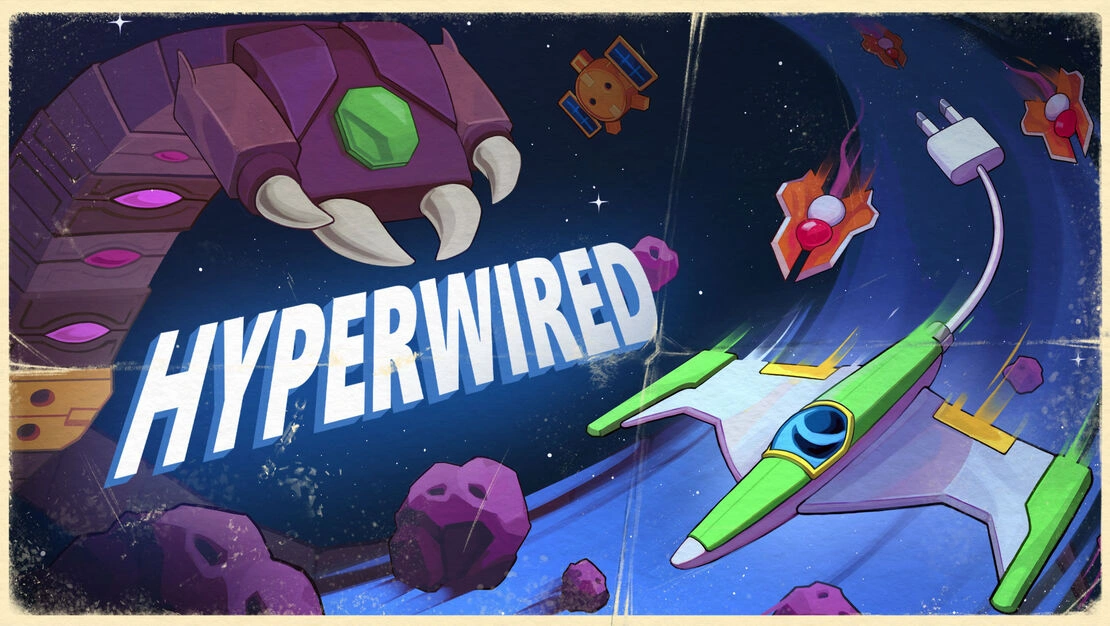

Most twin-stick shooters ask how long you can survive once the screen fills with enemies. HYPERWIRED complicates that question by asking how long your ship can keep functioning before its energy supply disappears. Movement, weapons, and abilities all feed into a resource loop built around a wonderfully literal solution: a cable hanging from the ship and a network of sockets scattered across each stage.
The objective is to activate four coloured satellites, then connect to the goal socket and move to the next procedurally generated area. Left stick controls movement, right stick handles aiming, and enabling automatic fire while aiming makes the basic shooting feel far closer to the immediate twin-stick format players will recognize from arcade roguelikes.
The similarity mostly ends there. Energy steadily drains, ammunition can become scarce, and health has an offensive use because the powerful laser consumes one health point when fired. HYPERWIRED turns nearly every gauge into something worth watching. That makes its early hours considerably busier than the average spaceship shooter.
Plug, Shoot, Recharge
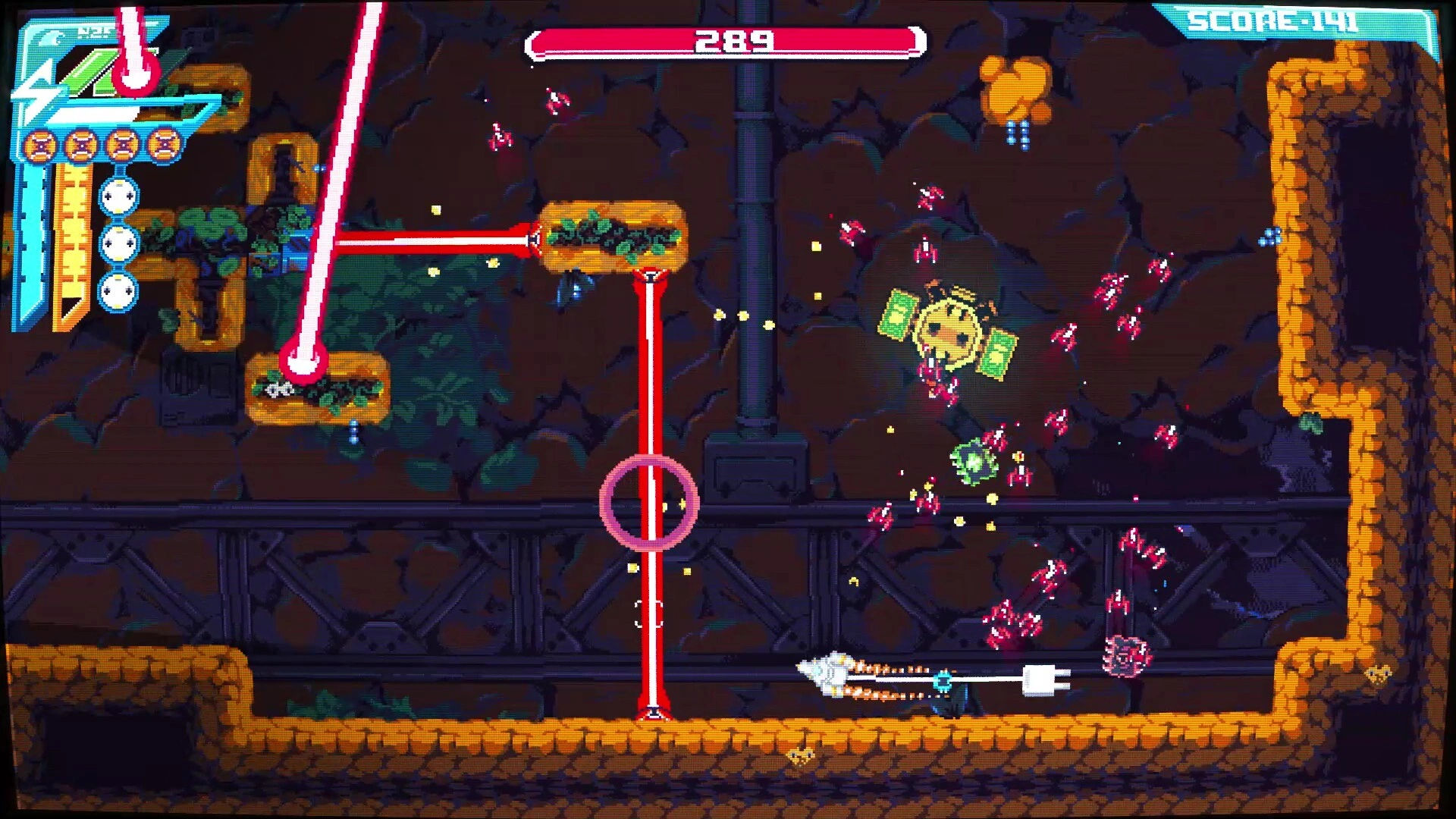
Connecting to a satellite is rarely a quiet refuelling stop. The ship has to physically plug into the socket and remain attached while its resources recover, leaving less freedom to dodge incoming fire. Staying connected for too long can trigger Overcharge, adding another restriction to a mechanic already defined by vulnerability.
The idea creates some excellent situations. Reaching a power socket with almost no energy left, then trying to hold position while enemies approach, carries a tension that simply collecting an energy pickup would never produce. Route knowledge gradually matters. Once players understand where useful connections may appear, stages become less about sweeping through every enemy and closer to moving between temporary lifelines.
The same structure can grind against the game’s pace. Running low on ammunition or bombs sometimes leads to circling an area while searching for the correct socket. Compared with roguelikes that keep combat escalating until a room is cleared, HYPERWIRED occasionally interrupts its own momentum with resource errands.
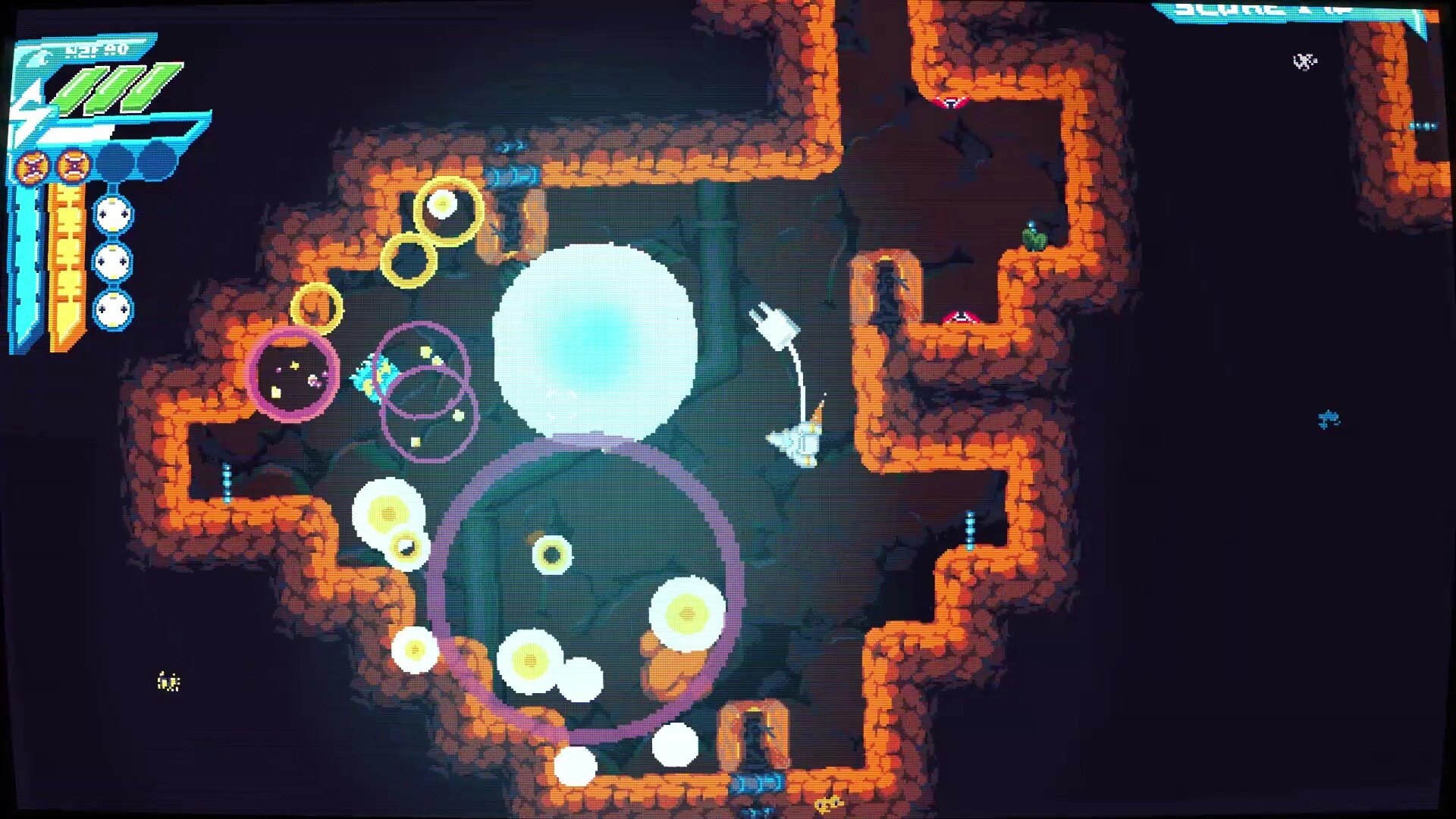
Combat brings another unusual wrinkle through weapon recoil. Regular shots push the ship backwards, so sustained fire changes positioning and can send the player drifting away from an intended route. Thankfully, crashing into walls causes no damage. Adding collision punishment to a system already juggling recoil, energy, ammunition, and a dangling cable would have crossed from demanding into vindictive.
There are also bombs capable of breaking parts of the environment, a chargeable ricocheting laser, and a slow-motion ability. The problem is remembering all of them. During hectic encounters, energy and aiming already command so much attention that bombs and slow motion can simply vanish from memory. HYPERWIRED has the ingredients of a deep arcade control scheme, yet a slightly leaner input setup might have made its best ideas easier to appreciate.
Building a Fleet
Ship rescues provide the strongest reason to look beyond the exit. Stranded vessels occasionally float through stages and can be towed to the appropriate satellite. Recharge what they need and they join the current fleet, following the player and providing extra firepower.
That temporary alliance is useful, but the larger reward comes from unlocking rescued vessels as playable ships for later runs. HYPERWIRED’s ships change combat enough to make roster expansion meaningful. This is where the game separates itself from roguelikes that treat unlockable characters as minor statistical variations. Learning how another ship responds to recoil or manages combat gives subsequent attempts a different texture.
Certain boss-like enemies extend the same idea. Defeating these tougher opponents can add them to the playable roster, turning a difficult fight into a permanent expansion of the game’s mechanical options. It gives enemy encounters a purpose familiar to creature collectors and character-driven roguelikes, except the reward here is another machine to learn.
The upgrade systems are considerably less confident. Batteries connected to sockets can alter weapons, chips dropped by enemies provide temporary stage-specific benefits, and shields add another layer of protection. Finishing a stage also offers upgrades such as stronger weapon damage, longer cables, faster charging, or additional support ships for the rest of the run.
On paper, the number of possible weapon modifier combinations suggests the kind of build experimentation associated with modern roguelikes. In practice, HYPERWIRED rarely lets those combinations become truly outrageous. Chips disappear quickly and their effects are not always communicated clearly. Battery bonuses vanish when the player disconnects from their sockets. Between-run progression also does little to reshape strategy.
Veterans of the genre know the pleasure of watching a modest weapon become absurd after the right sequence of upgrades. HYPERWIRED keeps checking the voltage before anything catches fire.
An Arcade Circuit With Loose Wires
The opening few runs can feel awkward because the player is learning several systems at once. Energy routes, cable positioning, recoil, ship abilities, socket types, and upgrade effects all compete for attention. The tutorial explains the essentials, but repeated attempts remain the real teacher.
Once those lessons settle, the game develops a strong one-more-run rhythm. Recognizing when to abandon a fight and recharge becomes instinctive. Rescuing another ship creates an objective that may justify crossing a dangerous section of the map. Unlocking a new vessel immediately raises the question of how differently the next attempt might play.
That learning curve recalls older arcade shooters, where improvement came from understanding a machine rather than filling out a permanent skill tree. HYPERWIRED mixes that mentality with roguelike structure, though its restrained progression means it sits awkwardly beside genre peers built around dramatic run-to-run escalation.
Its presentation follows the same restrained philosophy. The pixel art is colourful and readable when enemy ships crowd the screen, with later areas providing stronger visual variation. Enemy designs remain familiar to anyone raised on retro space shooters, and the soundtrack supports the pace without demanding attention.
There is room for extra modes. Multiplayer could make cable management and rescues chaotic in an entirely different way, while a separate campaign might give players a place to master ships without losing everything after a failed run. Stronger persistent upgrades could also give repeated attempts a firmer sense of development.
For now, HYPERWIRED’s family resemblance to modern roguelikes is clearest in its repeated runs and upgrade choices. Its real identity comes from somewhere stranger: being attached to a cable, watching energy disappear, and deciding which socket is worth risking the trip.
The Review
HYPERWIRED
HYPERWIRED finds a smart answer to a familiar roguelike shooter problem: how do you make another spaceship run feel mechanically distinct? Its cable, sockets, and draining energy turn positioning into resource management, while ship rescues and unlocks give repeated attempts a solid purpose. The genre's strongest entries let builds spiral into glorious excess, and HYPERWIRED remains strangely cautious there. Temporary chips, restrained progression, and an overcrowded control scheme keep its best ideas from fully taking charge. Still, once the systems click, plugging in for another run becomes dangerously easy.
PROS
- Distinctive cable-and-socket loop
- Excellent ship rescue system
- Meaningful playable ship variety
- Clever recoil physics
- Strong arcade replay pull
CONS
- Overcrowded controls
- Timid build progression
- Temporary buffs lack impact
- Resource hunts disrupt pacing