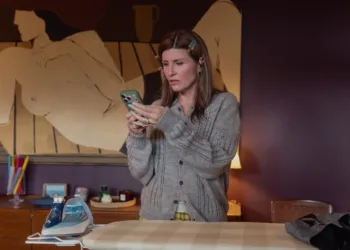
















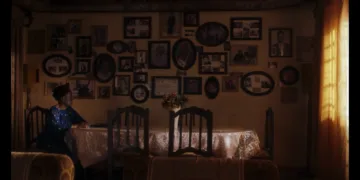














Lucero and Fernando can discuss inviting a stranger into their bed, yet neither can admit that the stranger has already moved in. It is boredom. It eats breakfast with them, walks through their immaculate house, and sits quietly between their bodies at night.
Teresa Simone’s Desire takes this marital vacancy and places an attractive swimming coach beside it, which is less a solution than a controlled demolition. Lucero, played by Ludwika Paleta, is a successful lawyer who has been married to Fernando for twenty years. Their wealth has survived. Their reputation has survived. Their physical intimacy has apparently entered witness protection.
The film announces the coming disaster through a flash-forward at an indoor pool, where an employee finds blood near the water. Someone will die. The early mystery concerns the identity of the victim and killer, yet the sharper question is how a family committed to appearances will justify the destruction required to preserve them.
Desire has the foundation for a poisonous domestic thriller about marriage, power, and the temptation to treat other people as corrective experiences. Its trouble begins when psychological tension gives way to plot machinery. Every character becomes a device in somebody else’s plan, and the film rarely pauses to consider what this does to them as human beings.
The Vacancy Between Two People
Lucero and Fernando’s public image carries the polished falseness of a luxury property brochure. They are accomplished, attractive, financially secure, and admired by those around them. Privately, they circle the subject of sex through pauses, hints, and carefully incomplete sentences. Both seem open to changing the terms of their marriage, but saying this directly would require them to acknowledge that something has already failed.
Call it intimacy outsourcing: the belief that another person can perform the emotional labor a couple has abandoned. The film is strongest during these early exchanges. Paleta and José María Yazpik play the marriage as a long negotiation conducted through tone. A glance can function as accusation. A joke can conceal a request. Lucero and Fernando possess the familiarity of people who know where every conversational trapdoor is located, then step around each one out of habit.
Matías arrives through Viviana, their daughter, who begins training with him at the pool. Played by Óscar Casas, he has the exact physical confidence required for this sort of story. He is a former competitive swimmer from Spain, comfortable with attention and aware of the effect his body produces. Simone frames his meetings with Lucero through lingering looks, exposed skin, and pauses long enough to become invitations.
The age difference between them receives much of the scandalous emphasis, but the twenty-year gap is hardly the disturbing element. Matías is nearly thirty. Lucero is neither confused nor coerced. The true violation comes from his position in Viviana’s life. Every encounter with him is tied to Lucero’s daughter, turning private desire into an intrusion upon the family’s internal boundaries.
Their affair, sadly, lacks the force required to explain its consequences. Lucero and Matías move from attraction to sex with little emotional discovery between those points. The film shows bodies meeting, but it gives the audience few reasons to believe these two people have found something irreplaceable in each other.
This creates a peculiar problem for an erotic thriller: the affair makes sense as an event, yet never quite convinces as a compulsion.
The sex scenes are carefully lit and deliberately prolonged, but their restraint works against the film’s stated temperature. They feel arranged rather than surrendered to. Lucero risks her marriage, her career, and her daughter’s trust for a relationship that appears to offer physical novelty and remarkably awkward silence.
Perhaps that emptiness is intentional. Desire, after all, often attaches itself to projection rather than knowledge. Lucero may want Matías precisely because she does not know him. The film gestures toward this idea, then replaces it with twists before it can become a serious argument.
Everybody Becomes Somebody’s Instrument
Viviana develops feelings for Matías without knowing that he has been sleeping with her mother. Her attraction gives the affair its most damaging consequence. Lucero is no longer hiding something from her husband alone. She is occupying the same emotional space as her daughter and refusing to surrender it.

Pilar Pascual gives Viviana an open, trusting quality, particularly in the scenes where she reads Matías’s attention as sincere. The screenplay rarely grants her enough interior life, though. Her feelings operate mainly as pressure on Lucero, and her pain becomes another mechanism for moving the adults toward violence. Then Fernando’s role changes.
Matías reveals that Fernando hired him to seduce Lucero and record their encounters. This reframes the entire affair as an engineered test, one designed by a husband who prefers surveillance to conversation. Fernando has turned his wife’s dissatisfaction into evidence. Matías has turned seduction into paid labor. Lucero has turned Matías into an exit from routine. Nobody sees another person. They see functions.
The twist gives Fernando the agency he previously lacked, but it also exposes how little the film has prepared his psychology. What did he hope to learn? Did he want proof of Lucero’s unhappiness, grounds for separation, or the pleasure of watching her fail a test she never knew she was taking? The script leaves these motives suspended, as if secrecy itself were character development.
Matías complicates the scheme by developing genuine feelings for Lucero. Once she rejects him, he refuses to disappear. His decision to date Viviana keeps him near Lucero and converts the daughter’s affection into leverage. He becomes seducer, rejected lover, manipulator, threat, and eventual victim in rapid succession.
Casas is persuasive when Matías is in control. His posture and easy smiles establish someone accustomed to being desired. The later desperation fits less comfortably. His pleading and volatility arrive as plot requirements rather than the endpoint of a carefully built collapse.
At first I thought this instability might be the point. Matías has spent the film performing roles assigned by richer, older people, and his breakdown could represent the moment the performance consumes him. Then the film rushes past the possibility. There is a murder to arrange, and interiority is apparently not invited.
Marriage as Criminal Conspiracy
The first hour moves through withheld information, slow conversations, and long stretches of discomfort. Simone lets silence sit between characters until it acquires weight. The approach creates an effective unease, especially when Lucero and Fernando speak around the affair without openly confronting it. The final act abandons this patience.
Fernando attacks Matías, leaving him badly injured. Matías later offers to leave the family alone, presenting disappearance as the last available compromise. Lucero no longer believes him. Fear for Viviana becomes her moral permission slip, though the film has already shown that protecting the daughter was never the adults’ first priority.
With the pool’s security cameras disabled, Lucero approaches Matías and lets him believe some possibility remains between them. He follows her into the water, injured and barely able to keep himself afloat. She presses his head beneath the surface until he drowns.
The pool has been the film’s most useful location. It begins as a space of discipline, where Viviana trains and Matías exercises authority. It becomes a site of attraction, then secrecy, then evidence. During the murder, water turns Lucero’s desire into a weapon. She kills Matías using the same intimacy that drew him toward her.
Paleta handles this scene with chilling control. Lucero does not erupt. She decides. The performance suggests exhaustion hardening into resolve, a woman reducing murder to the final administrative task in a family crisis.
The writing has not earned the transformation with equal precision. Lucero moves from panic over exposure to calculated homicide without enough intermediate choices. The film asks Paleta to supply the missing moral architecture through her face, and she nearly does.
Police accept Matías’s death as suicide, aided by his injuries and accounts of his emotional state. Lucero and Fernando escape suspicion. Their marriage, previously starved of intimacy, begins to recover through shared guilt. This is the film’s bleakest idea and its best one. Honesty could not reunite them. Complicity can.
Their renewed passion carries the logic of a blood oath. They finally possess something that belongs entirely to the two of them, a secret no outsider can enter without destroying their lives. Marriage is restored through mutual culpability (therapy would have been cheaper, but less cinematic).
The Children Carry the Sentence
Julian, the family’s quiet son, spends much of the film hovering near the plot without appearing fully attached to it. His card tricks, strange musical cues, and withdrawn behavior position him as a possible suspect in Matías’s death. The misdirection works only intermittently, since the screenplay remembers Julian whenever it needs suspicion or logistical assistance, then sends him back into storage.
He does become essential to the aftermath. Julian helps remove Viviana from the scene while his parents carry out their plan. He does not kill Matías, but he understands enough to know the suicide story is false. As the news reports the official account, guilt begins to register across his face.
His silence becomes the family’s unresolved threat. Telling the truth would produce justice for Matías and destroy his parents. Remaining silent would preserve the household and make him a permanent participant in its lie.
Viviana receives even less clarity. She has seen enough strange behavior to doubt the official story, yet nobody offers her a direct account of what happened. Her parents claim to have acted for her protection, but their actions leave her grieving a man she never fully knew inside a family she can no longer trust.
This is parental protection as contamination. Lucero and Fernando attempt to remove danger from their children’s lives, then transfer the moral cost of their choices directly into those children.
The film could have made Julian and Viviana the emotional endpoint of the adults’ behavior. Instead, their trauma remains secondary to the grim joke of Lucero and Fernando rediscovering marital passion. The children inherit the consequences while the parents enjoy the reconciliation.
Cold Rooms, Shallow Heat
Simone gives the Cortina household an attractive sterility. Cool blues, white walls, glass partitions, and oversized rooms make wealth look strangely airless. The family has space everywhere and privacy nowhere. Their home resembles a place staged for sale, which fits people who have spent years presenting a marketable version of happiness.
Some interiors are so dimly lit that atmosphere becomes obstruction. Faces disappear into shadow without gaining mystery from it. The visual strategy wants to express secrecy, but secrecy loses force when the audience is busy trying to locate the furniture.
The editing is stronger in the first half. Delayed reactions and long pauses let suspicion form gradually. Lucero’s conversations with Fernando carry tension because each cut seems to ask who understands what. Once the thriller mechanics take control, the rhythm accelerates through revelations, confrontation, assault, murder, and cover-up before the characters can process any of them.
Paleta remains the film’s stabilizing presence. She gives Lucero conflicting impulses without smoothing them into sympathy. Her guarded expressions during the marital scenes, her panic when Matías refuses to leave, and her composure in the pool suggest a person learning that control can feel intoxicating too.
Yazpik finds convincing moments once Fernando’s resentment becomes active, but the character spends too long drifting outside the story. Casas has the physical assurance required for Matías’s early scenes, then struggles against the script’s hurried conversion of him into a desperate stalker. Pascual makes Viviana’s trust believable, which leaves the film’s refusal to examine her betrayal feeling especially wasteful.
Desire belongs to a streaming cycle built around attractive bodies, expensive interiors, forbidden sex, and third-act catastrophe. It borrows the recognizable signals of erotic melodrama, then behaves as if showing restraint automatically grants psychological depth. It does not.
The film withholds the shameless excess that might make its affair entertaining and neglects the character work that might make it tragic. What remains is a glossy moral puzzle whose pieces have been forced together. Its sharpest image is Lucero holding Matías beneath the water, preserving her family by destroying any claim it had to innocence. The marriage survives. That may be the most disturbing part.
This Mexican thriller premiered globally on Netflix on July 17, 2026, following a theatrical release in Mexico and Spain earlier in May. The story follows a lawyer whose picture-perfect life begins to unravel after she enters into a risky affair with her daughter’s swimming coach, leading to a dangerous love triangle that threatens everything she has built.
Where to Watch Desire (2026) Online


Full Credits
Title: Desire (Deseo)
Distributor: Netflix
Release date: July 17, 2026
Running time: 1 hour 37 minutes
Director: Teresa Simone
Writers: Giulia Cardamone, Vanessa Miklos
Producers and Executive Producers: Pablo Cruz, Juana García Blaya, Pilar Robla
Cast: Ludwika Paleta, Óscar Casas, José María Yazpik, Leonardo Ortizgris, Matias Coronado, Pilar Pascual, Ivana Salomón, Gabi Zamora, Jaydy Michel, Giovani Florido
The Review
Desire
Desire treats adultery as a door to hidden selves, then discovers that murder is easier to dramatize than emotional honesty. Ludwika Paleta gives Lucero’s fear and calculation a credible pulse, while the pool imagery turns seduction into predation with cold precision. Yet the script rushes from marital frustration to conspiracy, obsession, and homicide without building the psychological bridges between them. The marriage survives because its members finally share a secret. It happens to be a corpse, which is one approach to couples therapy.
PROS
- Ludwika Paleta’s controlled performance
- Strong use of the swimming pool
- Polished production design
- Promising marital tension
- Bitterly ironic final premise
CONS
- Thin psychological development
- Unconvincing central chemistry
- Abrupt character transformations
- Rushed murder plot
- Underwritten children