










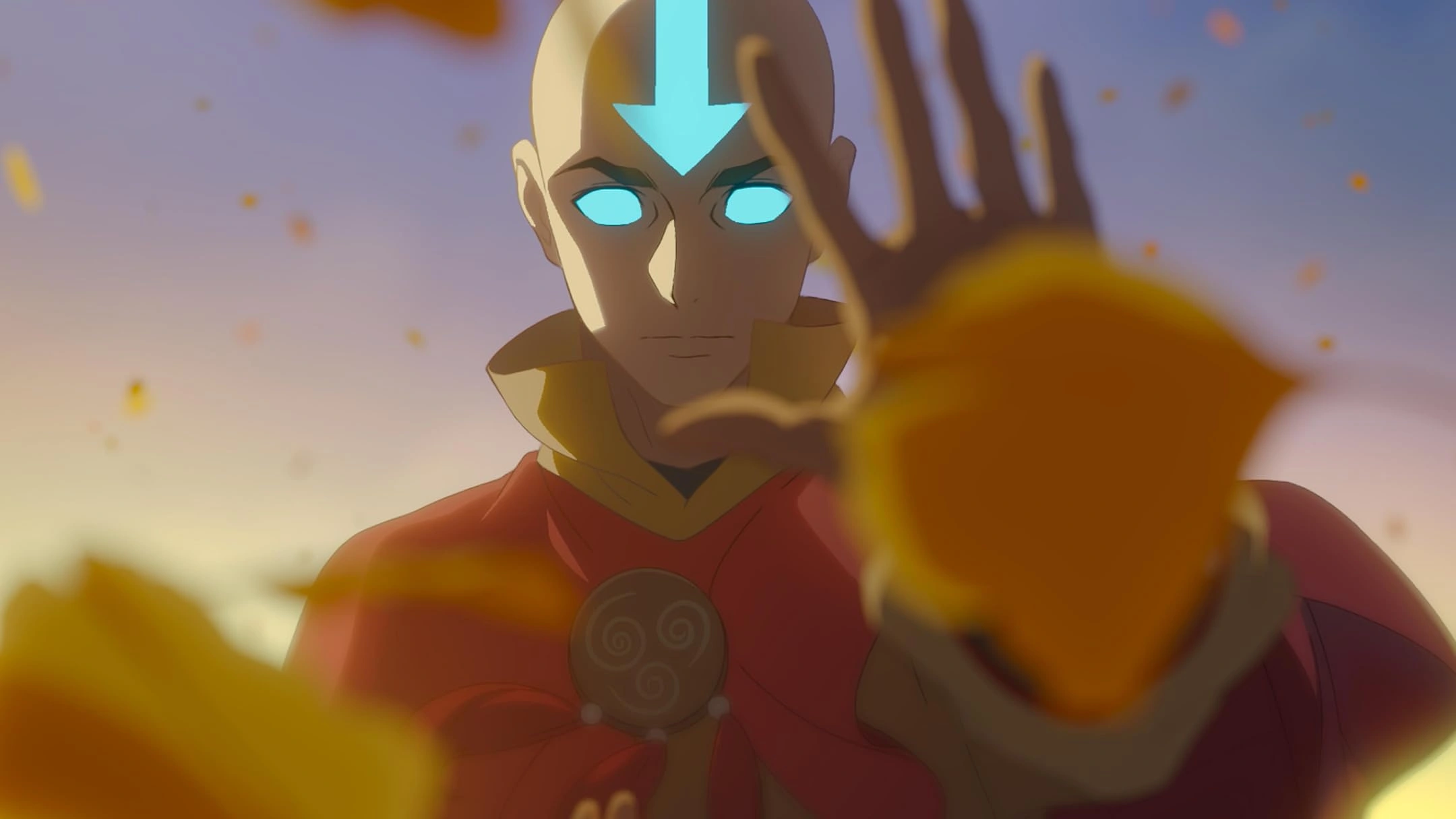

Peace has given Aang something war never did: time to listen to the dead. Years after Fire Lord Ozai’s defeat, the young Avatar has become a public symbol of unity, helping shape Republic City while spending long stretches at the Southern Air Temple collecting the remains of a culture no one else remembers. The contrast is immediate and painful. Aang can build a city for every nation, yet he cannot rebuild the people whose language, rituals, and jokes survive only through him.
Lauren Montgomery frames that conflict through a childhood memory. Young Aang flies beside the Air Nomads and receives gentle wisdom from Monk Gyatso, then the dream curdles into a nightmare of extinction. Adult Aang wakes beside Appa and Momo, two living companions from the life that was stolen from him. Their comfort carries warmth, but it also exposes the loneliness beneath it. Animals can preserve affection. They cannot restore a civilization.
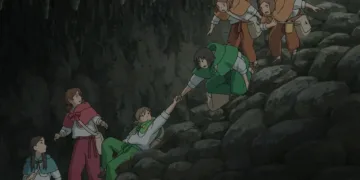
Avatar Aang: The Last Airbender places this grief inside a familiar adventure structure. The Denied, a militant movement of non-benders, steal an Air Nomad relic while searching for an artifact tied to the ancient Avatar Sonam. Aang calls Katara, Sokka, Toph, and Zuko back together, and the film briefly recovers the loose, affectionate rhythm of the original series. Yet the reunion serves a story built around one question: what does cultural preservation become when memory turns into political power?
The Museum and the Nation
Aang’s work at the Southern Air Temple appears noble, and the film refuses to mock it. He catalogs relics, protects damaged objects, and treats each discovery as evidence that his people existed. The temple functions like a private museum, except its curator is also the last surviving exhibit. That arrangement gives his mission emotional force while exposing its limits. Preservation without community can become a ritual of suspended mourning.
The film makes this clear when Aang pursues the stolen artifact with an urgency that exceeds the immediate threat posed by the Denied. He is chasing knowledge before he is chasing an enemy. The possibility that Sonam’s staff might return airbending to the world strikes directly at the wound that has defined him since childhood. Republic City represents a future built through cooperation. The staff promises a past restored by force.
This is where the story finds its strongest idea. Aang’s public role demands balance among different peoples, while his private grief tempts him toward a project centered on his own lost nation. The tension is political, not merely emotional. A ruler who believes his pain is exceptional can begin treating that pain as permission.
The screenplay does less with the Denied. Their anger rests on a clear grievance: benders control institutions, warfare, labor, and public authority through abilities unavailable to ordinary citizens. Yet the film rarely shows this imbalance in daily life. No workplace, council chamber, police encounter, or public dispute gives their resentment social texture.
They arrive as militants before they have been allowed to exist as citizens. The result repeats a weakness from the Equalist storyline in The Legend of Korra: structural inequality is introduced, then transferred into the hands of extremists so the institution itself can remain largely innocent.
Tagah’s Promise
Tagah enters as the person Aang has spent his life hoping to find. Frozen in ice for centuries, he remembers Air Nomad culture as lived experience rather than archaeological evidence. Dave Bautista gives him a calm, paternal warmth during his early exchanges with Aang. He does not sound like a villain offering temptation. He sounds like home.

That distinction matters. Tagah can name customs, explain relics, and speak to Aang without translating Air Nomad loss for outsiders. His presence changes Aang’s posture. The Avatar who carries every room suddenly behaves like a student. Montgomery lets their early scenes breathe just long enough for the betrayal to hurt, particularly when Tagah presents Sonam’s staff as a means of reviving airbending among non-benders.
Their conflict grows from two responses to extermination. Aang believes survival requires openness, mercy, and contact across nations. Tagah believes a destroyed people should never again depend on the goodwill of others. Strength, separation, and control become his answers to historical vulnerability. Calling him Aang’s dark reflection understates the threat. He is the political destination Aang might reach if grief were permitted to define justice.
The film moves from trust to confrontation too quickly. Tagah’s ideas deserve scenes in which he and Aang test them against Republic City, the Denied, or the failures of the new peace. Instead, the artifact hunt accelerates toward combat. Bautista carries much of the missing development in his voice, shifting from reassurance to command without turning Tagah into a sneering tyrant.
The eventual fight places Aang in spaces where force threatens civilians and fragile structures, preventing raw power from becoming an easy solution. The physical design understands the character’s ethics: every attack creates a second responsibility. When the clash expands into city-level destruction, bending sometimes loses the martial precision that defined the original series and slips toward glowing projectiles colliding across the frame.
Friends as Functions
The film’s clearest concession to nostalgia is the reassembly of Team Avatar. Each introduction efficiently connects childhood personality to adult responsibility. Sokka develops new technology while younger Water Tribe children mock him. Zuko attempts to rebuild the Fire Nation while bureaucrats bury him beneath protocol. Toph trains metalbenders with the same blunt authority she once used on her friends. These scenes suggest that maturity has altered their duties without sanding away their habits.
Once the quest begins, that promise narrows. Katara becomes Aang’s source of reassurance, while her own history of cultural loss should give her a sharp position on his desire to restore the Air Nomads. Toph and Zuko are deployed mainly when the film needs force. Sokka carries the jokes, including banter around Tagah, but his inventions rarely shape the plot in a decisive way. Suki’s absence is conspicuous because the story presents reunion as emotional currency, then leaves one of the group’s central relationships outside the frame.
This reduction is especially striking beside the original series, which treated friendship as a field of competing judgments. Katara challenged Aang’s avoidance. Sokka turned insecurity into practical intelligence. Toph resisted the moral language of the group when it became self-satisfied. Zuko carried the memory of the enemy inside the team. Here, those tensions are softened into loyalty. The bonds feel credible, but credibility without friction gives the ensemble little dramatic work.
Eric Nam preserves Aang’s optimism while lowering it into an adult register shaped by duty. His best moments arrive when hope becomes visibly dangerous, especially during the first conversations with Tagah. Steven Yeun gives Zuko authority and dry comic timing in the bureaucratic scenes. Román Zaragoza catches Sokka’s frantic rhythm, and Dionne Quan delivers Toph’s bluntness without turning it into imitation. Dee Bradley Baker’s return as Appa and Momo provides the most seamless continuity because those characters never had to grow older for the audience.
The recasting places performers of Asian and Indigenous heritage inside roles built from those cultures, correcting an old industrial contradiction. The franchise long drew its visual language, philosophy, clothing, architecture, and martial arts from Asian and Indigenous traditions while allowing many central voices to remain culturally detached from that design. The new cast cannot solve every representational debt, but the choice changes who is authorized to inhabit the world.
Beauty Without Risk
Flying Bark Productions and Studio Mir give the film images large enough to expose the smallness of its release strategy. Golden light slips through roof slats and curls around mountain ridges. Wide landscapes turn the Four Nations into physical territory rather than painted background. During the action, a single arrow release receives the same care as a wall collapsing under elemental force. The film was composed for a large screen, and its restricted theatrical presence becomes an institutional embarrassment disguised as distribution.
The blend of 2D characters and 3D environments is usually fluid, especially when the camera moves through temples, city streets, and open air. Some large fights sacrifice clarity for scale, yet the visual ambition remains unmistakable. Traditional Western feature animation rarely receives this kind of hand-drawn investment, which makes the movie’s existence culturally significant before its story earns the same distinction.
Jeremy Zuckerman’s score supplies continuity that exposition cannot. Familiar musical textures return during scenes of flight, grief, and reconciliation, linking adult Aang to the child who once carried the world’s catastrophe inside a playful body. The score expands during the largest confrontations, then recedes around Appa, Momo, and the temple relics, where loss is allowed to remain quiet.
The screenplay is less disciplined. A spirit-realm detour interrupts the Aang-Tagah conflict and feels designed around a guest appearance rather than a necessary moral encounter. Repeated memes, the cabbage merchant, and fan-oriented references treat recognition as a substitute for development. Such details can create affection, but here they often occupy minutes needed by the Denied, Katara, or Tagah.
The film’s beauty keeps pressing toward a bolder work than the plot permits. Its images imagine a world transformed by peace, migration, technology, and new political institutions. Its story retreats to an artifact hunt whose consequences must fit neatly between two completed series. Aang is asked to confront the danger of rebuilding culture through power, then returned safely to canon once the lesson has been delivered. The franchise has aged. Its caution has aged with it.
This animated feature film continues the beloved universe, following Aang and his friends on a brand-new cinematic adventure as young adults striving to maintain peace across the four nations.
Where to Watch (2026) Online








Full Credits
Title: Avatar Aang: The Last Airbender
Distributor: Paramount Pictures
Release date: October 2026
Rating: PG
Running time: 99 minutes
Director: Lauren Montgomery
Writers: Tim Hedrick, Christopher Yost, Bryan Konietzko, Michael Dante DiMartino, Kenneth Lin
Producers and Executive Producers: Maryann Garger, Latifa Ouaou, Michael Dante DiMartino, Bryan Konietzko, Eric Coleman
Cast: Eric Nam, Dionne Quan, Jessica Matten, Román Zaragoza, Steven Yeun, Dave Bautista, Taika Waititi, Ke Huy Quan
Director of Photography (Cinematographer): Not specified
Editors: Not specified
Composer: Jeremy Zuckerman
The Review
Avatar Aang: The Last Airbender
Avatar Aang: The Last Airbender treats cultural survival as a conflict between preservation and power, giving Aang’s grief a credible adult shape through his bond with Tagah. Its dazzling animation and forceful score deserve theatrical scale, yet the screenplay keeps its political tensions frustratingly abstract. The Denied receive grievances without social texture, while Katara, Zuko, Toph, and Sokka are reduced to familiar functions. This is an affectionate continuation with real beauty, held back by a story too cautious to disturb the canon it inherits.
PROS
- Extraordinary 2D and 3D animation
- Aang and Tagah’s ideological conflict
- Dave Bautista’s layered voice performance
- Jeremy Zuckerman’s expansive score
- Thoughtful depiction of cultural grief
CONS
- The Denied lack development
- Team Avatar is heavily sidelined
- Predictable narrative turns
- Distracting fan service
- Rushed emotional progression