





















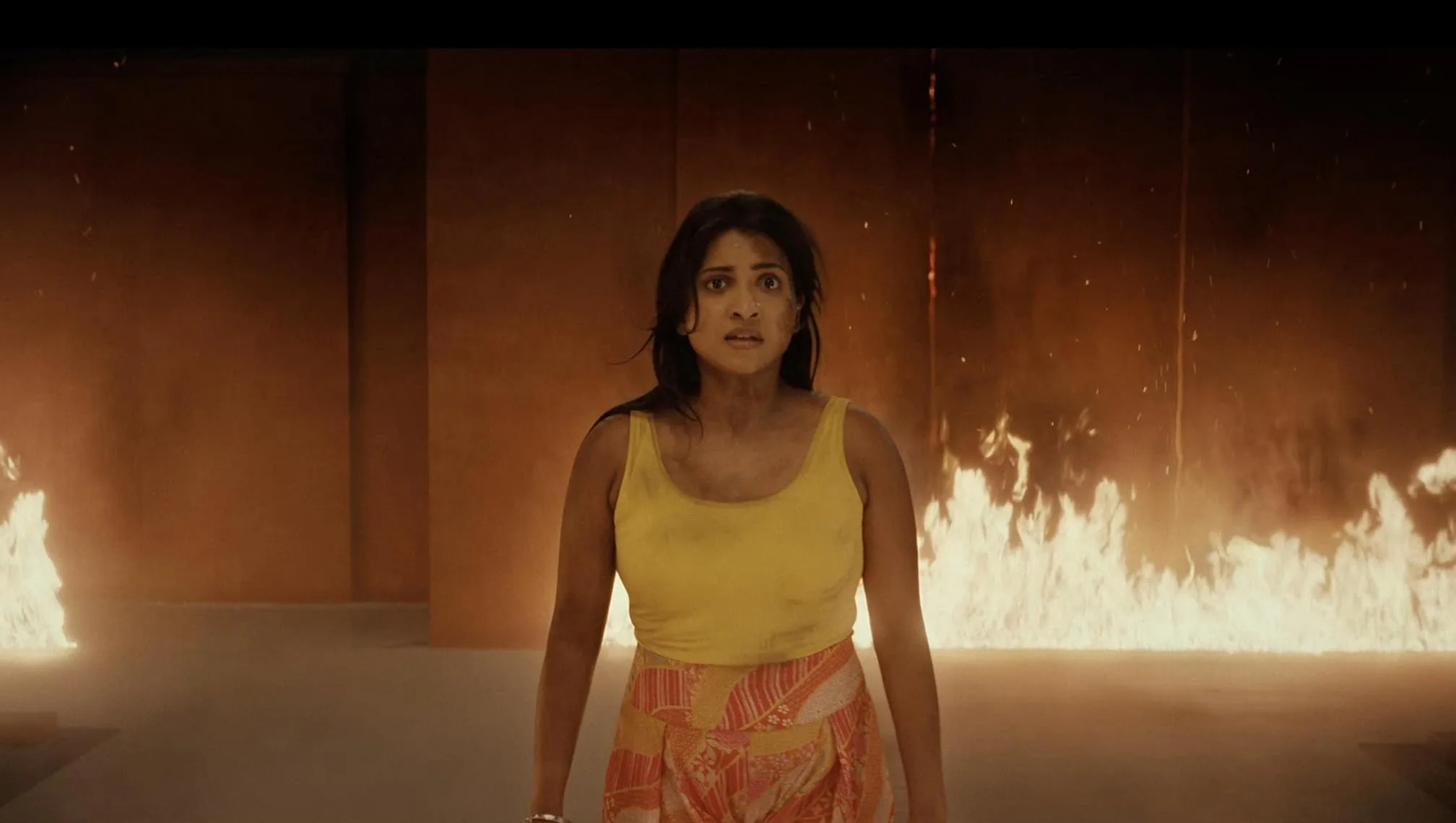

Reyna does not need to misunderstand yoga to exploit it. She understands exactly which fragments can be turned into merchandise, instructor packages, social media credibility, and the reassuring appearance of diversity. That distinction gives Namaslay its sharpest material.
Sibling filmmakers Rish Arhant-Sudhir and Kanish Arhant-Sudhir build their debut around Gayatri (Kirunthuja Srikanth-Talim), a Tamil American woman who moves from New Jersey to Los Angeles while grieving her grandmother Paati (Usha Krishnan). Yoga belonged to their relationship long before Gayatri encounters the polished studio run by Reyna (Christina Moore). Judy (Angela Sant’Albano), Gayatri’s friend, convinces her to attend a class, and Reyna quickly sees an opportunity. The studio needs diversity. Gayatri has the right background. Soon, both women are training to become instructors.
The setup gives the title’s pun a sharper edge. Reyna’s business takes something rooted in spiritual practice and converts it into an expensive lifestyle whose customers can buy the correct clothing, books, classes, and eventually the authority to teach it.
The Price of Authenticity
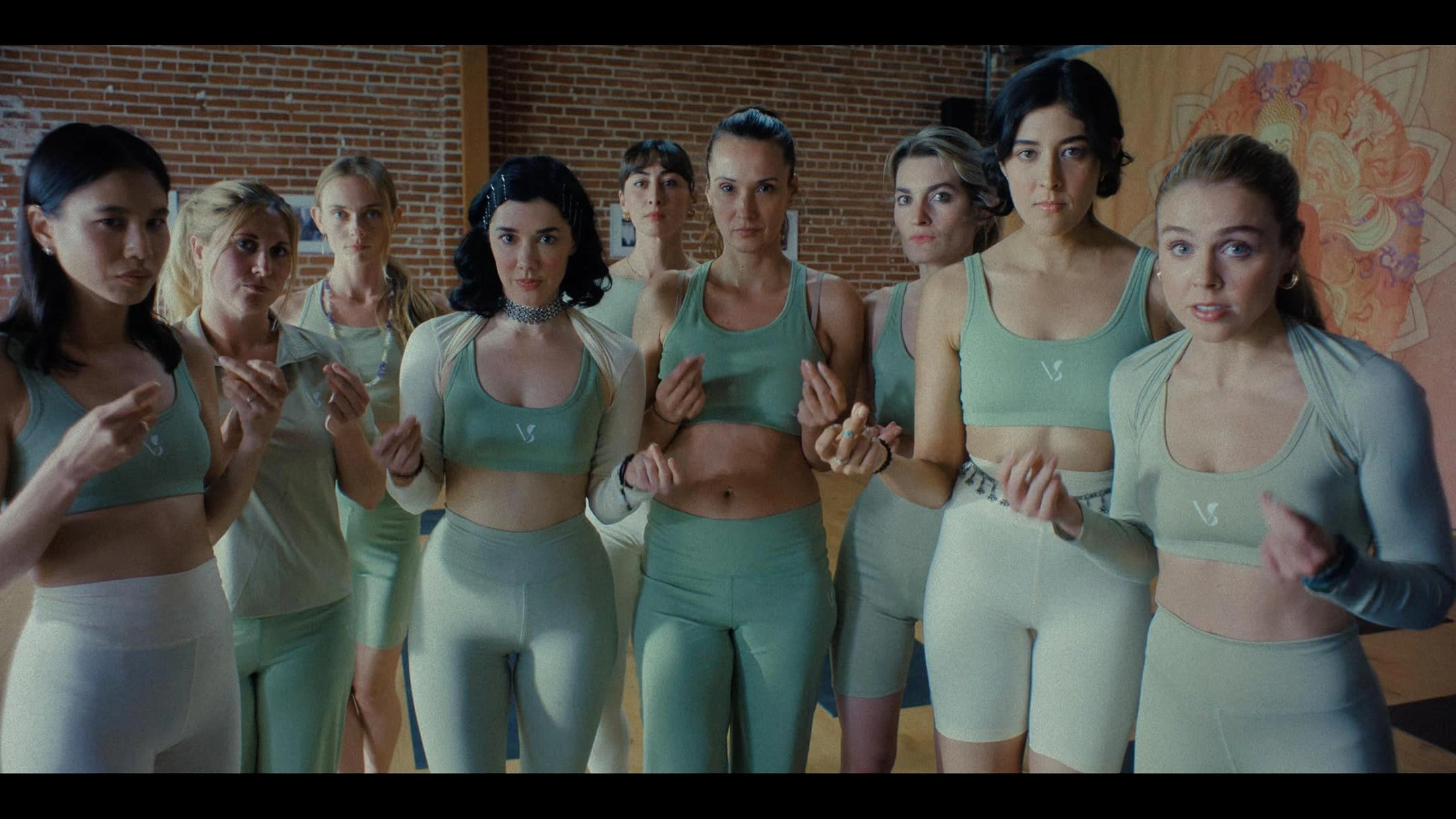
Christina Moore’s performance works because Reyna rarely behaves like someone who considers herself exploitative. She speaks in the polished vocabulary of wellness and inclusion, adjusting her phrasing whenever she senses she has crossed a line. The smile usually survives the correction. The irritation underneath it does not.
Gayatri becomes valuable because Reyna can present her as proof of authenticity, yet the retreat exposes the conditions attached to that acceptance. Gayatri teaches yoga in the manner Paati taught her, retaining its spiritual foundations. Reyna finds the approach unsuitable for the studio. Judy’s more commercial interpretation fits better. It is a precise joke about cultural consumption: the source is welcome until the source interferes with the product.
The film makes this distinction tangible through Paati’s flashbacks. Usha Krishnan gives those scenes warmth and authority, particularly when the younger Gayatri pushes against traditions she will later struggle to reclaim. Yoga here carries memory between generations. Reyna’s studio treats the same practice as intellectual property with scented candles.
Also Read






Judy complicates the argument nicely. Angela Sant’Albano plays her as affectionate toward Gayatri yet increasingly comfortable with the benefits Reyna’s world offers her. Their friendship strains because Judy can participate in this system without paying Gayatri’s cultural price. The conflict is strongest when neither woman needs to announce what it represents.
Masala by Design
Rish and Kanish identify Namaslay with masala cinema, and the label matters. Indian popular cinema has long permitted melodrama, comedy, romance, music, action, and heightened spectacle to coexist without apologizing for crossing genre lines. Here, that freedom allows family grief and workplace satire to sit beside supernatural horror.
The boldest expression arrives after Gayatri is pressured into taking ayahuasca. Her hallucination becomes a mountaintop dance sequence, complete with heightened backgrounds, choreography, and theatrical color. It briefly gives the film a sense of scale its modest production rarely reaches elsewhere. Rather than treating the musical detour as a joke about Indian cinema, the directors use its formal excess as part of Gayatri’s psychological and cultural world.
The Tamil and English yoga-pose title cards perform a similar trick on a smaller scale. Their funniest appearance accompanies a dead body with “Corpse Pose,” letting wordplay and violence occupy the same beat.
Problems emerge when the supernatural threat becomes dominant. Earlier hints, including Reyna’s dead partner and unexplained disappearances around the studio, promise something sinister beneath the immaculate branding. Yet the first hour spends too long restating Gayatri’s discomfort and Reyna’s suspicious behavior. At 112 minutes, the film leaves its horror waiting outside the studio door.
The final confrontation then demands mythological scale, physical terror, and effects work that the production cannot consistently provide. Some visual effects look too artificial, while the action lacks the conviction of the quieter confrontations between Gayatri and Reyna. Cultural theft expressed through a polite conversation about “authenticity” proves more unsettling than several supernatural images intended to make the same argument literal.
What Gayatri Inherits
Srikanth-Talim prevents those tonal shifts from scattering the film. Gayatri does not remain at the studio because she somehow fails to see what is happening. She is grieving, newly relocated, looking for community, and drawn toward a professional opportunity connected to something Paati once gave her. Her hesitation before accepting Reyna’s attention makes the decision credible.
That emotional thread gives the eventual conflict significance beyond defeating an obvious antagonist. Reyna initially recruits Gayatri because her heritage can authenticate the studio. Gayatri becomes a threat once she insists that heritage carries obligations Reyna cannot package.
The irony is especially fitting for a film drawing from masala traditions while criticizing Western habits of cultural extraction. Namaslay uses an Indian-rooted cinematic vocabulary to examine what happens when another Indian-rooted practice is stripped down for sale. Its horror finale may lack the resources to match that idea, but the instructor retreat already delivers the crueler image: Gayatri is welcomed as the face of authenticity, then corrected the moment she tries to define what authenticity means.
Namaslay premiered in theaters on August 13, 2026. The genre-smashing horror satire centers on a yoga instructor attending an exclusive retreat who uncovers dark secrets regarding westernized wellness culture.
Where to Watch Namaslay (2026) Online
Full Credits
Title: Namaslay
Distributor: Theatrical release
Release date: August 13, 2026
Running time: 1 hour 52 minutes
Director: Kanish Arhant-Sudhir, Rish Arhant-Sudhir
Writers: Kanish Arhant-Sudhir, Rish Arhant-Sudhir
Producers and Executive Producers: Kanish Arhant-Sudhir, Rish Arhant-Sudhir, Venk Potula
Cast: Kiru Srikanth, Angela Sant’Albano, Alicia Mitchell-Mangual, Usha Krishnan
Director of Photography (Cinematographer): Samudranil Chatterjee
Composer: Aashray Harishankar
The Review
Namaslay
Namaslay understands that its most potent horror is cultural extraction performed with a smile. Rish and Kanish Arhant-Sudhir give Gayatri’s inherited relationship with yoga real weight through Paati’s memories, then set it against Reyna’s polished business of selling authenticity. The masala approach permits satire, family drama, musical spectacle, and folklore to share the screen, with the ayahuasca dance sequence showing its possibilities. The 112-minute structure weakens that ambition, and the supernatural finale asks visual effects and action staging to carry weight they cannot sustain. Kirunthuja Srikanth-Talim and Christina Moore keep the clash sharp.
PROS
- Sharp cultural appropriation satire
- Srikanth-Talim’s grounded performance
- Moore’s controlled comic menace
- Inventive masala genre play
- Memorable hallucination sequence
CONS
- Overextended 112-minute runtime
- Repetitive middle stretch
- Horror arrives too late
- Underpowered climactic effects