




























Ann Oren treats sexual desire like an unstable material, something capable of migrating from flesh to fabric, from skin to wood, from another person to a stolen lighter. Objet a places that instability inside the immaculate life of Ingeborg (Aenne Schwarz) and Adam (Louis Hofmann), celebrated hand surgeons whose domestic routine carries the precision of an operating theatre. They exercise, eat boiled eggs, dress in severe black, and move through surgery with practiced efficiency.
Their bedroom follows its own strict choreography. Ingeborg’s fingertips are hypersensitive, turning touch into concentrated erotic sensation. Adam wants to become passive matter, asking to be handled “like a doll” and finding pleasure in asphyxiation. Conventional intimacy barely registers. Their desires require surfaces, objects, pressure and ritual.
Then Gaia (Simone Bucio) arrives with an abnormal finger that the surgeons remove. She asks to keep the severed tissue so she can bury it. Adam finds the request strange. Ingeborg accepts it. The difference is small, yet it exposes how differently each responds to a body refusing to become medical waste.
The Body Refuses the Routine
Ingeborg’s carefully managed existence fractures through an appropriately mundane act of compulsion. She steals a lighter from a man on the subway, runs while escaping, falls on the stairs and breaks her tibia. Gaia happens to find her afterward and soon becomes her driver and assistant.

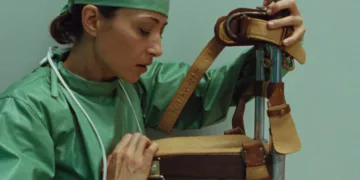
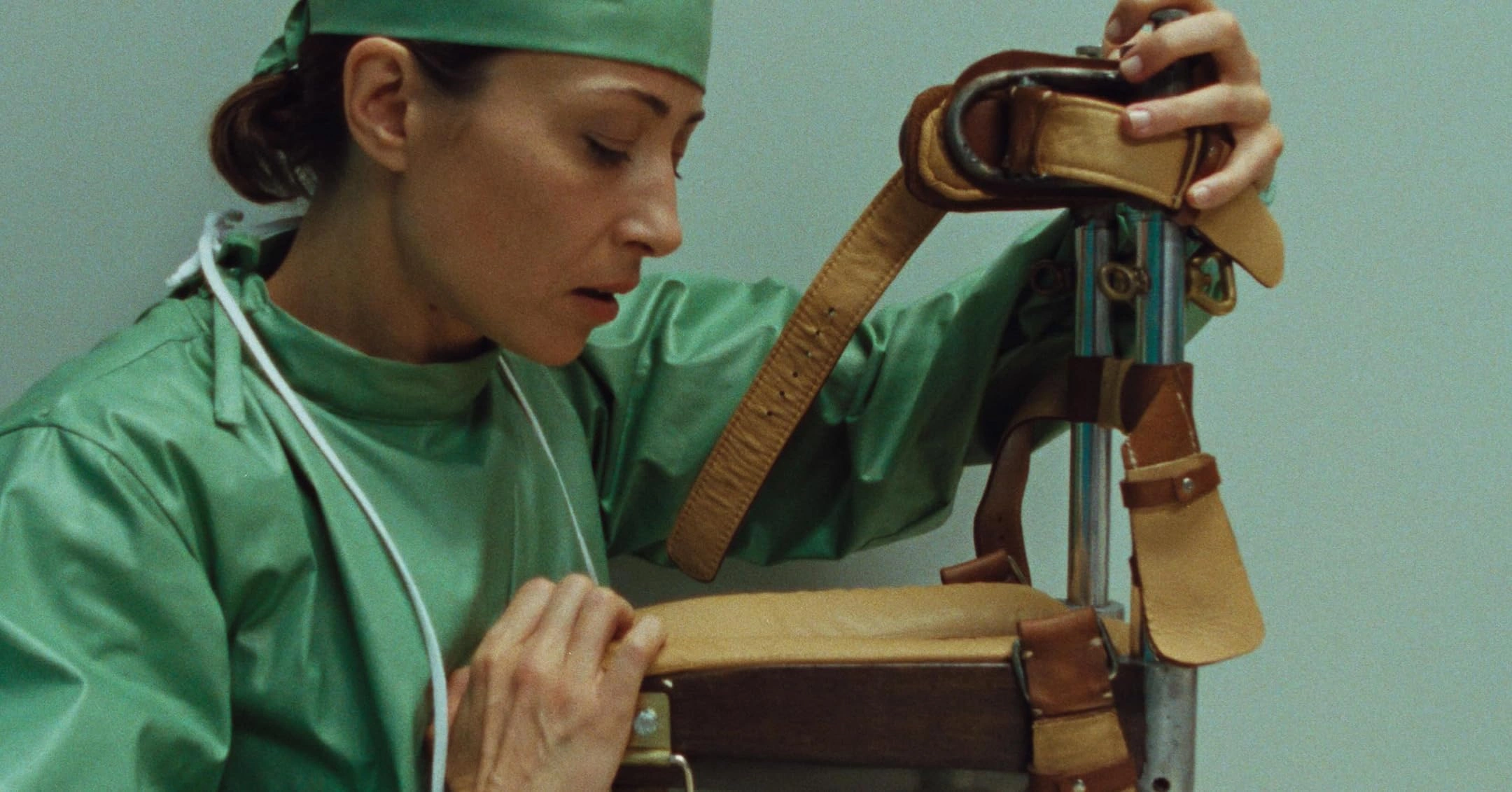
Rest would require Ingeborg to surrender control, so she instead acquires a custom leg support from a shop called Objet a. The name invokes Jacques Lacan’s “objet petit a,” the elusive cause that keeps desire moving toward objects without allowing permanent satisfaction. Oren makes the theory physical. The brace becomes a new erotic surface, fashioned from wood and leather, altering how Ingeborg moves and how Adam looks at her.
Adam’s fascination reveals something already present within their marriage. He does not merely desire Ingeborg. He desires the condition of objecthood represented by her brace. His separate attempt at finding a sexual partner makes the same point with dry precision: contact begins through photographs deliberately left around a bar, converting seduction into an exchange of images even when an actual conversation remains possible nearby.
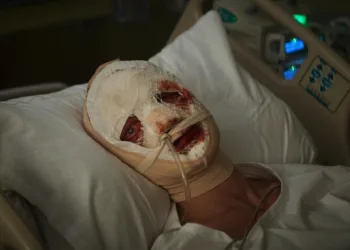
Gaia disrupts this system because her presence refuses clean distinctions. Patient becomes employee. Employee becomes erotic fixation. Human skin sits beside fungi, moss-like hair and strangely charged sweat. The sterile professional world begins admitting organic matter it previously kept outside.
Flesh, Wood and Fungi
Oren’s smartest decision is to deny these desires the spectacle of deviance. Nobody receives a speech explaining their sexuality. Nobody is punished simply for possessing an unusual appetite. Ingeborg touches fabric with the same concentration she brings to surgery. Adam submits his body to wrapping and pressure. Their behavior can be funny because it is treated with such solemn procedural care, yet the camera never sneers.
Schwarz makes Ingeborg’s transformation visible before the script names it. Her early posture is almost architectural, shoulders controlled and gestures economical. After the accident and Gaia’s arrival, that containment begins to loosen. Fingers linger. Attention wanders. Her body starts answering stimuli before her disciplined persona can reorganize them.
Hofmann builds Adam around surrender. His arousal comes through losing control over breath, movement and physical autonomy, culminating in a beautifully crafted wooden corset shaped around his torso. The object resembles armor stripped of any protective purpose. It confines him because confinement is exactly what he wants.
Bucio takes the opposite route. Gaia’s stillness gives her an elemental quality without turning her into a mystical cipher. Her connection to soil, fungi and bodily secretions makes her seem incompatible with a household built around surgical cleanliness.
Climate catastrophe keeps entering Adam’s sexual vocabulary. Near climax, he recites words associated with typhoons, pandemics and environmental collapse. The joke carries an ugly recognition: ecological panic has penetrated so deeply that even pleasure cannot escape it.
From Surgical Precision to Fever Dream
Juan Sarmiento G.’s Super 16mm cinematography initially supports the couple’s controlled environment through orderly frames and subdued interiors. As Gaia’s influence spreads, greens become richer, flesh looks warmer and organic textures begin claiming visual territory.
Sound is equally physical. Fabric brushing fingertips, leather pressing against skin, tongues meeting surfaces and surgical instruments contacting flesh receive heightened attention. Oren turns friction into language. A hand moving across cloth can carry the dramatic weight another film might assign to a confession.
The later passages abandon some of the formal discipline that makes the first two-thirds so exact. Camerawork becomes looser, bodies and materials begin merging, and Gaia’s presence drives the story toward abstraction. The shift can feel less precise than the marital study preceding it, particularly once imagery starts replacing the sharply observed rituals that gave Ingeborg and Adam such definition.
Yet this loss of control belongs to the film’s cultural argument. Modern life has taught these surgeons to classify bodies, isolate impulses and convert nature into material that can be cut, repaired or discarded. Gaia makes those categories porous. Fungi invade clean spaces. Prosthetics become erotic. Human bodies begin resembling crafted objects while crafted objects acquire sensual lives of their own.
Objet a locates desire in the places polite culture prefers to keep separate: medicine and sex, disability and pleasure, ecology and fetish. Oren does not ask permission before placing them together. She simply watches what happens once the partitions start rotting.
Objet A premiered on August 11, 2026, at the 79th Locarno Film Festival, with future North American distribution secured through Oscilloscope Laboratories. The story centers on two visionary hand surgeons whose tightly controlled life together begins to unravel when an enigmatic third party enters their world, stirring unexpected fixations and desires.
Full Credits
Title: Objet A
Distributor: Grandfilm, Oscilloscope Laboratories
Release date: August 11, 2026
Running time: 1 hour 35 minutes
Director: Ann Oren
Writers: Ann Oren, Geoffroy Grison
Producers and Executive Producers: Kristof Gerega, Fabian Altenried, Sophie Ahrens
Cast: Aenne Schwarz, Louis Hofmann, Simone Bucio, Georg Friedrich, Sofia Kokkali, Duncan Hodgkinson Luis, Martina Roth
Director of Photography (Cinematographer): Juan Sarmiento G.
Editors: Hansjörg Weißbrich
Composer: Kyan Bayani
The Review
Objet a
Objet a turns fetish, prosthetics, fungi, and ecological anxiety into a precise study of people who have sterilized desire until nature begins reclaiming the room. Ann Oren’s tactile direction makes leather, wood, sweat, skin, and surgical instruments speak with greater fluency than dialogue, while Aenne Schwarz gives Ingeborg’s unraveling a disciplined physical intensity. The late drift toward abstraction sacrifices some of the earlier sections’ exactitude, yet the film’s refusal to police the borders between body, object, and environment remains its sharpest provocation.
PROS
- Extraordinary tactile filmmaking
- Schwarz’s controlled physical performance
- Inspired production and costume design
- Bold treatment of fetish and desire
- Striking Super 16mm imagery
CONS
- Final act grows overly abstract
- Emotional distance can become alienating
- Gaia remains deliberately elusive