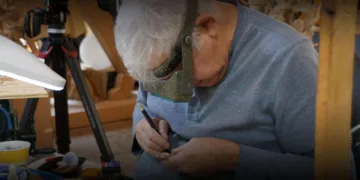

















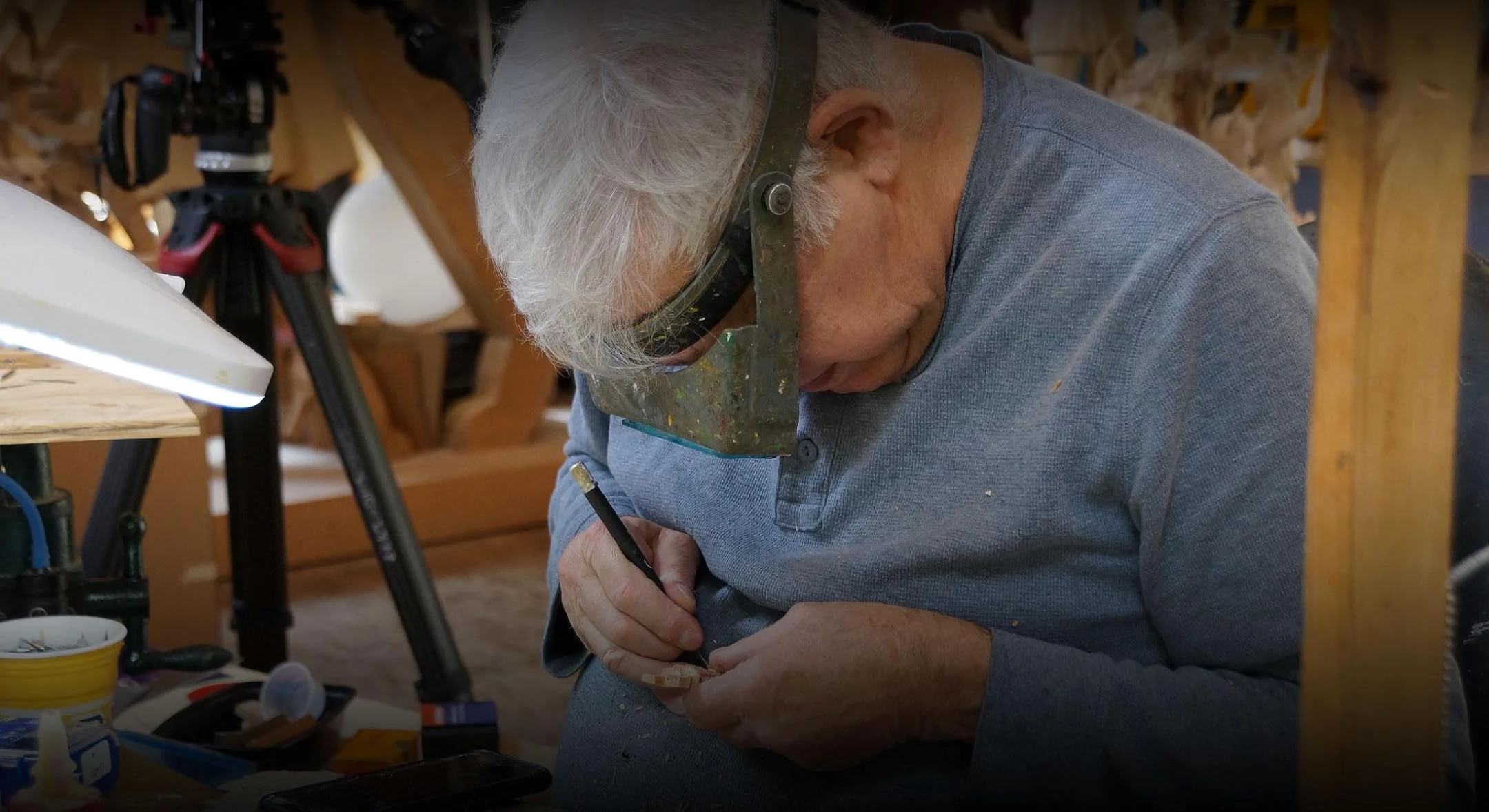

James Grashow spends much of Jimmy & The Demons carving figures that seem built to survive him. Cindy Meehl understands the contradiction immediately. Her documentary watches a 79-year-old artist shape demons, apostles, burning souls, and the face of Christ while his own body grows less cooperative. The wood stays still. Jimmy does not.
The project consuming him is The Cathedral, a massive commission depicting Jesus carrying a church across his back while grotesque creatures gather below. Grashow speaks about being in life’s “bottom of the ninth,” language made sharper by a previous pulmonary embolism and his private fear that this could be his final major work. When he admits that he prays he gets to finish it, Meehl does not underline the statement with melodrama. She returns to the studio. That choice defines the film. Mortality enters through repetition rather than speeches: another piece of wood clamped down, another carved face, another day when Jimmy looks tired and continues anyway.
Meehl filmed the process across several years. Grashow died in late 2025, after production had finished. Knowledge of his death changes how certain images register, yet the film resists turning every carving into a premonition. Jimmy remains too funny, restless, and stubbornly alive for that.
Hell Below, Hope Above
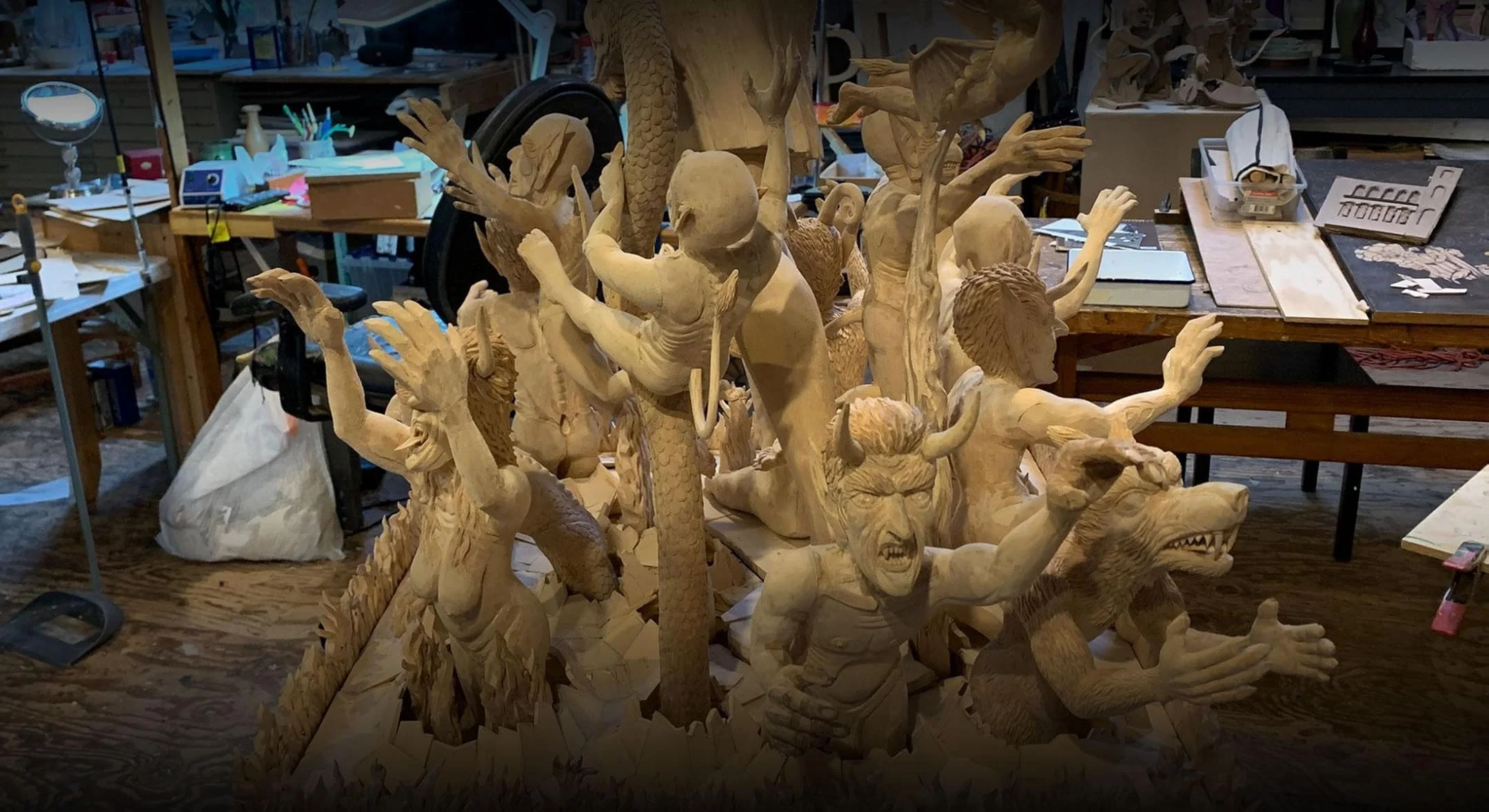
The Cathedral contains the film’s clearest visual philosophy. Jesus bears the building like Atlas beneath the world, while roughly 70 souls burn near his feet and demons crowd the lower reaches. The composition creates a vertical moral geography: torment below, spiritual aspiration above, one exhausted body holding the structure together.
Jimmy calls the sculpture a self-portrait. He does not mean that he sees himself as Christ. He recognizes himself in the distance between despair and hope. Meehl repeatedly lets the camera study the details that make this idea tangible. The cathedral opens to reveal painted interiors and a tiny praying figure.
Twelve Apostles occupy recesses around its exterior. One carries a teddy bear because Jimmy sees no reason an Apostle should not have one. Another resembles his friend Rick, represented with a hammer and paintbrush because helping people defines him. Later, Rick arrives to assist Jimmy with the sculpture itself, collapsing the distance between symbolic representation and ordinary friendship.
Even the demons refuse pure menace. Jimmy discusses carving their nipples with enough amusement to puncture any temptation toward solemnity. That humor matters. It keeps the imagery from becoming a neat diagram of good against evil. The smallest detail may carry the greatest weight. Above the cathedral sits a bell, and above that bell rests a bird. Jimmy sees the bird as hope. It occupies very little physical space. It does not need much.
The Workshop as Confessional
Meehl’s camera becomes most revealing when it simply stays near Grashow while he works. The studio functions like a confessional without a priest. Sawdust gathers. Tools scrape against wood. Jimmy talks about death, love, fear, imperfection, and the strange obligation to keep making things while knowing that every project eventually leaves its maker behind.
The physical process prevents these reflections from drifting into abstraction. When he speaks about mortality, his hands are usually busy shaping a demon or correcting some minute feature. Philosophy has a workbench here.
The film also reaches backward through archival photographs and footage. Grashow studied at Pratt Institute, received a Fulbright scholarship, created illustrations for publications including The New York Times, and designed album artwork such as Jethro Tull’s Stand Up. His cardboard sculptures reached institutions including the Museum of Modern Art.
His attitude toward cardboard is revealing. He rejects the assumption that permanence determines artistic worth. Cheap material can hold serious meaning. Wood can rot. Museums can misjudge artists. Nothing receives immortality by contract.
That position becomes especially pointed when the documentary touches on tensions between Grashow and the commercial art establishment. Meehl does not spend enough time there to turn the film into an institutional critique, yet the friction matters. Jimmy’s career survives because he keeps returning to the act of making. Guzzy and the Life Outside the Frame
The darkest passages gain definition from Lesley “Guzzy” Grashow, Jimmy’s wife of over five decades. Their marriage gives the film another measure of duration. The Cathedral may require years. Their shared life has required generations of patience.
Guzzy also sees what Jimmy occasionally refuses to acknowledge: his devotion to work can become physically destructive. He pushes through exhaustion and pain while she watches the cost accumulate. His request that the filmmakers avoid telling her he thinks The Cathedral may be his final piece is quietly devastating. He can carve infernal creatures without hesitation. Naming his own ending proves harder.
Their children, friends, fellow craftspeople, and former students widen the portrait. Footage of Jimmy leading workshops for children shows him encouraging instinct and play, the same impulses visible decades later when he gives an Apostle a teddy bear or invents another strange creature at his bench. His daughter recalls how he taught her to notice magic in ordinary life.
Meehl collected hundreds of hours of footage, and the best passages retain the patience implied by that volume. Her film watches creation happen slowly enough for obsession, humor, fear, commerce, marriage, and physical decline to occupy the same space. The Cathedral rises from that accumulation. Demons below. A bird above. Jimmy somewhere between them, still carving.
Jimmy & The Demons premiered at the Tribeca Film Festival in June 2025 before launching its limited US theatrical release on April 3, 2026. The philosophical art documentary follows acclaimed 79-year-old sculptor and woodcut artist James Grashow as he embarks on his ambitious magnum opus—a massive wood sculpture depicting Jesus carrying a cathedral amidst surrounding demons—confronting his mortality, faith, and artistic legacy.
Where to Watch Jimmy & The Demons (2026) Online
Full Credits
Title: Jimmy & The Demons
Distributor: Cedar Creek Productions, Magnetfilm
Release date: June 7, 2025 (Tribeca Film Festival Premiere), April 3, 2026 (US Theatrical Release)
Running time: 1 hour 33 minutes
Director: Cindy Meehl
Writers: Cindy Meehl
Producers and Executive Producers: Elizabeth Westrate, Cindy Meehl
Cast: James Grashow, Guzzy Grashow, Rabbi Zoë Klein, Zach Grashow
Director of Photography (Cinematographer): Scott Alexander Ruderman
Editors: Toby Shimin
Composer: Tyler Strickland
The Review
Jimmy & The Demons
Jimmy & The Demons finds its moral architecture in sawdust, aching hands, and a wooden Christ carrying impossible weight. Cindy Meehl lets James Grashow’s studio become a chamber where fear of death and delight in creation occupy the same frame. The Cathedral supplies the film with its richest visual argument, especially when tiny gestures like the bird above the bell answer the demons gathered below. Some career history moves quickly, yet the patient observation of Grashow at work gives the film unusual intimacy.
PROS
- Intimate observational filmmaking
- Rich visual symbolism
- Grashow’s magnetic personality
- Detailed Cathedral sequences
- Mortality handled with restraint
CONS
- Career history feels compressed
- Art-world conflicts receive limited space
- Family perspectives stay secondary