




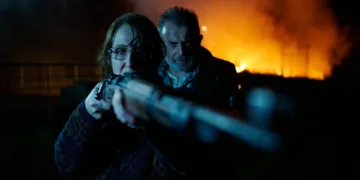










The most useful thing Bury the Devil does with its opening house fire is remove the question of survival from the equation. Flames consume the lakeside home while screams travel across the water, then Adam O’Brien rewinds the clock by 75 minutes. From there, nearly everything unfolds in real time.
Hospice nurse Julia (Emmanuelle Lussier Martinez) has arrived for her first night caring for Evelyn (Dawn Ford), an elderly woman experiencing severe memory loss. The assignment initially consists of familiar routines: getting Evelyn settled, speaking with Julia’s worried father on the phone, checking rooms, and gently correcting her patient when Evelyn mistakes her for someone else. That someone is Sarah, Evelyn’s deceased daughter.
The film gradually makes that confusion harder to explain medically. Julia finds disturbing paintings, books carrying strange symbols, unusual markings, and an old recording involving Evelyn and Sarah. When Evelyn begins wandering through the darkened house, her appearances carry an extra sting because the camera has already taught us the geography. We know which hallway Julia just checked. We know which room should be empty. Then Evelyn is standing there.
One Camera, No Escape
O’Brien and cinematographer Benoît Beaulieu build almost the entire film around the illusion of one uninterrupted shot. You can occasionally detect where a transition may be hiding, especially when the camera passes through windows, doorways, or other convenient visual barriers, yet spotting the trick rarely diminishes what the crew is pulling off. The harder achievement is making the technique affect how the horror feels.
Julia cannot simply cut from Evelyn’s bedroom to another part of the house, so neither can we. Every staircase has to be climbed. Every corridor has to be crossed. When she hears something behind her, turning around takes time. That physical continuity gives the house weight. It stops feeling like a collection of sets and begins behaving like a space we have reluctantly memorized.
Beaulieu’s lighting helps. Candles, wood-paneled rooms, dark corners, and the black shapes dominating Evelyn’s paintings provide enough information to keep the image readable while leaving patches of uncertainty around Julia. The best scares exploit those areas quietly, letting Evelyn emerge somewhere unexpected rather than announcing every threat.
Real time carries a price. Julia spends a fair stretch of the first act walking between rooms, checking on Evelyn, examining objects, and completing tasks that conventional editing would compress into seconds. The camera occasionally tries too hard to compensate, circling conversations or spinning around actors until movement becomes distraction. Motion itself cannot manufacture tension. Still, when the technique settles down, it creates the film’s strongest sensation: there is nowhere else for us to go. If Julia has to stay in the house, the camera stays too.
When Evelyn Stops Being Evelyn
Dawn Ford gets the film’s sharpest transformation. Early Evelyn is confused and vulnerable, moving between brief clarity and moments when Julia becomes Sarah in her mind. Ford makes those transitions abrupt enough to keep Julia uncertain about what kind of situation she is handling. A frightening outburst can still look like another symptom until the evidence stops allowing that interpretation.
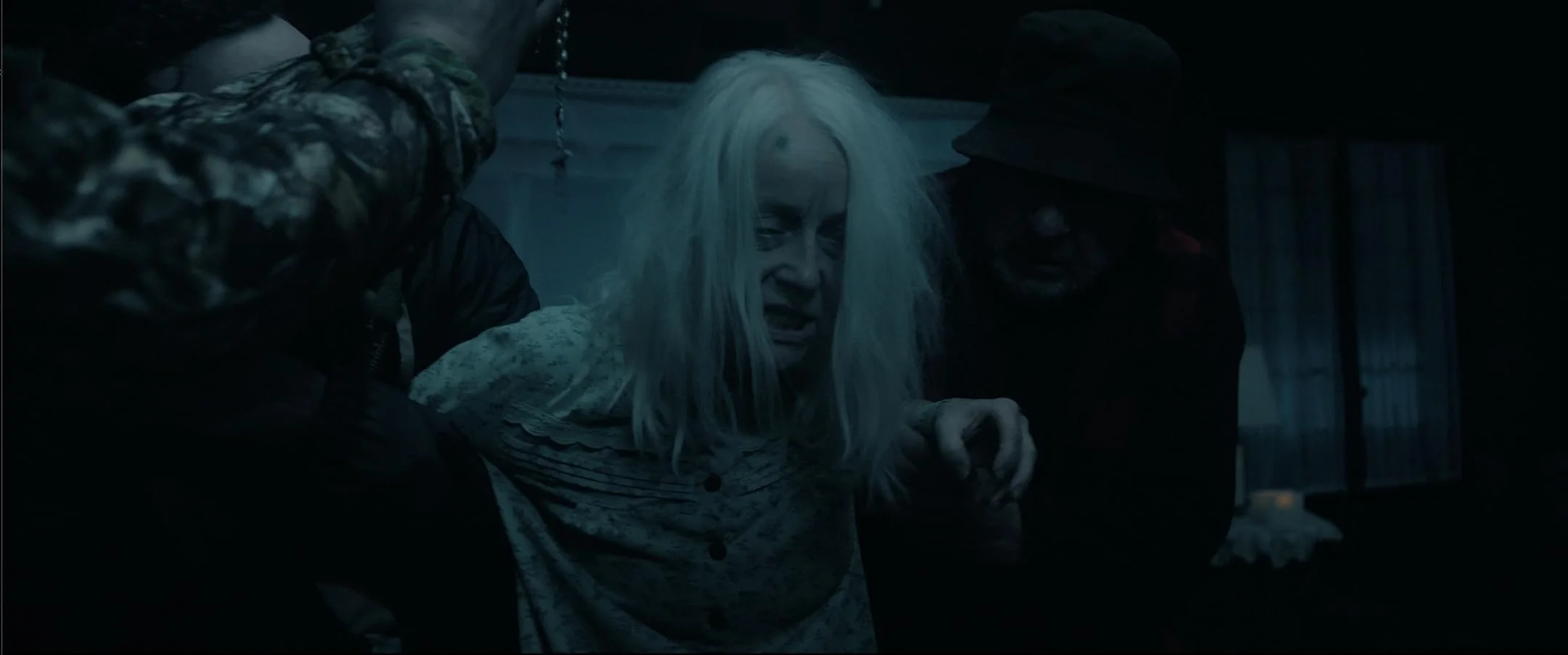
Julia brings grief into the relationship from the opposite direction. She recently lost her mother, while Evelyn keeps reaching toward a daughter who is already dead. That parallel gives their scenes an emotional pressure the supernatural material sometimes struggles to match. Martinez plays Julia with professional patience first, then lets small hesitations creep into her reactions as the house begins contradicting everything she understands.
The long-take construction makes both performances unusually exposed. Actors have to deliver dialogue while hitting physical marks, responding to effects, moving furniture, climbing stairs, and staying synchronized with a camera that cannot casually rescue a scene through coverage. Ford handles this pressure particularly well once Evelyn becomes physically threatening.
The difficulty grows when Evelyn’s ex-husband Randall (Bill Rowat) arrives late at night demanding answers about something Evelyn may have uncovered. His appearance changes the shape of the film. Julia is no longer alone with a possibly possessed patient. She now has strangers insisting that they understand the danger better than she does. More men eventually arrive with similar warnings, and Julia has to decide which version of reality deserves her trust while Evelyn grows less recognizable by the minute.
Familiar Demons
Brad Hodson and John Petrizzi’s screenplay is far less adventurous than O’Brien’s camera. Once Randall enters and the occult explanation begins taking shape, the film moves toward recognizable possession and exorcism territory. Recordings reveal information at useful moments. Symbols point in useful directions. Characters arrive carrying pieces of lore that Julia needs. The opening fire also means the destination is fixed. Suspense depends on the path toward destruction rather than uncertainty about where the night is heading.
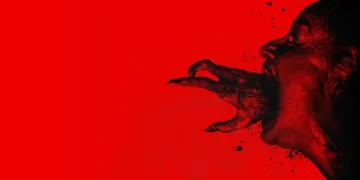
What keeps the material alive is how physically O’Brien stages the escalation. Practical effects have to function inside the same moving environment as the actors and camera, creating moments where bodies, blood, and violent aftermaths appear without the release of an obvious cut. Some brutality occurs outside the frame before the camera reveals what happened, a limitation turned into a useful horror device.
That approach fits Bury the Devil better than its explanations do. The film is most effective when Julia is crossing a familiar hallway and something about the space has changed, or when Evelyn’s face shifts from confusion into something Julia can no longer rationalize. Those moments turn the continuous shot into an emotional mechanism. We feel trapped because Julia is trapped, and because the camera has denied us the small mercy of looking somewhere else.
Bury the Devil premiered at FrightFest Glasgow in March 2026 before receiving its US theatrical and video-on-demand release via Brainstorm Media on August 21, 2026. Filmed in a single continuous shot, the supernatural horror thriller follows a dedicated hospice nurse who gets trapped in an isolated home with her dementia patient as a ancient demonic entity begins seeping through the cracks.
Where to Watch Bury the Devil (2026) Online







Full Credits
Title: Bury the Devil
Distributor: Brainstorm Media, Blue Finch Films
Release date: March 6, 2026 (FrightFest Glasgow), August 21, 2026 (US Theatrical & VOD)
Running time: 1 hour 26 minutes
Director: Adam O’Brien
Writers: Brad Hodson, John Petrizzi, Adam O’Brien, Philip Kalin-Hajdu, Julian Stamboulieh
Producers and Executive Producers: Benoit Beaulieu, Philip Kalin-Hajdu, Adam O’Brien
Cast: Emmanuelle Lussier Martinez, Dawn Ford, Jason Cavalier, Mark Antony Krupa, Bill Rowat
Director of Photography (Cinematographer): Benoit Beaulieu
Editors: Adam O’Brien
Composer: Mario Sévigny
The Review
Bury the Devil
Bury the Devil works best when its roaming camera makes Julia’s confusion feel like our own. Evelyn appearing unexpectedly in corridors, the paintings crowding the walls, and the increasingly frantic movement through the house give a familiar possession story real nervous energy. The script is less memorable, especially once convenient clues and exposition begin explaining the mythology. Still, Adam O’Brien’s real-time approach gives the practical horror a physical immediacy that conventional cutting might have softened. The demon may be familiar. Being trapped in the room with it is the hook.
PROS
- Strong continuous-take illusion
- Effective practical horror effects
- Dawn Ford’s volatile performance
- Atmospheric house and lighting
- Immersive real-time tension
CONS
- Predictable possession story
- Convenient supernatural clues
- Uneven exposition
- Occasional camera overactivity
- Slow early wandering