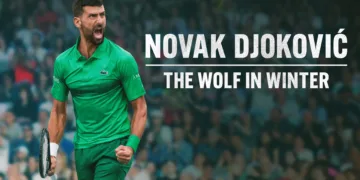




















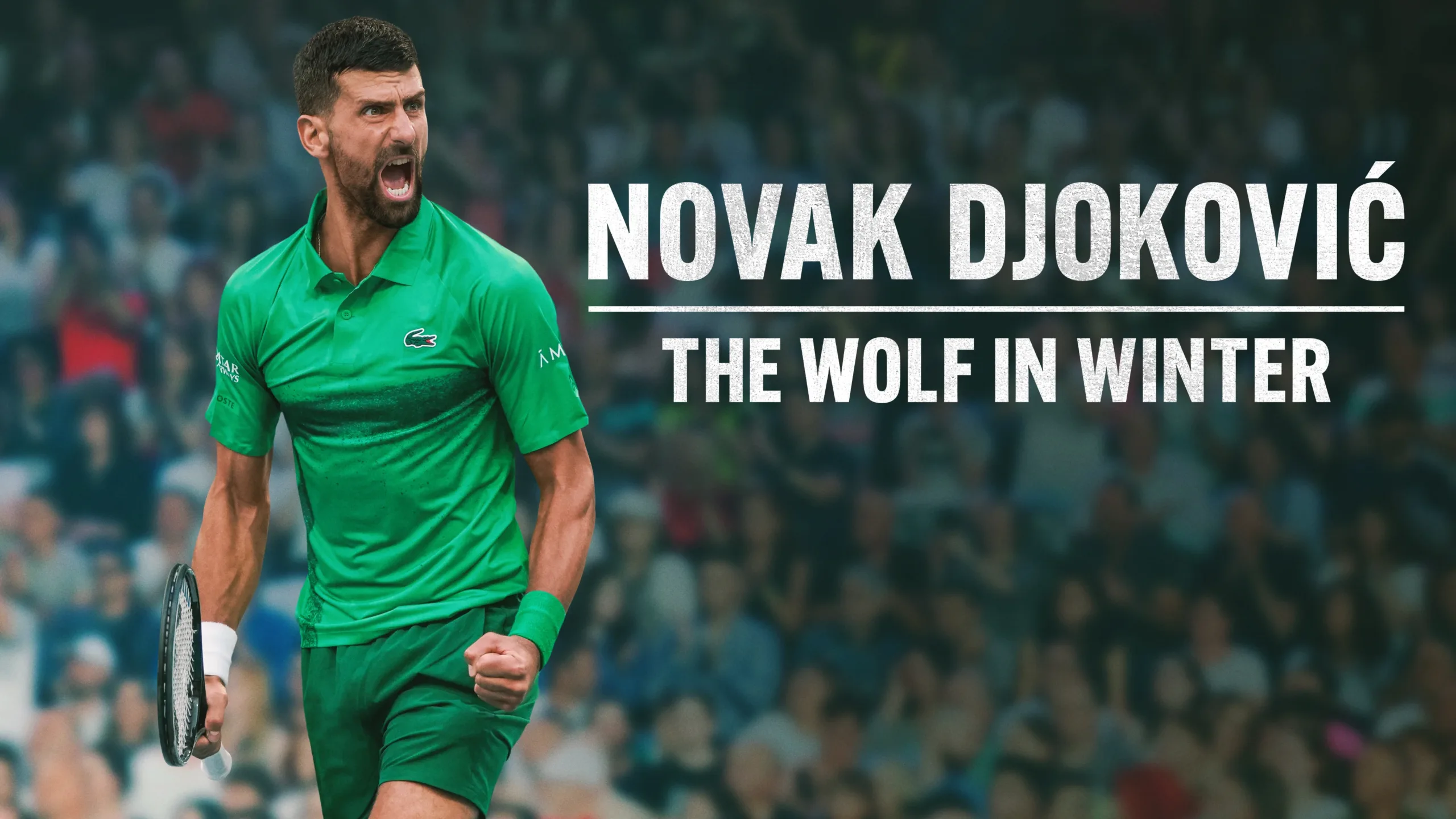

Novak Djokovic has spent much of his career converting rejection into competitive energy, so it feels almost inevitable that retirement would become another opponent to resist. Jason Hehir’s Novak Djokovic: The Wolf in Winter catches him at 39, still speaking about future tournaments while his body increasingly sends a different message.
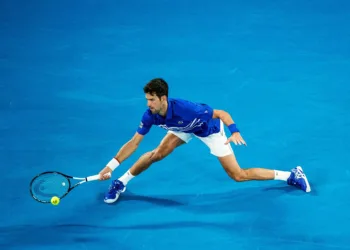
Hehir builds the film around Djokovic’s 2025 Australian Open campaign, using the tournament as a counterweight to the familiar chronology of his career. Djokovic can still defeat Carlos Alcaraz after dropping the first set and suffering a hamstring injury. He can still summon the grim concentration that made him one of tennis’s defining champions. Yet afterward, his language changes.
He talks about mental exhaustion, struggling to enjoy competition, and feeling unable to devote his entire existence to tennis. That tension gives the documentary a subject richer than another procession of trophies. Djokovic spent decades teaching himself that surrender was unacceptable. Now he has to decide what surrender even means.
The Education of Defiance
The childhood material provides the clearest explanation for why Djokovic developed that mentality. Home footage shows a remarkably serious boy holding a pink racquet and speaking about tennis with a certainty that would seem absurd coming from most children. His circumstances soon make that seriousness easier to understand.
Djokovic remembers running for shelter during NATO bombing in Serbia, falling behind his family and seeing explosions strike nearby. Tennis existed beside air raids, economic instability and a family increasingly willing to gamble its security on his talent. His father borrowed money and pursued sponsors. His mother worked relentlessly. Novak eventually left home for Nikola Pilić’s academy in Germany.
The Serbian concept of inat, stubborn resistance in the face of pressure, becomes less a convenient piece of sporting mythology here than a learned response. Djokovic understood early that his career carried consequences for people beyond himself.
Also Read





Hehir is particularly effective when connecting that upbringing to Djokovic’s later position within tennis culture. Federer and Nadal had already become the sport’s beloved binary: elegance against physical ferocity, Swiss control against Spanish intensity. Djokovic arrived imitating fellow players and entertaining crowds, then committed the social sin of becoming good enough to disrupt the arrangement. The cheerful impersonator became the intruder.
Loved Less, Winning Anyway
The film’s strongest cultural argument concerns the strange economy of affection surrounding elite sport. Success theoretically earns admiration. Djokovic discovered that success can also harden resentment when it threatens an established hierarchy.
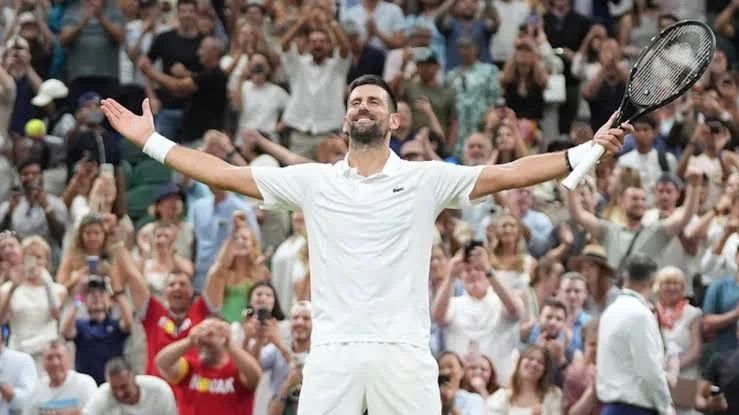
Andre Agassi supplies one of the sharper observations about Djokovic’s psychology, describing a player who appears to want warmth yet often performs best when surrounded by hostility. The pattern appears repeatedly. Medical timeouts early in his career provoked suspicion. Broken rackets and confrontations with spectators deepened an image of volatility. Djokovic responded by learning to turn boos into something resembling tactical equipment.
The documentary is less successful at examining the tennis that produced those reactions. A 92-minute runtime leaves defining matches such as the 2012 Australian Open final and 2019 Wimbledon final largely outside the frame. Nadal appears and acknowledges the extraordinary difficulty of facing Djokovic, yet their rivalry receives little detailed attention. Federer is absent entirely, a striking omission given how deeply Djokovic’s public identity was shaped by challenging him.
Hehir does return to Djokovic’s match-point-saving return against Federer at the 2011 US Open, when an apparently reckless swing became one of the defining gestures of his career. Without Federer reflecting on that moment years later, the scene loses an opportunity to examine how rivalry becomes mythology.
The Wolf in Winter
The 2022 Australian Open controversy exposes the limits of the documentary’s sympathy. Djokovic explains his refusal to receive a COVID-19 vaccination through personal autonomy and his belief that he did not need it as a healthy athlete. Jelena reveals that she advised him against announcing his exemption on social media, while Djokovic insisted the information remain.
Hehir lets the contradiction sit there. The same certainty that enabled Djokovic to reject crowds, expectations and competitive panic also makes him remarkably resistant to perspectives that challenge his own judgment. The film does not need to manufacture an answer because Djokovic supplies the conflict himself.
That rigidity looks different around his family. Footage with Jelena and their children reveals an affectionate, playful father confronting the accumulated cost of tournament life. Jelena refuses to dictate his exit, understanding that a man who constructed his identity around self-determination would hardly accept retirement as somebody else’s instruction.
Then comes Melbourne in 2025. Djokovic defeats Alcaraz through injury, speaks afterward as if his mind has begun rebelling against the demands he still places upon it, and later withdraws against Alexander Zverev. Sections of the Australian crowd boo him as he leaves.
It is a brutal little symmetry. After decades of using disbelief as fuel, Djokovic reaches the stage when the body can no longer be persuaded by anger, history or inat. Hehir’s camera has finally found an adversary that refuses to care how stubborn Novak Djokovic is.
Novak Djokovic: The Wolf in Winter premiered globally on Amazon Prime Video on August 20, 2026. Directed by The Last Dance filmmaker Jason Hehir, the sports documentary offers an intimate look at tennis legend Novak Djokovic, tracing his journey from a war-torn childhood in Serbia to becoming the most decorated men’s tennis player in history.
Where to Watch Novak Djokovic: The Wolf in Winter (2026) Online


Full Credits
Title: Novak Djokovic: The Wolf in Winter
Distributor: Amazon Prime Video
Release date: August 20, 2026
Rating: TV-14
Running time: 1 hour 32 minutes
Director: Jason Hehir
Writers: Jason Hehir
Producers and Executive Producers: Nina Krstic, Rebecca Kuo, Connor Schell, Libby Geist, Alexa Conway, Aaron Cohen, Nick Eisenberg, Jason Hehir, Sadoux Kim, Jeff Blackburn, Alexandra Dell, William P. Zagger
Cast: Novak Djokovic, Jelena Djokovic, Dijana Djokovic, Marco Djokovic, Rafael Nadal, Andre Agassi, Pete Sampras, Boris Becker, Jim Courier, Mary Carillo, Patrick McEnroe, Howard Bryant, Chris Clarey, Matthew Futterman
Director of Photography (Cinematographer): Not Available
Editors: Chad Beck, Paul Frost, Bret Granato, Ross Hockrow
Composer: Eric Byers, Lucia Micarelli
The Review
Novak Djokovic: The Wolf in Winter
Novak Djokovic: The Wolf in Winter is most persuasive when it stops cataloguing greatness and examines the culture that turned Djokovic into both champion and antagonist. Jason Hehir draws a clear line from wartime Serbia and family sacrifice to the defiance Djokovic later weaponized against hostile crowds, yet the abbreviated treatment of Federer, Nadal, and several defining matches leaves part of that argument unfinished. The 2025 Australian Open material gives the film its sharpest tension: a man trained never to surrender confronting a body, family, and future that demand another definition of victory.
PROS
- Strong childhood material
- Revealing 2025 Australian Open footage
- Thoughtful examination of public hostility
- Excellent access to Djokovic and his family
CONS
- Major matches receive little attention
- Federer’s absence is conspicuous
- Rivalries lack deeper examination
- Some psychological questions remain untouched