





























Camilo saves a drowning millionaire and spends the rest of Hombre Al Agua learning how expensive rescue can be. Gael García Bernal plays the Cuban lifeguard who pulls Mexican businessman Abel (Jorge Salinas) from the sea, accepts a job in his company, marries Abel’s daughter Juana (Esmeralda Pimentel), and somehow wakes up inside a life that appears to belong to somebody else.
Bernal, directing from a script he co-wrote with Argentine playwright Mariano Pensotti, treats that transformation like a crooked fairy tale. Camilo acquires the estate, the corporate position, the wife and the baby, yet his authority keeps shrinking as his comforts increase. It is an interesting reversal of the usual rags-to-riches structure. The reward is real. So is the trap.
What makes the premise interesting is that Camilo barely drives it after the rescue. Abel chooses his professional future. Juana dictates much of his domestic identity. Later, politics and filmmaking turn him into material for still other people. The man who once acted instinctively in the ocean becomes increasingly passive on dry land.
Privilege Without Power
That passivity works best when Hombre Al Agua gives it a concrete social cost. Abel can parade Camilo’s Cuban background around the boardroom when diversity proves useful, then expect him to blend seamlessly into the family’s world everywhere else. Juana takes the contradiction somewhere far stranger during their sexual role-playing, asking Camilo to disguise his Cuban accent and perform another version of himself.
The scene is funny until it suddenly is not. Bernal plays the discomfort quietly, letting Camilo’s hesitation do the work instead of turning the moment into a speech about identity. His character has gained access to a class that once existed far above him, yet belonging requires constant adjustments to the person who gained that access.
Juana then begins writing and directing a movie about her own life, including her career as a pole vaulter and her belief that rich people face prejudice. Brazilian actress Fabiana (Débora Nascimento) arrives to study her, effectively moving a fictional copy of Juana into Juana’s own home.
Camilo fares worse. Ricky Martin appears as the handsome actor hired to portray him, making Camilo watch somebody else inherit his identity on screen. When circumstances eventually place Camilo in the role himself, the film finds one of its smartest ideas. Reading Juana’s scripted version of their relationship lets him say things to her that he cannot manage in ordinary conversation. Performance becomes his clearest route toward honesty.
Politics, Movies and Manufactured Selves
The same idea spreads into Abel’s business life. His company is preparing for a sale to European buyers, workers face layoffs, and Abel responds to his deteriorating circumstances by entering politics. Camilo becomes a trusted aide, only to hear Abel explain campaigning as a matter of controlling what voters see rather than exposing who a candidate really is.
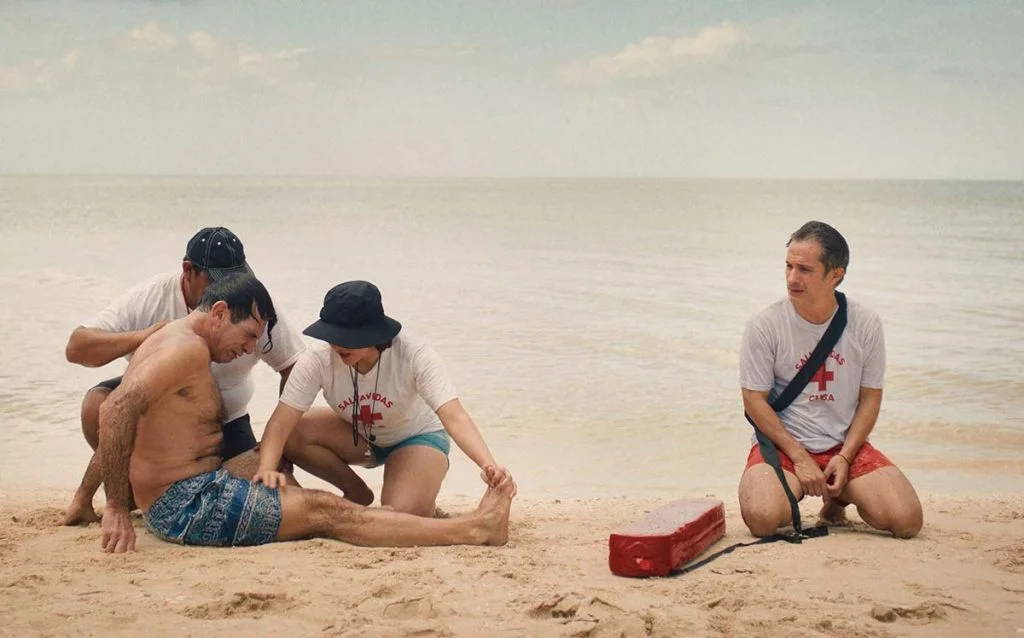
Bernal keeps multiplying those manufactured realities. Juana has her autobiographical film. Abel has campaign advertisements. The factory gets its own engineered narrative. Camilo repeatedly watches melodramatic television, including black-and-white material that briefly takes control of the movie’s visual language. Even intimacy becomes role-play.
I like the basic design because it makes fiction functional. These characters are constantly editing themselves, casting others, or selling an image. Camilo is simply the least powerful editor in the room.
The trouble is volume. Abel’s pregnant mistress Silvina (Natalia Oreiro) arrives at the estate. Fabiana develops her own place inside the household. Factory unrest grows. Abel’s political ambitions expand. Sexual jealousy, class resentment, immigration, masculine insecurity and corporate corruption all start demanding space.
Individual scenes can still land, especially Abel conducting political business with the casual entitlement of someone who assumes every room belongs to him. The threads surrounding those scenes rarely receive enough time to develop before another idea pushes forward.
The Frame Swallows the Man
Fabrizio La Palombara’s cinematography provides a cleaner expression of Camilo’s predicament than the screenplay sometimes does. Bernal frequently stages conversations across deep spaces, allowing characters to move through large rooms while the camera tracks them fluidly across several visual planes.
Camilo often looks small inside those compositions. Bernal rarely rushes toward the close-up that would normally secure the protagonist’s emotional authority. It is an elegant visual choice because the environments seem to absorb him: Abel’s estate, the factory, Juana’s production, the political machine.
It also creates distance. A passive protagonist already asks an audience to work harder to understand what he wants. Keeping Camilo physically removed can make his internal life harder to reach, and the intermittent narrator never appears consistently enough to solve that problem.
The film is funniest about its own artificiality. A poster for The Motorcycle Diaries appears behind Fabiana, with Bernal’s real name visible, briefly allowing the actor-director’s career to leak into Camilo’s fictional world. Bernal wisely leaves the gag hanging instead of turning the movie into a puzzle about its own reality.
That restraint makes the crowded structure slightly frustrating. Hombre Al Agua has sharp visual ideas about class, performance and authorship, yet its many fictional layers keep competing for control in much the same way its characters do. Camilo finally gets the chance to speak through a role written for him. By then, the film has spent so long rewriting his life that hearing his own voice feels almost illicit.
Hombre al agua premiered at the Venice International Film Festival in September 2026. The class satire follows a Cuban lifeguard who marries a wealthy businessman’s daughter after saving him, only to realize he has stepped into a web of manipulation.
Full Credits
Title: Hombre al agua
Distributor: The Pool Films, La Corriente del Golfo
Release date: September 2026 (Venice International Film Festival)
Running time: 1 hour 56 minutes
Director: Gael García Bernal
Writers: Mariano Pensotti, Gael García Bernal
Producers and Executive Producers: Gael García Bernal, Fernanda de la Peza, Stacy Perskie
Cast: Gael García Bernal, Esmeralda Pimentel, Débora Nascimento, Natalia Oreiro, Anna Diaz, Manuel Garcia-Rulfo, Jorge Salinas, Ricky Martin
Director of Photography (Cinematographer): Fabrizio La Palombara
Editors: Yibran Asuad
Composer: Memo Guerra