





























Accessibility has a peculiar political afterlife. Once a curb is cut, a ramp installed, or a public building made usable by a wheelchair, the argument that produced it disappears into concrete. What once sounded expensive, disruptive, even radical becomes architecture. Then everyone forgets there was a fight.
Being Heumann is at its best when Siân Heder refuses that forgetting. Her film returns to a moment when disabled Americans were required to argue that entering a school, holding a job, using public transportation, or simply getting through a doorway belonged within the definition of civil rights. That sounds self-evident now. The dangerous temptation is to treat its self-evidence as proof that history was always moving toward the correct answer. It wasn’t. People had to make themselves extremely inconvenient. Judy Heumann understood inconvenience as political technology.
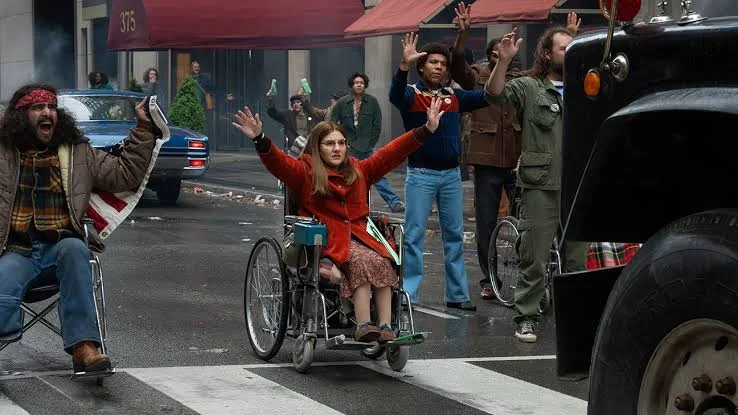
Ruth Madeley plays her without sanding down the qualities that would make her exhausting company in almost any committee meeting. She is impatient, combative, funny, stubborn, and sometimes plainly convinced that the room would function better if everyone surrendered to her judgment. Early on, Judy moves through New York in a wheelchair while the city makes virtually no accommodation for her existence. Drivers honk. Pavement becomes an obstacle course. When a demonstration fails to create sufficient pressure, she rolls into traffic and stops it herself.
There is an entire political philosophy in that gesture. If society has designed its streets under the assumption that you will remain elsewhere, entering the street already counts as disruption. Heder and co-writer Rebekah Taussig wisely concentrate much of the film around the 1977 campaign surrounding Section 504 of the Rehabilitation Act and the nearly month-long occupation of a federal building in San Francisco.
The narrow time frame rescues Being Heumann from the dutiful chronology that ruins so many biographical dramas. We do not move through Judy’s life collecting achievements like stamps. We watch a political action mutate in real time.
That mutation gives the film its strongest stretch. A protest becomes an occupation. An occupation requires food, medication, communication, press attention, strategy, patience, and the increasingly difficult maintenance of solidarity among people who do not automatically agree because they share a cause. Political history becomes logistics.
This is where Heder’s affection for the group works rather beautifully. The activists argue, flirt, joke, improvise, irritate one another, and eventually create a makeshift sex tent because apparently even revolutionary struggle has zoning requirements. Brad Lomax’s connections to the Black Panthers become materially useful when protesters need support and food. Hale Zukas, communicating through a pointer and alphabet board, is allowed wit and anger rather than being reduced to an image of perseverance. Kitty Cone’s gentler temperament repeatedly collides with Judy’s aggressive instincts.
The casting matters for reasons deeper than authenticity as a promotional talking point. Disabled, Deaf, and Blind performers fill the building, and Heder allows the audience’s perception of them to change through duration. At first, disability is difficult not to register as an identifying feature because the entire political conflict concerns the way bodies encounter public space. Then personalities begin to overwhelm categories. Someone is funny. Someone is infuriating. Someone wants sex. Someone thinks Judy is behaving like an egomaniac.
Call it accessibility amnesia: society gets used to the accommodation and forgets the argument that made it necessary. Being Heumann occasionally achieves the inverse. It begins with categories imposed by political reality, then gradually makes those categories insufficient to describe the people occupying the screen.
Madeley’s performance is essential to that process because she refuses to turn Judy into a monument. Her abrasiveness has consequences. Kitty questions the degree to which ego influences Judy’s decisions, and the film gives that criticism enough room to sting. Judy’s impatience is simultaneously a personal defect and one of the reasons anything gets accomplished.
I initially thought the film needed to explain her better. There is relatively little here about the private origins of that fury, and the romantic material with Jim Pechin only briefly opens another register. Madeley is asked, again and again, to play determination at different temperatures.
But I am less convinced that psychological excavation would improve the film. Biopics have trained us to expect a childhood injury, parental relationship, romantic wound, or other explanatory key that converts public action into private motivation. Judy’s political anger does not really require one. The inaccessible street is right there.
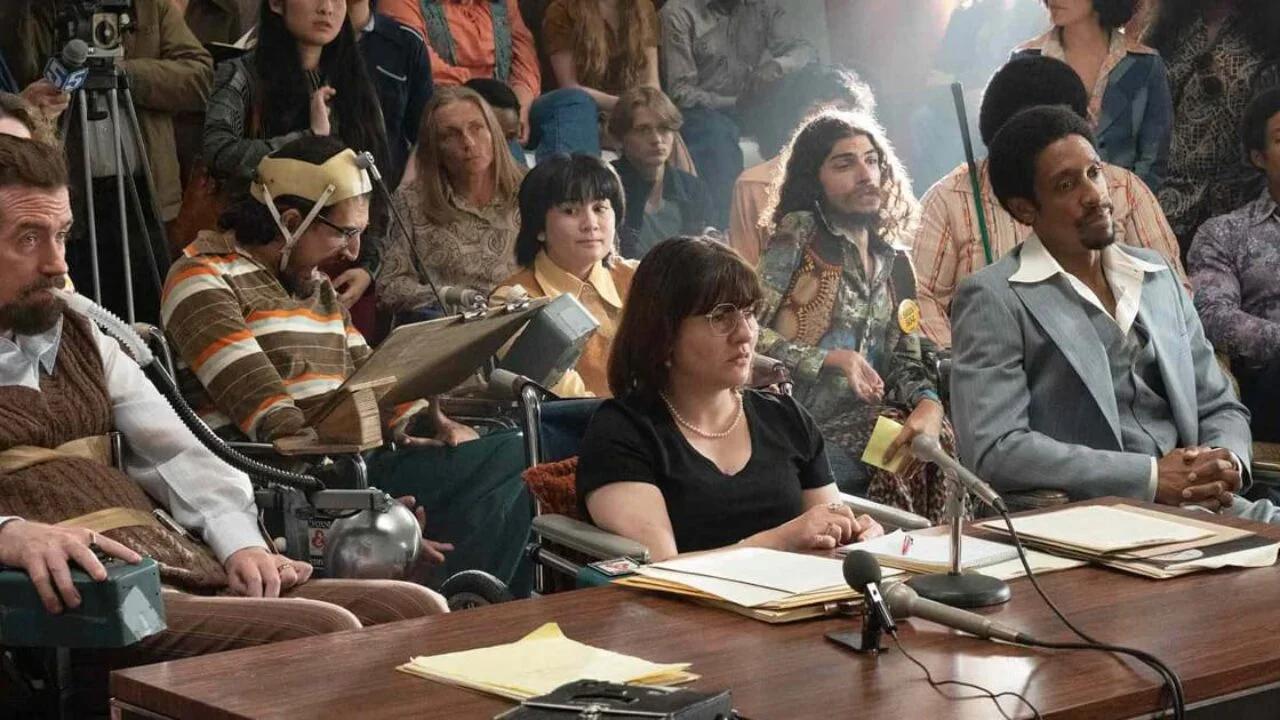
The problem lies elsewhere. Joseph Califano, played by Mark Ruffalo, should embody the film’s most uncomfortable political idea. His resistance to implementing the Section 504 regulations is tied to cost. Accessibility requires alterations to buildings, schools, transportation systems, sidewalks, and institutions. Equality is agreeable in theory until somebody produces an invoice.
That distinction gives the conflict real teeth because Califano does not need to imagine himself as cruel. He can regard himself as practical, fiscally responsible, even sympathetic. The protesters are asking him to recognize that a society designed around one range of bodies has already made a spending decision. The expense has merely been transferred onto the people excluded from it.
Ruffalo sometimes plays the bureaucratic weakness too broadly, though, and the film occasionally lets institutional resistance collapse into the shortcomings of one frustrating official. That makes the political struggle easier to digest. Systems become villains with faces. Faces eventually concede.
Heder’s larger tonal strategy creates a similar problem. The occupation is full of pop music, humor, sexual energy, camaraderie, and moments of genuine communal pleasure. None of that feels inappropriate. Quite the opposite. A disability-rights drama that treated disabled life as uninterrupted suffering would reproduce one of the assumptions its characters are fighting. Joy belongs here.
Yet Heder is so comfortable with uplift that she sometimes protects us from the danger surrounding it. Protesters have serious medical needs. Supplies matter. A hunger strike raises the physical stakes. Police pressure becomes frightening. Days accumulate. The government can afford to wait in ways the people inside the building cannot.
The movie acknowledges these pressures, then repeatedly returns to a register assuring us that history has already chosen its winners. This is the strange burden of dramatizing successful activism. The audience knows that curb cuts exist. The ramp outside the cinema is, in its own quiet way, a spoiler.
Being Heumann cannot eliminate that knowledge. What it can do, and often does, is restore some of the absurdity of a world in which access itself had to be argued into legitimacy. Its liveliest scenes understand political change as a disorderly collision of bodies, personalities, budgets, appetites, and stubbornness. Its weaker ones convert that disorder into inspiration. The difference matters. Inspiration allows us to admire Judy Heumann. Disruption asks why someone like her had to become so difficult in the first place.
Being Heumann premiered as the opening film of the Toronto International Film Festival on September 10, 2026, before heading to select theaters and global streaming on Apple TV. The biographical drama chronicles disability rights icon Judy Heumann as she leads a historic 1977 federal building occupation to fight for equal accessibility laws.
Where to Watch Being Heumann (2026) Online
Full Credits
Title: Being Heumann
Distributor: Apple TV
Release date: September 10, 2026 (TIFF) / November 6, 2026 (Theaters) / November 13, 2026 (Apple TV)
Rating: PG-13
Running time: 2 hours 6 minutes
Director: Siân Heder
Writers: Siân Heder, Rebekah Taussig
Producers and Executive Producers: David Permut, Kevin Walsh
Cast: Ruth Madeley, Mark Ruffalo, Dylan O’Brien, Madeline Delp, Rob Delaney, Ray Fisher, Michael Patrick Thornton, Antwan Tolliver
Director of Photography (Cinematographer): Jamie D. Ramsay
Editors: Geraud Brisson
Composer: Francesco Le Metre
The Review
Being Heumann
Being Heumann understands that accessibility did not arrive through social enlightenment. It was demanded by people willing to become inconvenient. Ruth Madeley gives Judy Heumann enough abrasion to keep her from turning into a commemorative statue, while the ensemble makes the 1977 sit-in feel communal, funny, argumentative, and alive. Siân Heder’s weakness is her instinct for reassurance. The political danger sometimes softens into inspirational familiarity, and Mark Ruffalo’s Califano cannot carry the institutional complexity the film assigns him. Still, the anger survives the uplift.
PROS
- Ruth Madeley keeps Judy abrasive and human
- Strong disabled, Deaf, and Blind ensemble
- Sit-in logistics give the history dramatic life
- Humor and sexuality resist sanctification
- Sharp ideas about accessibility and public obligation
CONS
- Uplifting tone softens the political danger
- Califano becomes too simplified
- Judy’s private life remains lightly developed
- Later stretches lose some procedural momentum