





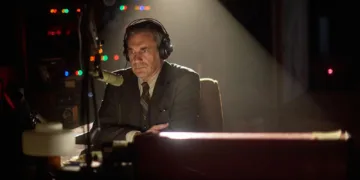




















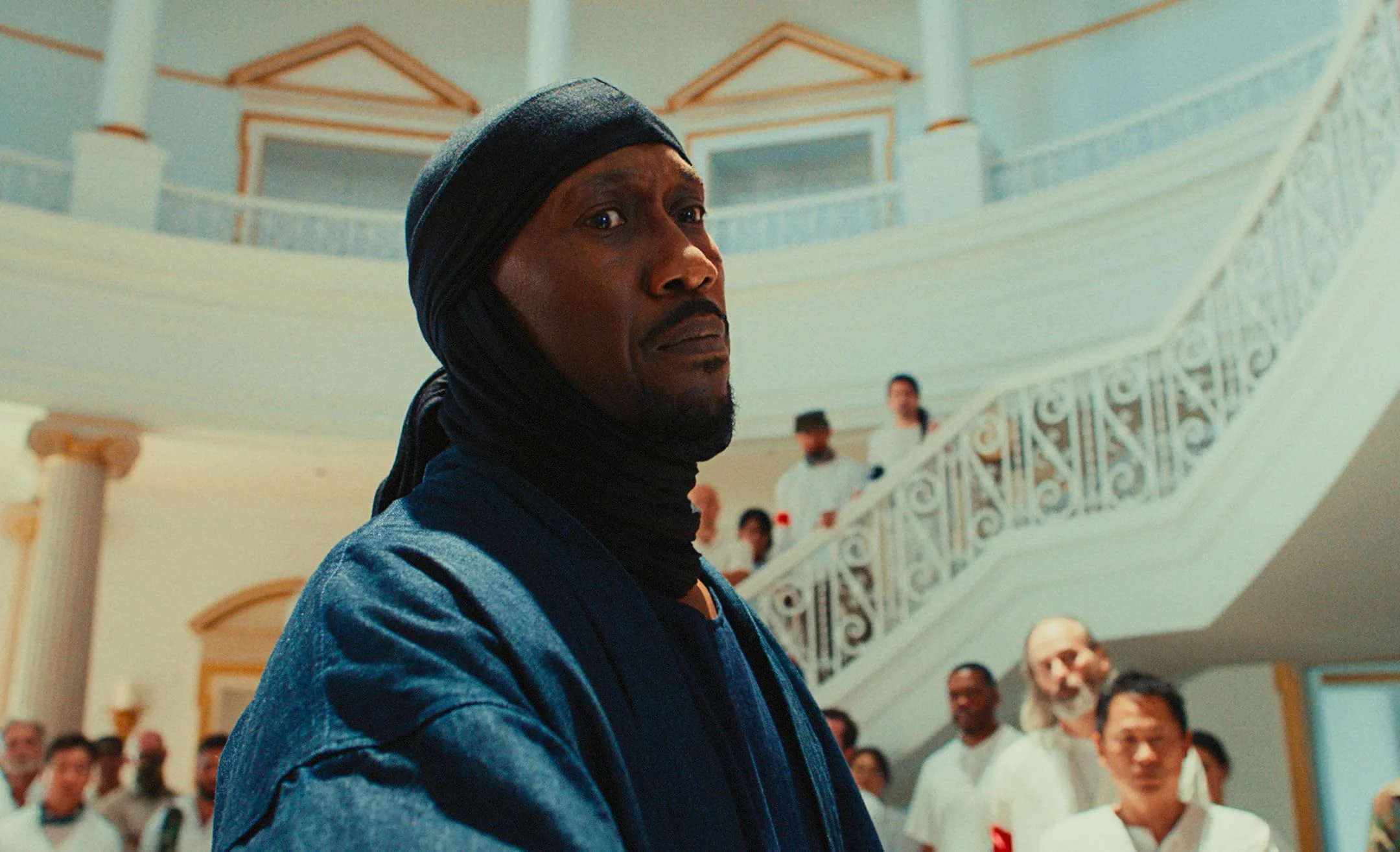

Bassam Tariq understands that an action hero can look most vulnerable when the problem in front of him cannot be punched, stabbed, or outmaneuvered. Latif can survive a close-quarters fight in a filthy bathroom. He can pin a man to the floor and drive a blade into his chest. What he cannot do is make his infant daughter digest formula.
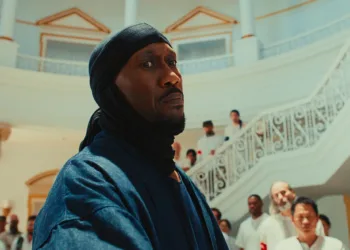
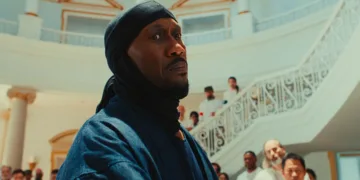
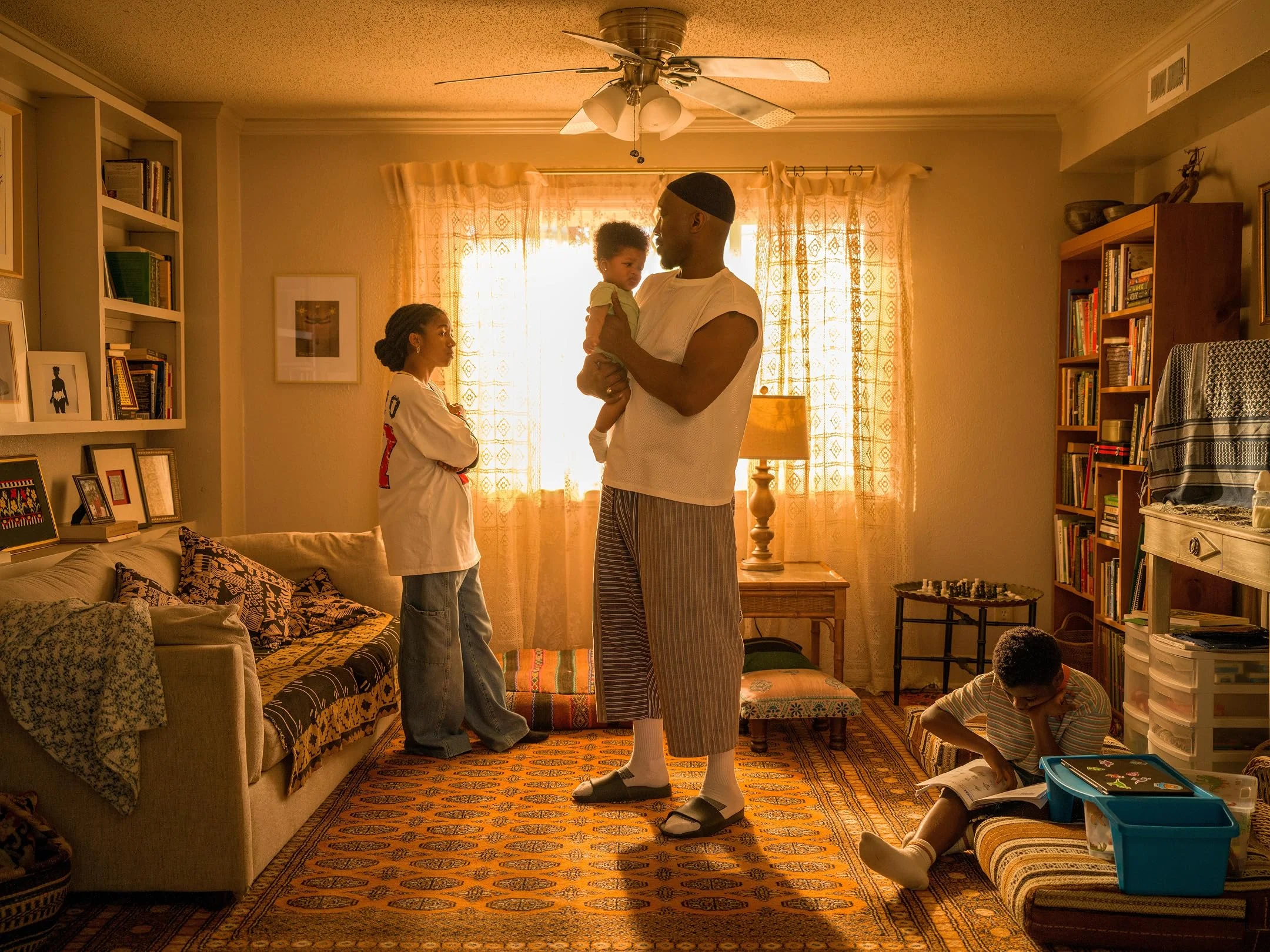
That gap between physical competence and parental helplessness gives Your Mother Your Mother Your Mother its shape. Mahershala Ali plays Latif, a devout Muslim and contract killer whose wife Khadijah dies suddenly, leaving him responsible for teenage Fatiha, young Qadir, and baby Aziza. Latif understands how to provide money and protection. Caring for three grieving children asks something different of him, and Tariq keeps finding ways to turn that difference into drama rather than simply stating it as a theme.
The opening makes the conflict clear through juxtaposition, the editing technique of placing contrasting images or ideas beside each other so each changes how we read the other. Latif fights brutally in a bathroom while the film invokes a Hadith in which the Prophet is repeatedly asked who deserves the best of a man.
Three times, the answer is his mother. Soon Latif is cleaning his blade with supplies from his daughter’s diaper bag. It would be easy for that combination to feel overly designed, but Tariq keeps returning to the contradiction until it becomes character. Latif takes life while trying to sustain it. Khadijah’s death exposes how narrow his definition of providing has been.
The sharpest expression of that problem is also the movie’s strangest plot engine. Aziza cannot tolerate formula, and the family’s frozen supply of Khadijah’s breast milk is disappearing. A large stretch of the film becomes a desperate search for someone who can feed her. A milk bank cannot simply solve the problem. Eventually Latif must seek help from Fugazi, a breastfeeding sex worker played by Tiffany Boone, whose life does not fit comfortably inside his moral categories.
I love that Tariq trusts such a mundane need to carry this much dramatic weight. A lesser action movie would invent a kidnapped child or ticking bomb. Here, the emergency is milk. That choice shrinks Latif’s world down to something intimate while making his helplessness harder to escape. He can justify killing through elaborate ideas about righteousness. A hungry baby does not care about his philosophy.
Ali is terrific at letting that humiliation register without turning Latif into a visibly broken man. His performance relies heavily on posture, pauses, and the sense that Latif is always calculating what a room might demand from him. That makes the action convincing, but it helps even more during the quieter scenes. When this enormous, controlled man is exhausted by feeding schedules, grief, and children who ask questions he cannot answer, the contrast does much of the acting.
Adia’s Fatiha keeps those questions from becoming abstract. She is grieving her mother while taking on responsibilities inside the household, and she increasingly sees through her father’s moral evasions. Latif wants to protect his daughter from the world, yet his own choices may be among the dangers she needs protection from. Her looser interpretation of religious rules also pushes against his tendency to treat faith as a fixed code.
That religious tension becomes much louder once John Cho enters as Hwan Yoon, an Iraq War veteran turned Christian extremist. The costume design announces him before the script has to: cowboy hat, gold grill, conspicuous weapons, the visual language of American self-mythology turned slightly grotesque. Cho plays him with enough theatricality to make the character entertaining without losing the threat beneath it.
Hwan works because he is less Latif’s opposite than his distorted reflection. Both men connect faith with violence. Both have built stories that allow them to see themselves as righteous. The difference is doubt. Latif can still be unsettled by his children, challenged by Abdul Malik, or embarrassed by the contradictions in his own behavior. Hwan treats certainty itself as evidence of virtue.
That distinction keeps the film from collapsing into a crude religious showdown. Tariq seems less interested in arguing over which faith contains the right answers than in asking what happens when conviction stops allowing self-examination. Latif’s beliefs can bend under pressure. Hwan’s have hardened into permission.
The movie gets shakier when its criminal and extremist factions begin taking up greater space. Some of the early material has an unusually delicate balance between domestic comedy, grief, faith, and danger. Later confrontations inevitably make the machinery louder, and certain supporting characters push close to caricature. I occasionally missed the smaller film about a widower trying to keep breast milk in the refrigerator.
Still, Tariq’s action direction is good enough that the shift rarely feels empty. Cinematographer Katelin Arizmendi and editor Cam McLauchlin shoot and cut Latif’s fights around his physical intelligence. The camera stays close enough to preserve impact, while the editing remains readable enough that we understand how he moves through a space. Fast cutting can create the impression of speed while hiding choreography. Here, Ali’s movement usually establishes the rhythm instead.
Son Lux’s score pushes those scenes into stranger territory, mixing spiritual unease with electronic intensity. The effect fits a movie in which prayer, parental exhaustion, pornography, religious extremism, and sword fights somehow occupy the same moral landscape. Tariq does not always make those ingredients sit comfortably together, but comfort would probably betray what he is attempting.
The abandoned Blade collaboration between Tariq and Ali will inevitably hang around this film, especially when Ali starts moving with a weapon in his hand. Yet the comparison becomes less useful as Latif’s real crisis comes into focus. He has built a life around the belief that strength means protecting, providing, and knowing who deserves punishment. His children gradually expose the holes in that definition. Fatiha challenges his certainty. Qadir keeps faith present as something lived rather than merely defended. Aziza reduces his entire moral system to one brutally simple requirement: keep me alive.
The film’s final choices resist the clean action payoff its genre seems to promise. That refusal may frustrate viewers waiting for violence to settle the argument, but it belongs to Tariq’s larger idea. Latif has spent years solving problems with force. Fatherhood keeps handing him problems that force cannot solve, leaving his old definition of strength increasingly difficult to defend.
Your Mother Your Mother Your Mother has its world premiere at the Toronto International Film Festival in September 2026 before releasing theatrically via Amazon MGM Studios. The action drama follows a devoutly religious hitman in Houston who goes on a desperate journey to protect his children after his wife dies.
Where to Watch Your Mother Your Mother Your Mother (2026) Online
Full Credits
Title: Your Mother Your Mother Your Mother
Distributor: Amazon MGM Studios
Release date: September 2026 (Toronto International Film Festival) / September 25, 2026 (United States)
Running time: 1 hour 52 minutes (112 minutes)
Director: Bassam Tariq
Writers: Bassam Tariq
Producers and Executive Producers: Not publicly specified
Cast: Mahershala Ali, John Cho, Giancarlo Esposito, Abubakr Ali, Tramell Tillman, Tiffany Boone, Laith Nakli, Adia
Composer: Son Lux
The Review
Your Mother Your Mother Your Mother
Your Mother Your Mother Your Mother turns an assassin’s crisis into something unexpectedly intimate: a test of what strength means once violence stops solving the problem. Bassam Tariq’s mix of family drama, religious inquiry, comedy, and action occasionally strains as the criminal plot grows louder, yet Mahershala Ali and Adia keep the emotional stakes firmly grounded. Its sharpest idea is beautifully simple. Latif can defeat armed men, but caring for his children requires surrendering the certainty that once defined him.
PROS
- Mahershala Ali’s controlled, physical performance
- Breast-milk search gives the drama unusual stakes
- Faith examined through character and daily behavior
- Strong dynamic between Latif and Fatiha
- Clear, forceful action choreography
CONS
- Later criminal plotting overwhelms subtler material
- Some supporting characters approach caricature
- Tonal ingredients do not always fit comfortably together