



























Sandra Vale’s collapse onstage should be the hinge that reorganizes Closing Night. Until then, Cody Fern’s debut has been loading its chamber: an acclaimed actress struggling through rehearsals for Mother Courage, a sister she has avoided for three decades, a nephew quietly reconnecting with her, and invitations that drag an estranged family toward New York.
Once Sandra forgets her lines and lands in the hospital, the story finally has the event capable of forcing every buried grievance into the same room. The problem is that Fern and co-writer Devon Bostick have already decided that almost every grievance should arrive at maximum volume.
The underlying structure is stronger than that approach suggests. Sandra has built her adult identity around separation, control, and professional authority. April, her sister, has built much of hers around resentment, still carrying the wound of Sandra sleeping with her boyfriend decades earlier. April’s son Theo knows Sandra only as the relative his mother has kept at a distance, yet he has started seeing his aunt without telling her.
His girlfriend Lucy is pregnant, adding another generation to a family that has spent years withholding information from the one before it. Diane, Sandra and April’s mother, initially refuses to attend the reunion at all. When she finally enters the story, she brings enough hostility to make everyone else look moderately well adjusted, which is quite an achievement.
There is a useful dramatic question inside all of this: when does silence become dishonesty? Theo has not technically betrayed April simply by meeting Sandra, yet the secrecy carries its own charge. Sandra’s long absence did not freeze the family in place. Everyone adapted to it, told themselves stories about it, and made choices around those stories.
Fern and Bostick understand that resentment can become structural. The trouble is that their script keeps expressing that insight through the same mechanism. Characters pair off, reveal something, shout, retreat, then reappear in another combination ready for the next collision. After a while, the family tree begins to resemble a tournament bracket.
That repetition matters because Sandra’s diagnosis introduces a different kind of pressure. Her cognitive deterioration is not another secret waiting for the right argument. It is a deadline. A woman whose career depends on memory, timing, language, and command can no longer trust the instrument that made her formidable. Sarah Paulson is very good at showing the panic beneath Sandra’s severity.
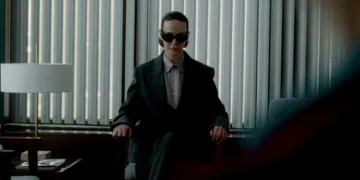
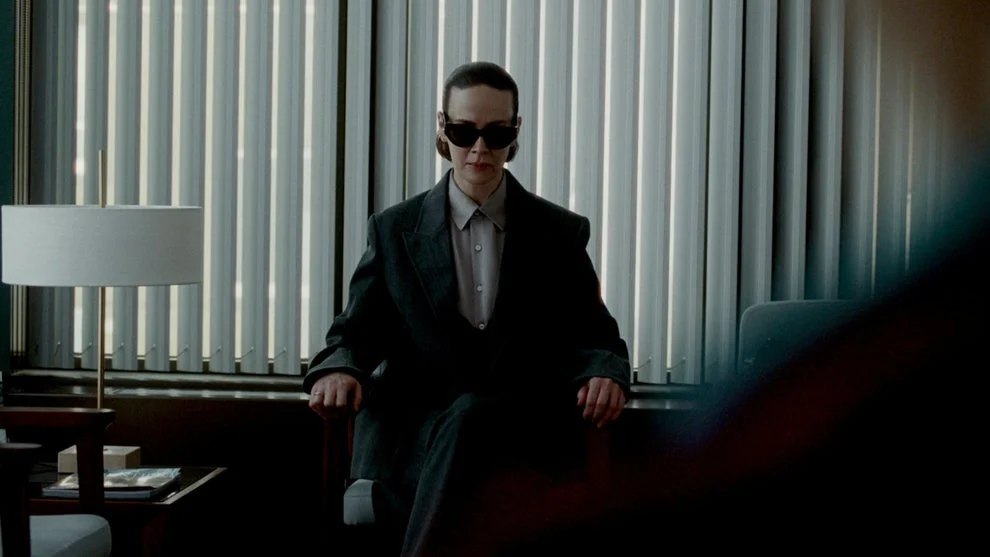
The sunglasses, expensive clothes, clipped speech, and refusal to yield make sense as extensions of somebody accustomed to controlling both a stage and a room. When that control slips, Paulson does not soften Sandra into an easy object of sympathy. The character remains abrasive even while fear begins eating through the performance she has constructed for everyone around her.
Naomi Watts has the harder assignment because April is written in broader strokes. She arrives in New York already frayed, carrying old anger, anxious habits, and a tendency to steal small objects that feels suspiciously like a screenwriter adding a behavioral underline. Watts gives those pieces continuity through posture and nervous energy. April often looks as if she is bracing for an impact she has rehearsed for years. Her later confrontation with Sandra gains force because Watts makes the anger feel lived in rather than newly summoned for the scene.
Dianne Wiest enters with even less interest in restraint, at least initially. Diane drinks heavily, insults freely, and demands access to a minibar with the determination of someone who has identified the one reliable relationship left in her life. The performance could easily collapse into caricature. Wiest prevents that by changing scale when the script allows her to.
A quieter moment at a mirror, stripped of the verbal aggression that usually defines Diane, gives her greater complexity than another round of family combat could have managed. It is also evidence of the film Fern might have made had he trusted silence as much as confrontation.
That tension runs through his direction. Fern clearly knows how to give actors space. Yves Bélanger’s camera often stays with faces long enough for pauses, hesitations, and stumbles to matter. Those choices let Paulson, Watts, and Wiest complicate material that sometimes arrives pre-labelled.
Odessa A’zion brings useful volatility to Lucy, while Toby Wallace gives Theo a steadier presence amid the escalating family warfare. Yet the screenplay repeatedly pushes those carefully observed performances back toward another explosion. Fern appears confident inside individual scenes and less certain about how loudly those scenes should accumulate.
The tonal problem grows sharper once Sandra’s illness becomes the dominant pressure. Closing Night begins with room for bleak comedy and theatrical exaggeration. April’s disarray, Diane’s cruelty, Sandra’s grand hauteur, and the family’s mutual suspicion can support that register. Later, the film asks the same heightened characters to carry discussions of self-harm, mortality, and decisions about the end of Sandra’s life. Some discomfort is clearly intentional. People joke around terror all the time.
Here, though, the line between defensive humor and tonal confusion keeps moving. A neurologist talking about Swiss bread, jokes surrounding suicide, and Diane’s flamboyant drinking sit beside material that wants considerably greater emotional gravity. The shifts do not always feel designed; sometimes they feel like competing versions of the same movie.
That makes the late drama frustrating rather than empty. Fern and Bostick have found a potent idea in Sandra losing her memory just as her family finally begins excavating its own. Reconciliation cannot clean up what happened, and illness does not absolve anyone. April’s anger does not become childish because Sandra is sick. Sandra’s fear does not erase the choices that helped produce the estrangement.
Diane’s arrival does not suddenly convert decades of damage into a solvable misunderstanding. The story is strongest when it allows those truths to remain incompatible. By the time Sandra faces what her diagnosis means, the family has finally begun saying things it spent decades withholding, at the exact moment when one of them can no longer count on remembering what was said.
Closing Night had its world premiere at the Toronto International Film Festival on September 12, 2026. The drama film follows a celebrated movie star who invites her estranged family to the opening night of her Broadway play, sparking a tense family reunion.
Full Credits
Title: Closing Night
Distributor: Elevation Pictures
Release date: September 12, 2026 (Toronto International Film Festival)
Running time: 1 hour 55 minutes (115 minutes)
Director: Cody Fern
Writers: Cody Fern, Devon Bostick
Producers and Executive Producers: Nancy Grant, Rosalie Chicoine Perreault, Will Howarth, Matilda Comers
Cast: Sarah Paulson, Naomi Watts, Dianne Wiest, Toby Wallace, Odessa A’zion
Director of Photography (Cinematographer): Yves Bélanger
Editors: Dany Cooper
Composer: Mathieu David Gagnon
The Review
Closing Night
Closing Night has a better dramatic structure hiding beneath a screenplay that too often mistakes escalation for development. Cody Fern gives Sarah Paulson, Naomi Watts, and Dianne Wiest room to find difficult, wounded people inside characters written at considerably higher volume, and their work keeps the family conflict alive when the plotting grows mechanical. Sandra’s cognitive decline gives the film genuine weight, especially as disappearing memory collides with decades of withheld history. Fern can direct actors. His next challenge is knowing when the script should stop shouting at them.
PROS
- Excellent work from Paulson, Watts, and Wiest
- Sandra’s diagnosis creates a strong dramatic deadline
- Patient close-ups give performances room to breathe
- Family secrecy produces meaningful structural tension
CONS
- Confrontations become mechanically repetitive
- Tonal shifts weaken the darker material
- Several character traits feel overly schematic
- Escalation often replaces psychological development