





























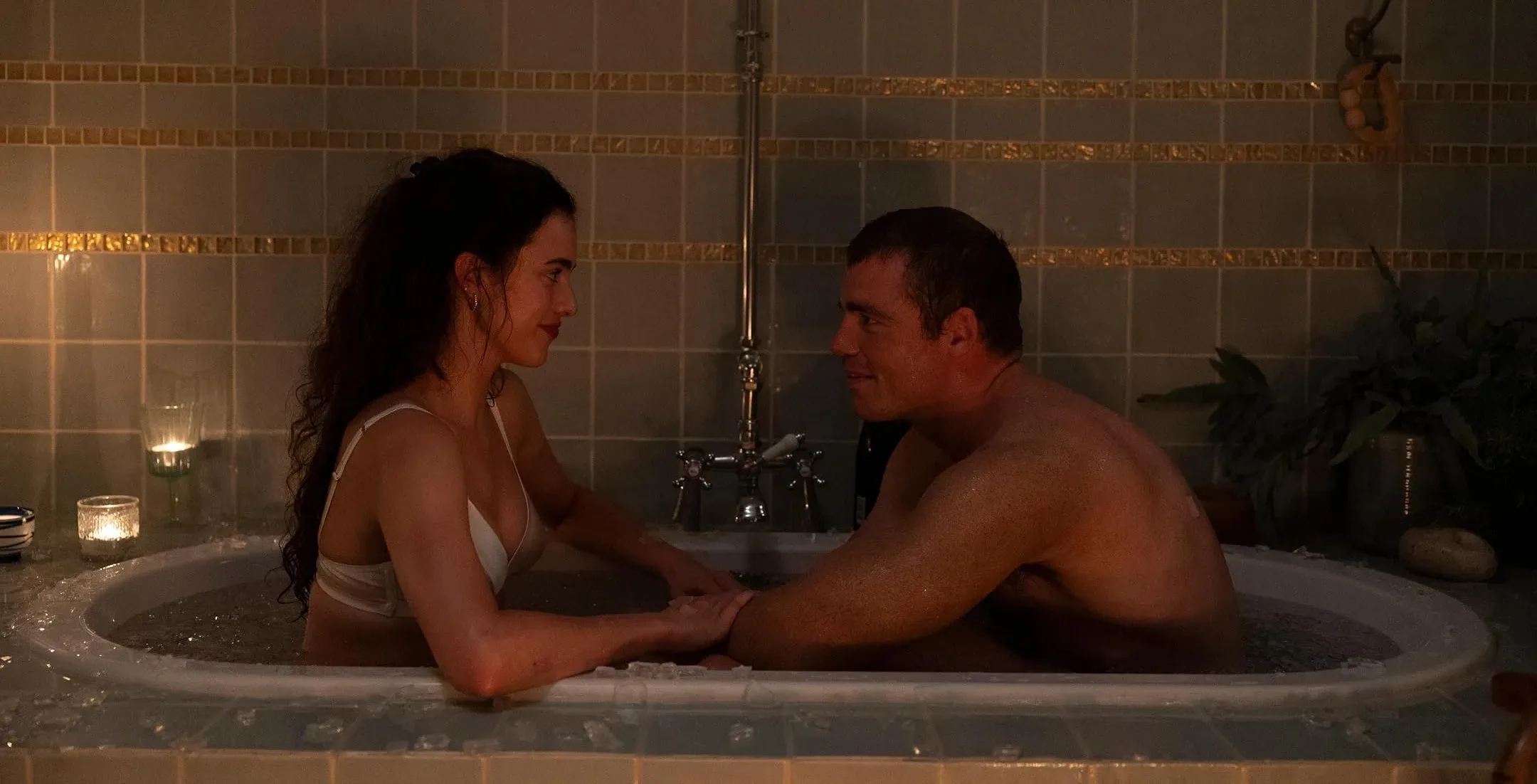

The film spends a long time teaching us how secure Maya’s future looks before one date, March 2020, tears that future apart. That structural choice is risky. Rachel Morrison makes the romance so warm, polished, and inviting that the early stretch can seem almost excessively sweet. Yet the sweetness has a job to do. We need to understand the life Maya thinks she has secured before the film asks her, and us, to imagine surviving its disappearance.
Maya, played by Margaret Qualley, is a Boston nurse whose life largely consists of exhausting hospital shifts and emotional self-protection. She meets Charlie (Gabriel Basso) while buying a nightstand, and his slightly awkward persistence works its way through her defenses. He is intelligent, affectionate, socially effortless, and surrounded by the kind of close family Maya has never known. Their relationship moves quickly through dating, cohabitation, friendship circles, and an impromptu wedding.
Morrison shoots this period with the confidence of someone who spent years thinking through images before moving into directing. What matters here is visual grammar, which is simply the way repeated images, lighting choices, and compositions teach us how to read a world. Boston is full of warm interiors, autumn colors, soft light, music, and inviting public spaces. The film gradually associates Charlie with openness itself. Maya’s life feels larger once he enters it.
That makes the pandemic shift especially brutal. Maya works directly inside the crisis, and the film becomes far more tactile once the hospital fills with patients. The medical sequences have an urgency that the earlier romance deliberately avoids. Maya moves between overwhelmed wards and careful decontamination at home, while Charlie’s asthma turns an already dangerous situation into something terrifyingly personal. When he becomes ill, Maya eventually has to say goodbye through a screen.
These scenes are where Love of Your Life is most precise. Grief has not yet become an idea. It exists through masks, hospital rooms, distance, exhaustion, guilt, and the awful logistics of being separated from someone who is dying.
Qualley is especially good at carrying the change without turning Maya’s pain into a showcase. Her performance works through withdrawal and irritation as often as tears. There is even something close to resentment inside Maya’s grief, directed partly at herself. She built her identity around independence, allowed Charlie to convince her that attachment was worth the risk, and then received the most brutal possible argument for her old worldview.
The film grows less precise once Maya leaves America. Years later, she is in Lisbon, smoking, drinking, wandering at night, sleeping with strangers, and describing part of her existence as “solitary hedonism.” Morrison and cinematographer Todd Banhazl shift the palette with her. The warm domestic spaces are gone, replaced by nocturnal streets, temporary rooms, and travel. It is a clear visual expression of someone who no longer wants a stable life because stability now feels like something that can be taken away.
The problem is that these places remain extremely beautiful, and that contradiction is interesting at first. Maya wants anonymity, yet the movie keeps surrounding her with postcard imagery. Her emotional dislocation is framed through lovely streets, attractive rooms, and international movement. Sometimes that tension works because the world keeps looking alive while Maya feels detached from it. Elsewhere, the polish begins to soften the messiness of what she is experiencing. Grief starts resembling an unusually photogenic lifestyle.
Aaron Pierre enters as Felix, a British single father Maya meets in Portugal, and his sheer charisma makes the renewed romance easy to accept. He is warm, attentive, emotionally available, and connected to a daughter and an ex-partner with whom he maintains a functional relationship. His life offers Maya another version of family, one she can enter without having to build from nothing.

Pierre and Qualley have enough chemistry to keep those scenes moving, though Felix’s near-ideal suitability creates an unintended problem. He can feel less like a fully complicated person than the cleanest possible test of Maya’s ability to love again. If she cannot feel safe with this man, the obstacle must still be inside her.
That is where Julia Cox’s screenplay begins relying on emotional shorthand. The earlier hospital material lets behavior explain Maya’s state. The later passages increasingly depend on major life changes, therapy, travel, reunions, and conversations that tell us where she has reached psychologically. The film spans years, and that scale gives Maya’s recovery room to evolve, yet the time jumps can make the evolution feel prearranged. We see the milestones clearly. The connective tissue is thinner.
Patrick Schwarzenegger’s Jason suffers most from this compression. He is supposed to be Maya’s longtime best friend and one of the relationships damaged by her retreat after Charlie’s death, but their shared history is barely dramatized. When he reappears and forces buried history back into Maya’s present, the story understands the function of the moment better than it has established the relationship behind it.
Catherine Keener has richer material as Charlie’s mother, Ruth. After Charlie dies, Ruth directs some of her anguish toward Maya, blaming her during a moment when neither woman has any capacity to carry the other’s pain. Their eventual reunion gives the film something it has been missing during Maya’s travels: another person whose grief cannot be folded neatly into Maya’s personal recovery.
Keener brings years of exhaustion into the scene. Ruth did not get to disappear into another country or construct a temporary life. She remained close to the domestic world Charlie left behind. When she tells Maya that grief has no end, followed by the same observation about love, the writing comes dangerously close to explaining its own theme too neatly. Keener and Qualley keep the scene grounded because their faces carry history that the dialogue occasionally simplifies.
That late encounter also gives the title its second meaning. Maya’s life after Charlie cannot become the life she expected, and loving Felix does not erase the person she lost. The phrase shifts from describing a soulmate to naming the life that remains available to her. Morrison sometimes packages that realization too beautifully, but it lands most fully when Maya stops moving long enough to sit with someone who never had the option of escaping Charlie’s absence.
Love of Your Life had its world premiere at the Toronto International Film Festival on September 13, 2026, ahead of its theatrical release. The romantic drama follows a young woman navigating a profound personal journey to find a way forward after losing her husband.
Where to Watch Love of Your Life (2026) Online
Full Credits
Title: Love of Your Life
Distributor: Amazon MGM Studios
Release date: September 13, 2026 (Toronto International Film Festival)
Rating: R
Running time: 1 hour 46 minutes (106 minutes)
Director: Rachel Morrison
Writers: Julia Cox
Producers and Executive Producers: Ryan Gosling, Jessie Henderson
Cast: Margaret Qualley, Aaron Pierre, Patrick Schwarzenegger, Gabriel Basso, Catherine Keener, Tamara Lawrance, Corey Johnson
Director of Photography (Cinematographer): Todd Banhazl
Composer: Dustin O’Halloran
The Review
Love of Your Life
Love of Your Life is strongest when grief remains physical: hospital routines, empty spaces, strained relationships, and the difficulty of returning to a life that kept moving. Rachel Morrison’s polished images sometimes make Maya’s recovery look cleaner than it feels, while Julia Cox’s later writing leans too heavily on emotional shorthand. Margaret Qualley and Catherine Keener restore much of the missing texture, especially when Maya finally confronts a grief she cannot outrun. The film may smooth its hardest ideas, but its best moments understand why surviving love can be as complicated as finding it.
PROS
- Margaret Qualley’s restrained, emotionally detailed performance
- Strong pandemic-era hospital sequences
- Rachel Morrison’s expressive visual storytelling
- Catherine Keener gives the late drama needed weight
- Clear contrast between romance and grief
CONS
- Later recovery feels compressed
- Travel imagery can romanticize Maya’s pain
- Felix is written too ideally
- Jason’s friendship lacks development
- Some late dialogue states themes too plainly