



























Lady Cho learns early that intelligence becomes dangerous when the wrong person owns it. As a girl, she supplies ideas that men credit to Cho-won, helps him toward the state examination, and watches a society congratulate him for capacities it would rather pretend she does not possess.
Years later, that same intelligence has not disappeared. It has simply been rerouted into private schemes, coded letters, social maneuvering, and eventually a wager built around other people’s bodies. That progression is what gives The Scandal its real bite. The obvious scandal is sexual. The harsher one is institutional.
Lady Cho cannot publicly become the scholar her mind seems suited for, and she cannot escape the expectation that her marriage must produce an heir. When Lord Yoo takes So-ok as a concubine, Lady Cho absorbs the humiliation with the composure expected of a respectable wife.
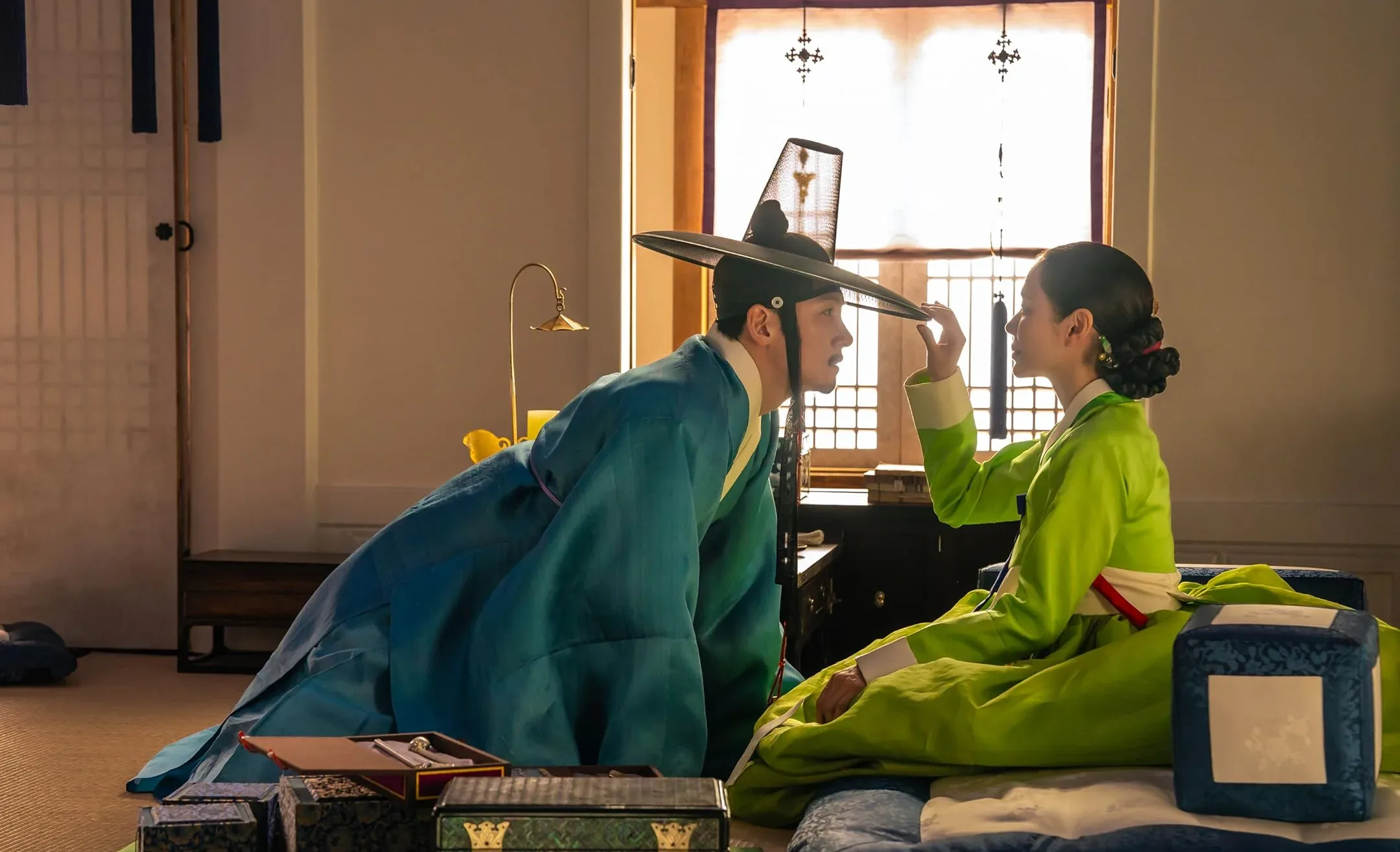
Then she does something much less respectable: she asks Cho-won to impregnate So-ok. The plan mutates once Cho-won notices Hui-yeon, a widow surrounded by rules about grief, chastity, and social honor. Soon Hui-yeon’s seduction becomes the prize in a wager between cousins whose unresolved desire has spent years disguising itself as gamesmanship. My first instinct was to read Lady Cho’s behavior as rebellion. That interpretation survives for about five minutes.
Her cruelty does come from confinement, and Son Ye-jin makes that origin difficult to forget. Lady Cho can appear composed while jealousy, humiliation, calculation, and longing move beneath the surface. She has been trained by circumstance to communicate indirectly because direct expression carries consequences. Yet oppression does not turn manipulation into liberation.
Lady Cho has learned the logic of the world around her so well that she begins using it against everyone else. Call it borrowed sovereignty: power exercised with tools supplied by the structure one wants to escape. The phrase sounds grander than the behavior. The behavior is often petty, sexual, vindictive, and painfully human.
The wager exposes that problem with almost mathematical neatness. Lady Cho has been reduced to reproductive usefulness, so she attempts to control the paternity of So-ok’s future child. Hui-yeon is expected to surrender her future to the memory of a dead husband, so Lady Cho and Cho-won turn her chastity into a challenge.
Cho-won imagines seduction as proof that he answers to nobody, yet even his supposed freedom remains tethered to Lady Cho. Three women and a possible child become pieces in a private contest between two people who consider themselves unusually perceptive. They are perceptive. That may be the problem.
Hui-yeon gives the drama an ethical pressure the game cannot contain. Cho-won first encounters her after the death of her husband, when she is pulled from the river following an attempt to die. He later approaches her with calculation, aided by information gathered through servants and a letter that never reaches its intended recipient. Lady Cho works from another angle, returning Geum-ho’s book and encouraging Hui-yeon to speak about the man she lost before she had the chance to build a life with him. Both cousins tell themselves they understand people. Hui-yeon becomes the person who reveals how crude that confidence is.
Ji Chang-wook plays Cho-won’s early certainty with an almost performative swagger. He treats the wager like a stage on which his reputation can confirm itself. The useful shift comes when Hui-yeon stops functioning as an objective and starts existing as a person in his perception. His feelings may become sincere, but sincerity cannot travel backward in time and erase the conditions under which he approached her. Love does not retroactively produce consent. It merely makes the deception harder to excuse.
Nana’s restraint keeps Hui-yeon from becoming a decorative victim in somebody else’s moral crisis. Her grief, sincerity, and self-possession exert pressure without imitating Lady Cho’s methods. She changes Cho-won precisely because she does not treat intimacy as a contest. That distinction matters. The series is full of people mistaking control for knowledge, possession for affection, and sexual access for proof of emotional truth. Hui-yeon quietly breaks that equation simply by remaining legible as herself.
This is also why the erotic material belongs here. The series would be easier to dismiss if its sensuality existed only to advertise adult prestige. Instead, sex repeatedly functions as social currency. Lord Yoo’s concubine is connected to lineage.
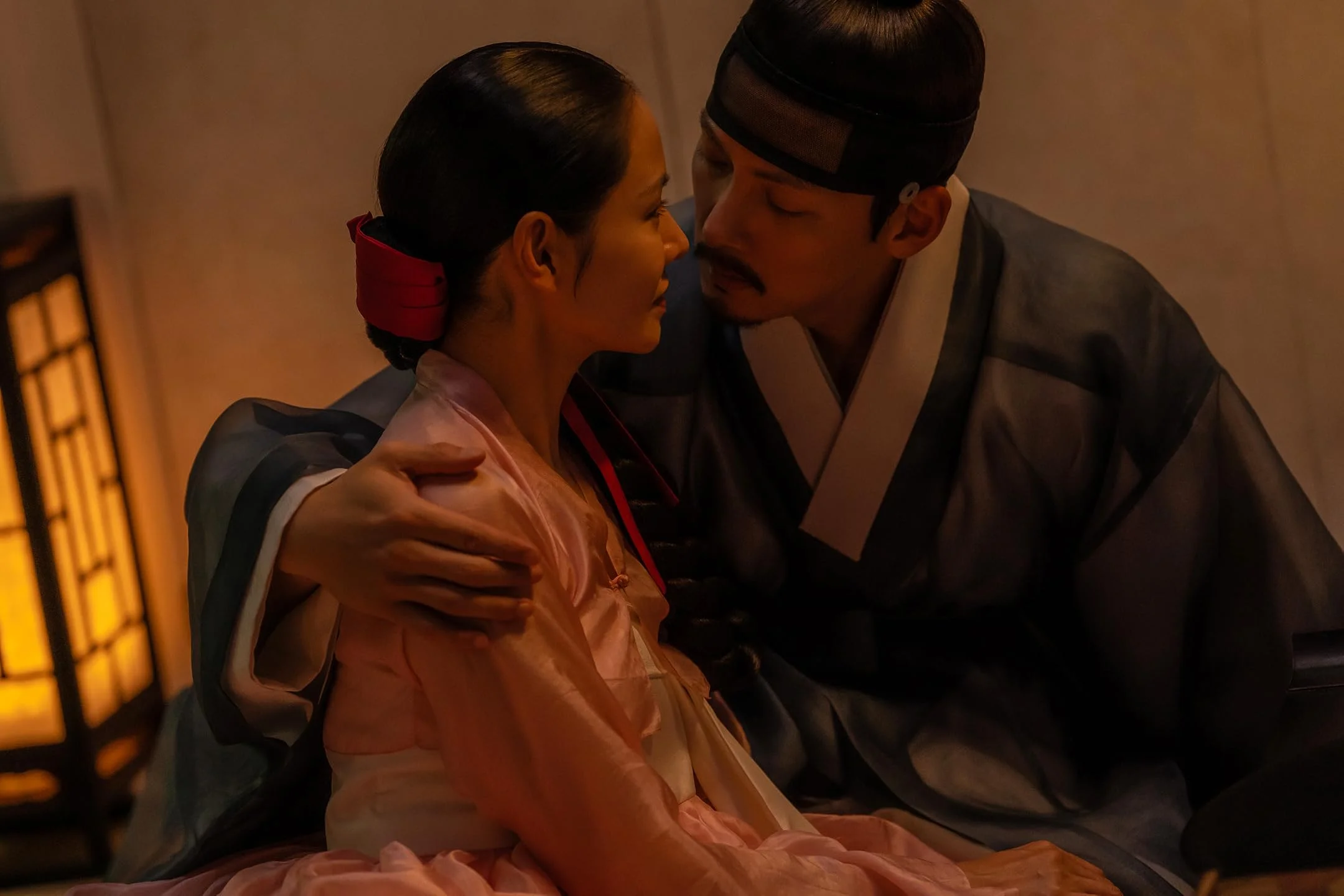
Lady Cho’s status is damaged by childlessness. Hui-yeon’s widowhood makes celibacy a public virtue. Cho-won’s identity is built partly through seduction. So-ok uses attraction as one of the few forms of leverage available to her. Desire is everywhere, yet permission to express it is distributed with absurd precision. Joseon morality apparently had a filing system.
The danger is that a drama critiquing the conversion of sex into power can still enjoy the spectacle of that conversion. The Scandal does. I am not sure that contradiction weakens it. The series often seems fascinated by the same behavior it condemns, and that unease suits characters who are equally unable to separate pleasure from control.
Its period form supports the idea when it stays attached to behavior. Painterly compositions, elaborate clothing, and controlled interiors turn social order into something visibly attractive, which is fitting for a world where oppressive arrangements arrive wrapped in ceremony. The use of pansori adds another tension. These characters survive through concealment, coded messages, false names, and withheld intention, while a performative narrative tradition sits nearby making stories public. Secrecy becomes personal technique; storytelling becomes social exposure.
Even the household around Lady Cho complicates any easy division between powerful men and powerless women. Bun-hee possesses money and commercial influence as a tobacco seller. So-ok uses the opening created by concubinage to pursue Lord Yoo. Lady Cho initially resents the arrangement, then begins educating So-ok and responding to her youthful warmth. Their relationship refuses to settle neatly into solidarity or rivalry.
Lady Cho can take genuine interest in So-ok’s growth while privately treating her fertility as something to engineer. Her lessons to the younger woman carry an ugly double meaning: she is preparing So-ok to survive the household while simultaneously imagining So-ok’s pregnancy as a problem she can solve through Cho-won.
The Scandal premiered worldwide on Netflix on September 18, 2026. Set during the Joseon dynasty, the period romance drama series follows two nobles who enter a dangerous game of seduction and manipulation that spirals out of control.
Where to Watch The Scandal Online


Full Credits
Title: The Scandal
Distributor: Netflix
Release date: September 18, 2026
Rating: TV-MA
Running time: 60 minutes per episode
Director: Jung Ji-woo
Writers: Lee Seung-young, Ahn Hye-song
Producers and Executive Producers: Movierocks, Cine Forest
Cast: Son Ye-jin, Ji Chang-wook, Nana, Han Sun-hwa, Kang Ji-eun, Shin Youn-ha, Kang Chan-hee, Lee Ji-hoon
Composer: Lee Ji-yeon
The Review
The Scandal
The Scandal turns seduction into a study of who is allowed to want, choose, and control. Its sharpest idea lies in Lady Cho, whose intelligence survives social confinement by adopting the same transactional logic that confines her. Son Ye-jin, Ji Chang-wook, and Nana give that moral knot emotional weight, while the period setting makes desire inseparable from status, fertility, and reputation. The series sometimes seems seduced by the spectacle it critiques, but that tension rarely weakens its argument.
PROS
- Lady Cho's moral complexity
- Strong central performances
- Desire tied meaningfully to social power
- Period setting serves the thematic argument
- Hui-yeon complicates the seduction game
CONS
- Erotic spectacle occasionally competes with the critique
- Some supporting material is less substantial
- The central manipulation can make emotional investment deliberately uncomfortable