



























Nostalgia works best when a movie gives you something specific to miss. A cracked baseball glove. A certain stretch of road at dusk. The particular way a friend laughs before getting everyone into trouble. American Summer keeps reaching for that feeling, yet it rarely trusts the details of Mikey’s life to create it. Instead, the film repeatedly tells us that this was a precious summer, and the more insistently it does so, the harder that preciousness becomes to feel.
Steve Guttenberg plays the older Mikey, who settles onto his porch and addresses the audience directly as he remembers himself at fourteen, played by Logan Gray. His younger self spends the summer chasing a spot on a travel baseball team, hanging out with friends, working at a local restaurant, falling for Kelly, and worrying about his Army father, who has gone missing during an overseas deployment. The ingredients are familiar, but familiarity is hardly the problem. Coming-of-age stories often depend on repetition. What matters is the precision with which a particular childhood separates itself from every other movie childhood.
That is where Michael W. Gray’s film starts losing its grip. Older Mikey looks back across decades, yet the younger Mikey’s world barely seems attached to a decade at all. Clothes, locations and behavior have been kept broad enough to suggest a vague past, while the music and other details can sound or feel much newer. The result is less timeless than unplaced. Mikey remembers this summer with enormous affection, but the film gives his memory few textures that feel unmistakably his.
The problem reaches beyond production detail. It changes the emotional relationship between the viewer and the story. Nostalgia depends on specificity because specificity gives memory weight. Without it, a baseball field is simply a baseball field, a porch is simply a porch, and a summer BBQ becomes one item in a collection of Americana shorthand. American Summer keeps arranging these images as signals for warmth, hoping recognition will do the emotional labor.
Young Mikey’s baseball ambition offers the clearest opportunity to make the season accumulate meaning. He wants a spot on the travel team, gets a job at Coach Eddie’s restaurant to help cover the cost, practices, suffers setbacks and finally reaches the expected big game. Cullen Moss gives Coach Eddie some welcome steadiness, and the baseball material has an easy family-film appeal. Yet the progression feels less like Mikey changing through effort than a sequence of stations placed between opening day and the inevitable winning moment.
The same problem appears in the people around him. Kelly, played by Mia Talerico, is the girl Mikey cannot stop thinking about, and she carries an insecurity of her own through her fear of singing in front of others. Their relationship should give the summer another emotional register, one built on awkwardness, uncertainty and the intensity that first crushes acquire simply because there is nothing to compare them with yet. Instead, their connection often feels prewritten. Even the dream material built around Mikey and Kelly supplies extra sweetness before their relationship has gathered enough detail to support it.
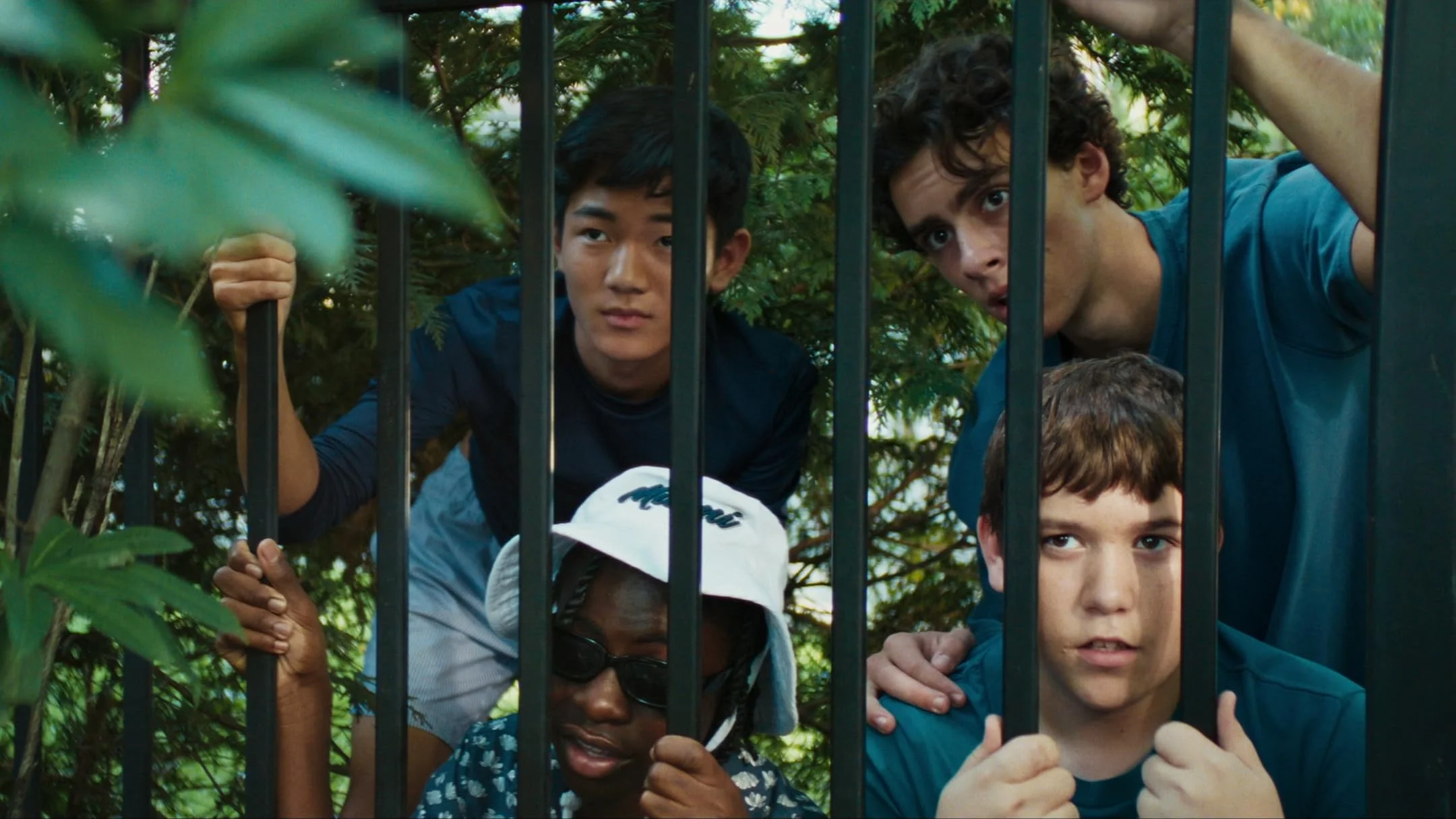
His friends are treated similarly. Puff disappears and eventually turns up after collapsing from a medical issue, an incident that could have shifted the mood of the group or changed the way Mikey understands the fragility of his carefree summer. It passes. Buck, the older bully who causes trouble at the boys’ secret baseball field, is briefly given a glimpse of vulnerability through his difficult relationship with his father. That moment hints at a richer kid beneath the role the screenplay has assigned him, then the movie moves on. These episodes keep occurring, but too few of them alter the emotional temperature of what follows.

The most important missed opportunity involves Mikey’s father. His disappearance overseas should sit beneath every baseball game, every conversation with Kelly and every ordinary afternoon. There is a strong story available in the contrast between childhood pleasures and a fear large enough that a fourteen-year-old cannot fully process it. Mikey’s mother Erica and his grandfather try to maintain normal life around him, but the father’s absence rarely develops into the constant pressure the premise promises.
That makes his eventual return at the baseball game feel strangely light. A family movie can earn relief as powerfully as grief, and this reunion needs the weight of everything Mikey has been carrying before it. The screenplay does not let the uncertainty around his father inhabit enough of his behavior, home life or relationships, so the reunion lands as another expected destination rather than the collapse of a fear we have been carrying with him.
Gray frequently compensates by supplying emotion from the outside. Older Mikey interrupts the flashbacks to explain what the past means to him. The score leans hard into sentiment and patriotic feeling. BBQs, beaches and idealized neighborhood imagery keep reinforcing the idea of a cherished American summer. There is even late montage material and a dream-dance sequence, stylistic flourishes that push the film toward the same emotional destination.
The cumulative effect is oddly distancing. Each time narration or music tells us how much a moment matters, it removes some of the space in which that feeling could have formed naturally. A better version of this story would not need Older Mikey to keep reminding us that these were the days worth remembering. The baseball field would have done that work. Kelly would have done it. His father’s empty place at home would have done it.
There is real gentleness in what American Summer wants to preserve. An older man remembering his friends, the girl he eventually married, the summer he made the team and the day his father came home is a perfectly sincere foundation for a family film. That sincerity never disappears, even when the dialogue stiffens or the sentiment becomes too obvious.
What is missing is the sensation of memory turning into loss. By the time Older Mikey walks away from his porch and back into the life those memories produced, we understand why he says that summer mattered to him. The harder feeling, the one nostalgia is supposed to create, never quite arrives: wishing for a moment that we had been there too.
American Summer arrived in select theaters on September 4, 2026, distributed by Blue Harbor Entertainment. The family comedy captures a nostalgic coming-of-age story set during a memorable season filled with youthful escapades and heartfelt community moments.
Where to Watch American Summer (2026) Online
Full Credits
Title: American Summer
Distributor: Blue Harbor Entertainment
Release date: September 4, 2026
Rating: PG
Running time: 1 hour 23 minutes (83 minutes)
Director: Michael W. Gray
Writers: Michael W. Gray, Jennifer B. White
Producers and Executive Producers: Michael W. Gray, Michael Cuomo, Ann M. Gray
Cast: Steve Guttenberg, Christie Brinkley, Dan Lauria, Michael Cuomo, Ellen Toland, Kobi Frumer, Josh Folan
Director of Photography (Cinematographer): Colin Brazie
Editors: Greg Cusumano
Composer: Timothy Bright
The Review
American Summer
American Summer reaches for the warmth of a cherished childhood memory but keeps explaining the feeling instead of letting its scenes create it. The baseball storyline, Mikey’s first romance, and his father’s disappearance all offer emotional potential, yet few moments accumulate enough weight to make the final reunion or victory truly land. Its sincerity is clear, and Cullen Moss brings welcome steadiness as Coach Eddie, but heavy narration, blunt scoring, and a strangely undefined sense of time leave the nostalgia feeling manufactured rather than lived.
PROS
- Sincere family-film intentions
- Cullen Moss brings welcome steadiness
- Baseball provides an accessible emotional framework
- Some genuine gentleness in Mikey’s memories
CONS
- Nostalgia lacks convincing specificity
- Father subplot carries too little emotional weight
- Romance and friendships feel underdeveloped
- Narration repeatedly explains the intended feeling
- Music pushes emotions the scenes have not earned