



























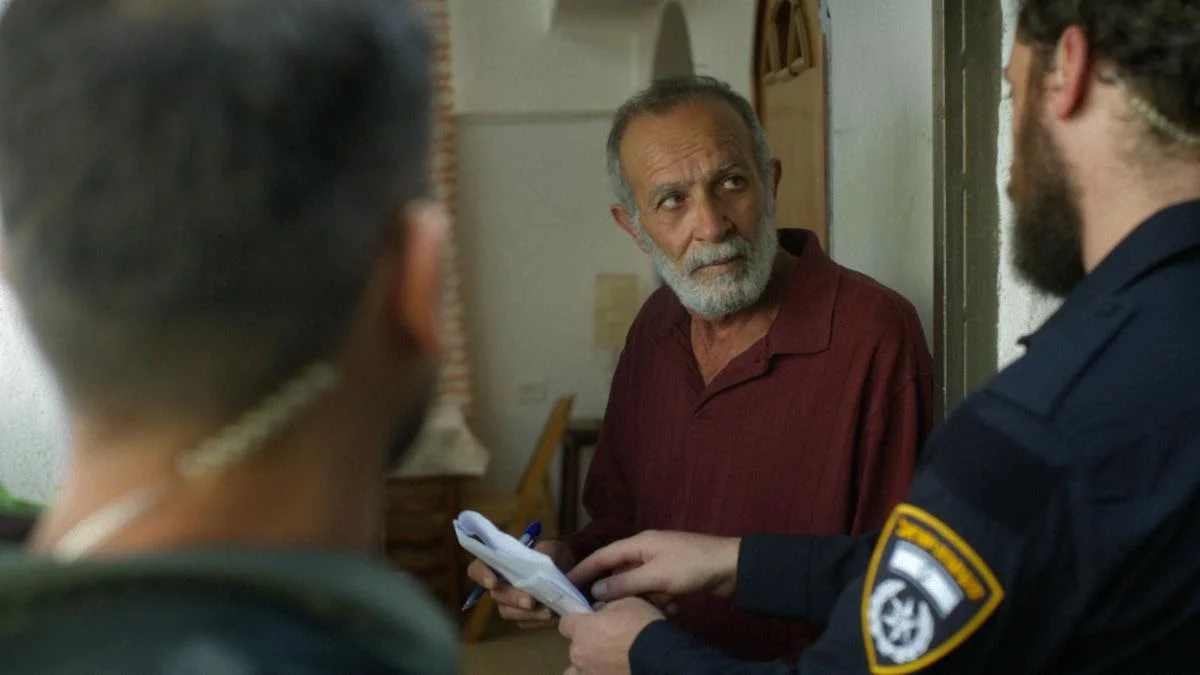

A missing death certificate is a remarkably efficient way to reopen twenty years of family damage. Kamal Hamed has spent decades living with the knowledge that his son Wael drowned, yet an Israeli court suddenly insists otherwise, at least on paper. The government believes Wael owes years of social security payments, and Kamal must prove that a son he has spent twenty years believing was dead actually died. Bureaucracy supplies the inciting incident with the efficiency of a filing error and roughly the same emotional sensitivity.
That absurd demand gives Muayad Alayan’s Conversation With The Sea its narrative engine. Kamal, played by Kamel El Basha, begins trying to correct an administrative mistake and slowly finds himself investigating the circumstances surrounding Wael’s death. The distinction matters because Alayan and co-writer Rami Alayan have constructed the film so that each new clue about Wael exposes another piece of Kamal. The apparent mystery concerns a dead son. The harder questions concern the father who was not there.
Kamal lives alone in Jerusalem, baking bread and resisting persistent efforts from a developer, Marwan, to purchase his family home. His daughter Wafa ignores his phone calls. People who once knew him carry grudges that have clearly survived longer than some marriages. As the search develops, the reason becomes clearer. Kamal left for America years earlier, intending to establish himself and eventually bring his family with him. Stability never arrived. From the perspective of the people he left behind, neither did Kamal.
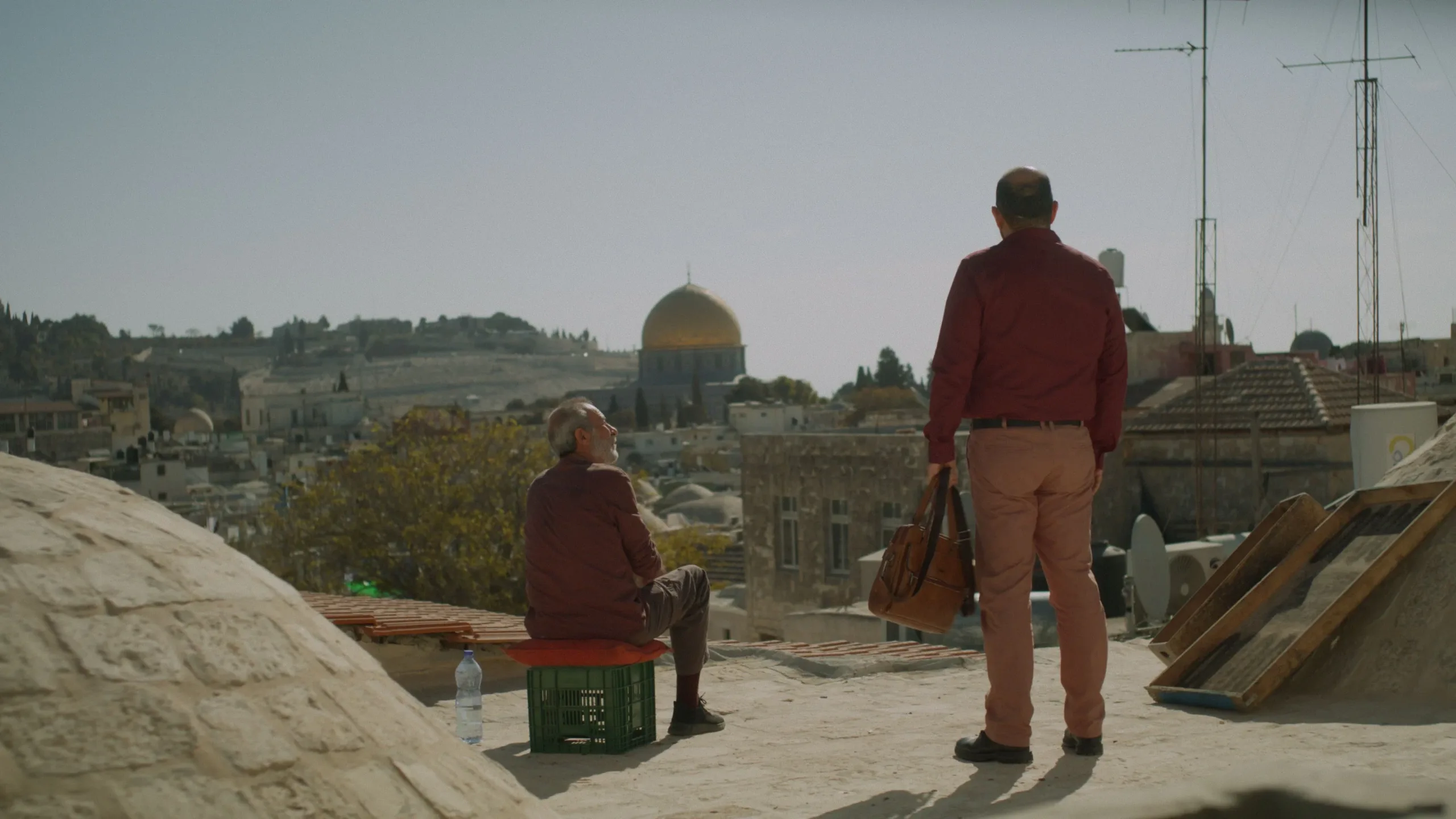
This information comes gradually, usually through people Kamal must approach while tracing what happened to Wael. It is a smart structural choice because exposition becomes confrontation. Someone from Kamal’s past does not simply tell us that he failed his family. They remind him of it. His absence from Wael’s funeral becomes especially important, turning the investigation into something close to self-interrogation. Each conversation strips away another version of the story Kamal has been able to live with.
The film is strongest when that process remains uncomfortable. Kamal had reasons for leaving, and the circumstances surrounding Palestinian life in Jerusalem make simplistic judgments difficult, but the screenplay refuses to let circumstance erase responsibility. He wanted a different future for his family and ended up disappearing from their present. Those two truths can coexist, which gives his regret weight. A less disciplined script might have converted political hardship into a complete explanation for his choices. Alayan leaves some blame where it belongs.
The mystery itself is less successful once Kamal’s search for Einat, an Israeli woman connected to Wael shortly before his death, sends him through a sequence of encounters that occasionally feel arranged with a little too much care. One household responds with suspicion.
Another reacts aggressively. Elsewhere, Kamal finds himself among educated Israelis whose friendliness carries its own condescension. Individually, these scenes have dramatic purpose, and together they expand the social landscape surrounding his search. Their placement can still feel schematic, as though the screenplay is checking perspectives off a list before allowing Kamal to move to the next clue.
That weakness becomes easier to notice because the investigation keeps promising the mechanics of a detective story. Questions arise around the body identified as Wael, the condition in which it was found, and what Einat may know. Yet the eventual answers matter less than the uncertainty that sends Kamal looking for them.
Once that becomes clear, some of the procedural suspense begins to feel borrowed from a film that Conversation With The Sea never seriously intends to become. El Basha becomes essential here because his performance prevents Kamal from turning into a delivery system for the screenplay’s themes.
He carries himself with the caution of someone accustomed to evaluating a room before speaking in it, but the restraint never feels like simple passivity. Shame, irritation, grief, and stubbornness keep appearing underneath. Kamal wants forgiveness while understanding that asking for it may be another selfish act. El Basha lets that contradiction remain visible without announcing it.
When people confront Kamal with his absence, he rarely has the luxury of indignation for long because their accusations contain enough truth to stop him. Alayan frequently relies on El Basha to supply emotional transitions that the screenplay could easily have overexplained, and he does. A story built around delayed revelations needs an actor capable of making yesterday feel present before the script explains why.
The film’s wider political setting places additional pressure on that personal story. It begins with footage of Palestinian protesters confronting Israeli security forces, establishing a reality that continues through Kamal’s encounters with officials, soldiers, civilians, walls, and divided spaces around Jerusalem. The strongest use of this context comes when it affects narrative behavior directly. Kamal’s caution, the bureaucratic complications around Wael, and the vulnerability attached to his home all belong to the same lived environment.
At times, Alayan pushes those ideas harder than the drama requires. Certain encounters arrive already carrying their intended interpretation, leaving little for the scene to discover. The film is considerably better when politics and character cannot be separated cleanly. Kamal’s decision to leave Jerusalem, his family’s resentment, his attachment to the house, and his eventual return all gain force because personal choices were made inside pressures larger than one household.
That balance keeps Conversation With The Sea from collapsing into either a mystery or a political parable. Its detective structure is sometimes too tidy, yet the character story inside it remains stubbornly messy. Kamal can uncover records, locate witnesses, and reconstruct events surrounding his son. None of those tasks offers the harder convenience of rewriting the years when he was gone.
By the time the investigation gives way to confession, the important discovery has already happened. Kamal finally understands that finding the truth about Wael cannot repair the role he played in losing the rest of his family. The case can be solved. The past has less accommodating paperwork.
Conversation with the Sea world-premiered in the Spotlight section at the 83rd Venice International Film Festival on September 7, 2026. The drama follows a sixty-year-old Palestinian man in Jerusalem who investigates what truly happened to his son after an Israeli court demands payment for a social security debt under his son’s name, decades after the young man supposedly drowned.
Full Credits
Title: Conversation with the Sea
Distributor: Mad World, PalCine Productions, KeyFilm
Release date: September 7, 2026 (Venice International Film Festival)
Running time: 1 hour 52 minutes (112 minutes)
Director: Muayad Alayan
Writers: Muayad Alayan, Rami Alayan
Producers and Executive Producers: Muayad Alayan, Rami Alayan, Hanneke Niens, Faycal Hassairi
Cast: Kamel El Basha, Amer Hlehel, Ruba Blal, Haitham Omari, Bahira Ablassi, Maria Zreik, Rebecca Esmeralda Telhami
Director of Photography (Cinematographer): Lorenzo Casadio Vannucci
Editors: Matteo Faccenda
Composer: Fabienne van Eck
The Review
Conversation With The Sea
Conversation With The Sea works best when its mystery stops pretending to be the main event. Muayad Alayan occasionally makes Kamal’s search feel too carefully arranged, but the structure succeeds in forcing a damaged father through the history he spent years avoiding. Kamel El Basha gives that design its emotional credibility, holding guilt, grief, and defensiveness in the same restrained performance. The detective mechanics may resolve too neatly, yet Kamal’s reckoning does not. That imbalance keeps the film human.
PROS
- Kamel El Basha’s restrained lead performance
- Strong use of investigation as character revelation
- Morally complicated treatment of Kamal
- Political context tied closely to personal choices
CONS
- Some encounters feel schematically arranged
- Supporting figures can serve obvious thematic functions
- Detective mechanics promise greater mystery than they deliver