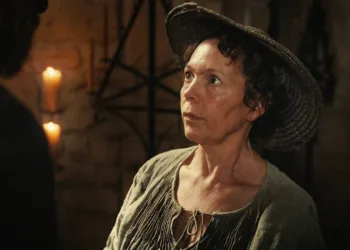







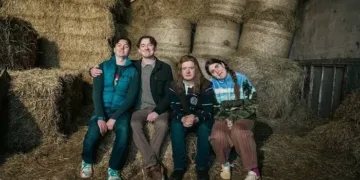
















A Danish director adapted Knut Hamsun’s Norwegian farming saga for silent film in 1921. A century later, Hans Petter Moland gives it sound and lets the wind carry much of the conversation. It presses against the walls of a makeshift shelter and follows Isak and Inger as they turn that shelter into a home. Their labour is audible too, in the creak of trees and the repeated cut of a scythe. Growth of the Soil belongs to a Scandinavian tradition of rural epics, but its most persuasive history is told at the scale of a task that has to be done again tomorrow.
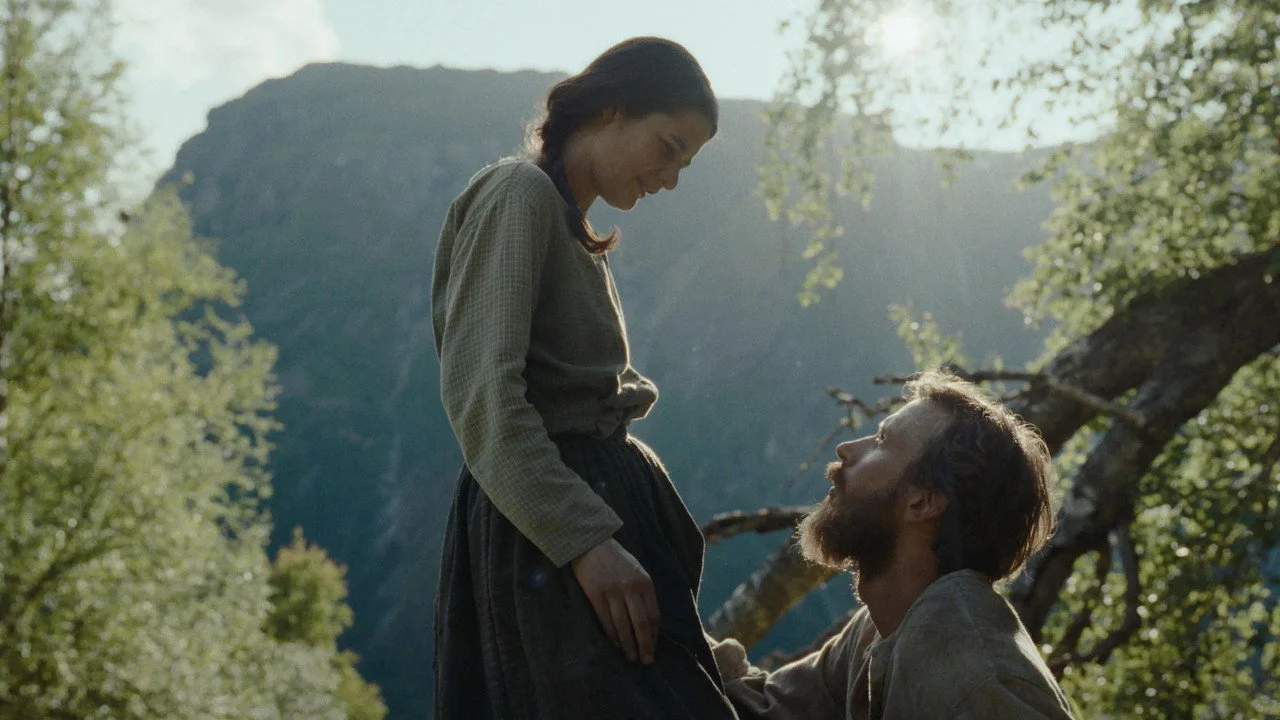
Herbert Nordrum’s Isak can say a good deal with a cough. When he wants Inger to notice something he has made or brought home, the sound becomes a shy request for approval. Asta Kamma August gives Inger a more legible curiosity, though the two actors make their closeness depend on attention rather than declarations.
They are especially convincing in the small adjustments of a shared life: an axe repaired, a new possession inspected together, work picked up where the other person left it. The scarcity of dialogue gives those exchanges room, and their performances give Moland’s long stretches of quiet a human pulse.
Their partnership begins without much assurance. Isak is trying to establish himself in the mountains of northern Norway when Inger appears in the cold. He offers shelter; she accepts it while keeping a stone close for protection. Nordrum and August allow trust to develop at the pace of practical cooperation.
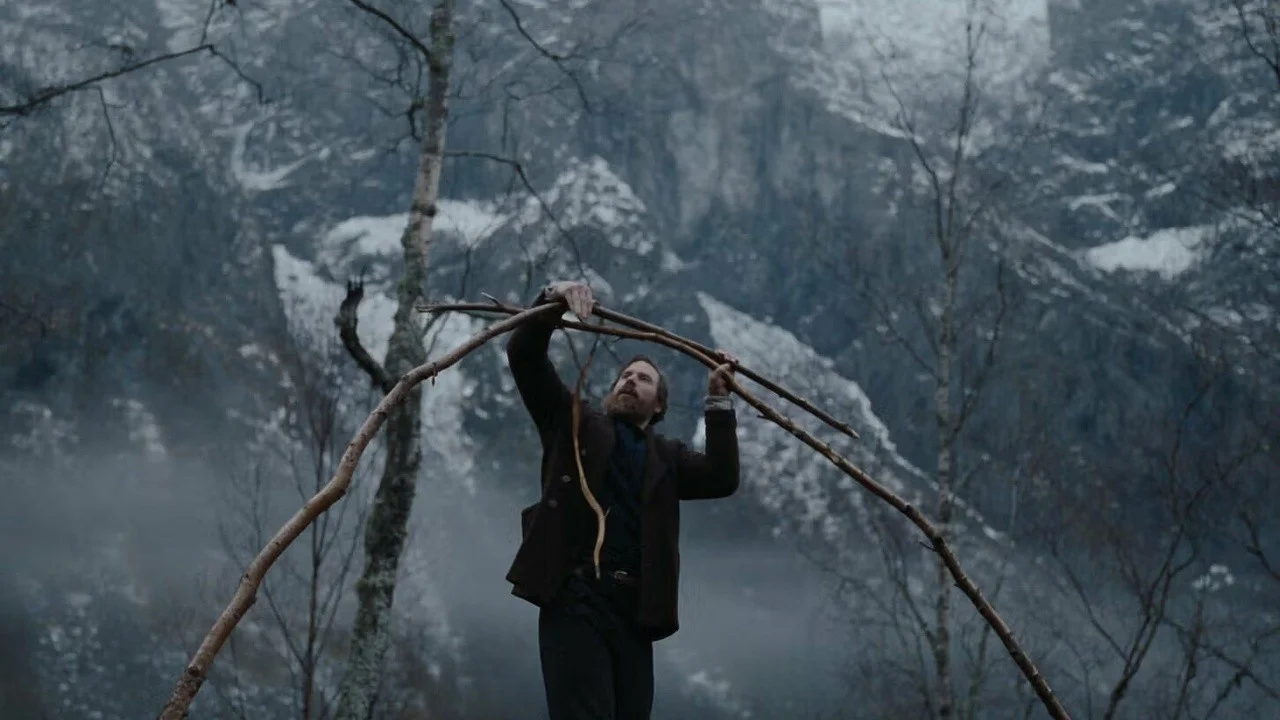
Isak’s attempts to construct a shelter have been frustrated by frozen hands and stubborn materials. With Inger there, the shelter finally takes shape. As the years pass, a stone house, a working farm, and two sons follow. The film’s images of individual persistence keep showing two people doing the work.
That detail matters in an adaptation of a novel so closely associated with the figure of the self-reliant settler. Moland photographs the surrounding land with rugged restraint: the open views dwarf the family, while the closer attention to crops and buildings shows how much effort each apparent improvement has cost. Linda Man’s seasonal edits let a hard winter give way to spring without making the intervening labour disappear.
The chapter divisions and deliberate pace invite comparison with the sweeping Scandinavian sagas of The Emigrants and Pelle the Conqueror. Moland finds a quieter rhythm within that tradition. At roughly two and a half hours, the film asks for patience, but its early passages make time feel like something Isak and Inger must physically endure.
Time becomes stranger once they can afford a clock. Isak and Inger watch its pendulum with delight, although neither can read its face. The moment is gently funny and revealing: an object from a changing world can be beautiful to them before it becomes useful. Later, deeds, taxes, and officials give the outside world a less welcome presence.
Isak has worked the land for years before an authority arrives to tell him what he owes for it. Since he and Inger cannot read, the language of ownership leaves them at a disadvantage on ground they know intimately. Moland makes that encounter frustrating without pretending that their isolation could remain untouched indefinitely.
The changes outside the farm also expose differences within it. Isak grows wary of the settlers, machines, and institutions entering his world. Inger shows a greater appetite for contact beyond their household. August makes that impulse credible because Inger’s earlier life on the farm never looks passive or merely temporary; she has invested herself in it as fully as Isak has. When the birth of their third child leads to a desperate act and a long separation, the consequences alter both partners. Moland is attentive to the distance between returning to a home and returning to the person who once shared it with you.
Here the film’s cultural inheritance becomes difficult to set aside. Hamsun’s later support for Nazism casts a shadow over any uncomplicated celebration of the man who needs no society. One reading of Moland’s film sees officials and newcomers as intruders upon an honest life. Another has to account for Inger, whose labour helped build that life and whose possibilities need not end at the farm’s boundary. The film sometimes admires Isak’s steadiness so openly that the first reading threatens to prevail. Its better scenes leave space for August to disturb it.
Moland’s control of sound is essential to that space. Gisle Tveito’s wind and working noises often take precedence over Kaspar Kaae’s spare music, keeping the farm present as a place of effort rather than an untouched refuge.
The later stretch has fewer developments to sustain the film’s patient rhythm, and some of its historical changes arrive with less force than the early construction of the household. Still, Nordrum and August hold the widening distance between Isak and Inger in view. The land remains under their feet; the question of what each of them wants from a life on it has changed.
Growth of the Soil world-premiered at the Toronto International Film Festival in September 2026. Based on Knut Hamsun’s Nobel Prize-winning novel, the epic period drama follows a pioneer carving out a rugged existence in the Norwegian wilderness alongside a resilient woman he takes as his partner.
Full Credits
Title: Growth of the Soil
Distributor: 4 1/2 Fiction, Scanbox Entertainment, Beta Cinema
Release date: September 2026 (Toronto International Film Festival) / October 2026 (Norway)
Running time: 2 hours 35 minutes (155 minutes)
Director: Hans Petter Moland
Writers: Hans Petter Moland, Gard B. Eidsvold
Producers and Executive Producers: Håkon Øverås, Chris Sanger, Birgitte Skov
Cast: Herbert Nordrum, Asta Kamma August, Gard B. Eidsvold, Anders Baasmo, Oddgeir Thune, Sjur Vatne Brean
Director of Photography (Cinematographer): Oskar Dahlsbakken
Editors: Linda Man
Composer: Kaspar Kaae
The Review
Growth of the Soil
Moland’s patient adaptation finds the weight of a changing Norway in the work Isak and Inger share. Nordrum and August make their quiet bond absorbing, while wind, labour, and passing seasons give the rural epic its texture. The later stretch loses some force, and the film’s admiration for Isak can narrow its view of Inger. At its best, her presence keeps the story’s promise of independence open to question.
PROS
- Nuanced lead performances
- Rich, physical sound design
- A thoughtful challenge to the lone settler myth
CONS
- Less eventful later stretch
- Occasional overidentification with Isak
- Some historical changes lack the early scenes’ force