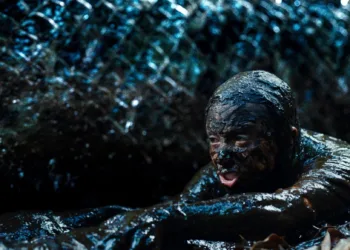





























Scanning a locked door in End of Abyss identifies the key it needs and records that information on the map. Cel, the combat technician sent into its underground facility, can also inspect fragile walls, mechanisms, and enemy weaknesses. The scanner turns observation into information she can use later. Across floors connected by ladders, elevators, bridges, and narrow openings, that record matters: finding a tool is useful partly because the player already knows where to take it.
Explosive Charge gives those earlier observations a practical payoff. Cracked walls encountered before its acquisition become access points to equipment and upgrades, while individual keys can open several doors across the facility. Progression changes the value of places already visited. Section 9 Interactive makes backtracking satisfying when a return trip has a purpose: the player remembers an obstruction, understands the new capability, and chooses to investigate. The facility gradually becomes something Cel can work with, even as its inhabitants remain hostile.
The trouble starts when a route is available but difficult to recognize. Darkness can hide a lever, and a small vent can be easy to overlook among the facility’s industrial surfaces. The scanner helps, but its usefulness depends on remembering to inspect the right space. Missing an interaction can leave the player searching areas whose useful possibilities appear exhausted.
That is a different demand from remembering a wall that needs explosives. One rewards accumulated understanding; the other can consume time without producing new understanding. Trains connect areas, yet reaching their stations still involves enough local travel to make repeated searches wearisome.
Exploration’s rewards acquire urgency through combat. Cel’s basic pistol has unlimited ammunition, but enemies make the time required to kill them dangerous. Movement and aiming use separate sticks, with a laser showing the firing direction. The controls permit shooting while repositioning, and that freedom matters against creatures that stagger, change direction, or suddenly lunge. Ordinary enemies have no visible health bars, so the player cannot reliably calculate how much longer a threat will remain active. An apparently manageable encounter can tighten while the pistol keeps firing.
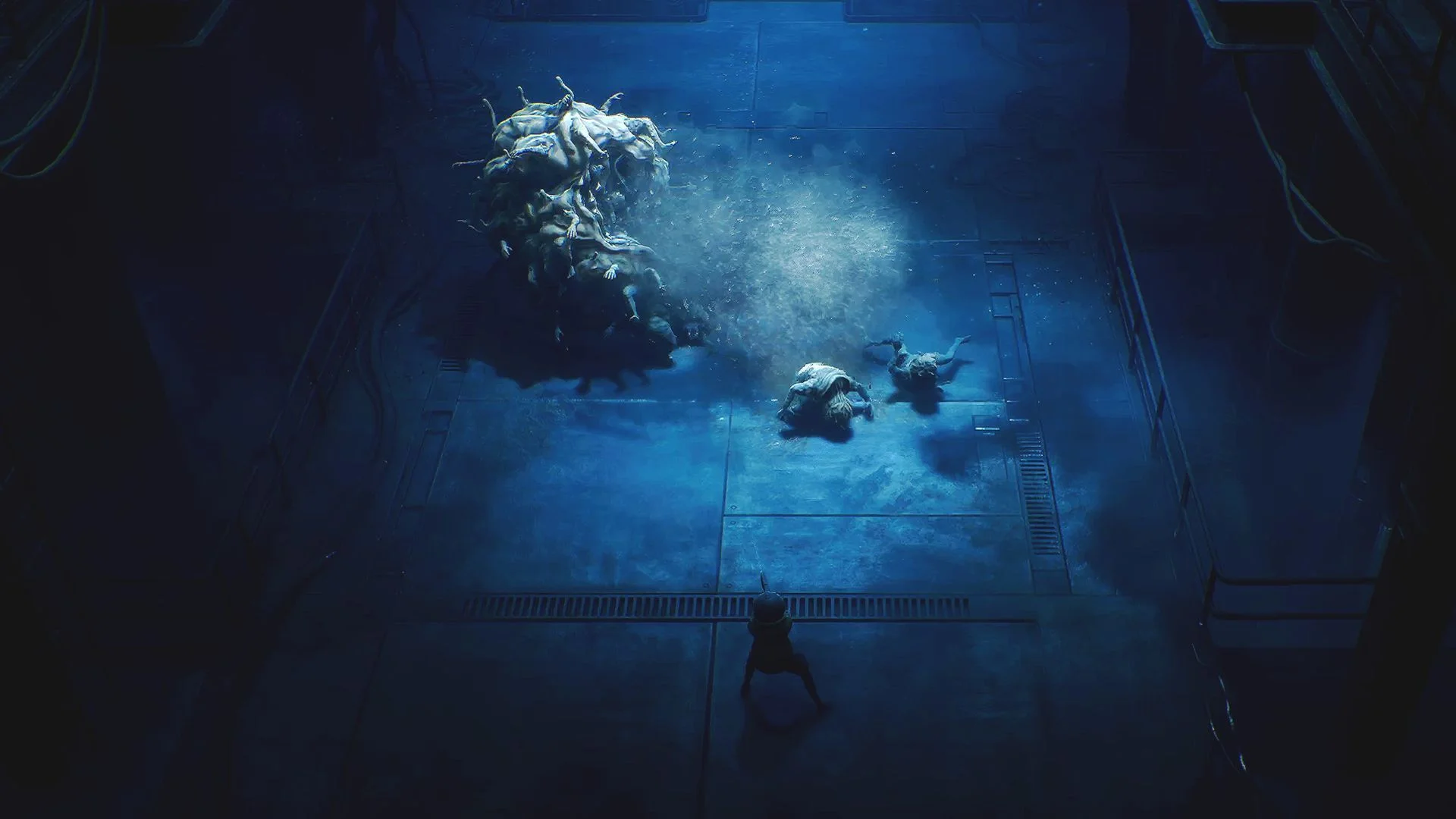
The conjoined creatures make this pressure particularly effective. Damage separates them into two attackers, changing the encounter’s demands before resolving it. The player must reassess targets and available space rather than simply continue shooting the same shape. Lockdown rooms intensify that calculation by confining Cel with the threats. A shotgun or flamethrower offers another response, but its crafted ammunition attaches a cost to faster relief. The unlimited pistol preserves a fallback while stronger weapons let the player spend resources to regain control. Horror survives the generous ammunition rule because ammunition is only one part of the encounter.
Enemy durability sometimes strains that arrangement. Keeping a creature alive creates tension while it forces movement or changes a firing decision; sustained shooting becomes repetitive once those decisions stop developing. Bosses usually demand a more active exchange of dodging, recognizing attacks, and exploiting openings.
The first boss’s additional enemy waves are a less convincing introduction. Dividing attention can test the same crowd management used elsewhere, but adding that demand while the player is still mastering aiming and movement makes the lesson unnecessarily crowded. Its difficulty comes partly from several demands arriving together.
Preparation gives the player ways to answer those demands before entering a room. Fragments dropped by enemies support ammunition crafting and weapon upgrades, with upgrades also requiring materials such as complex alloys. Spending on ammunition addresses an immediate problem; spending on a weapon improves its usefulness across later fights. This is a legible economy without requiring fragments to be perpetually scarce. Even with a comfortable supply, the two uses occupy different time scales. Exploration feeds that preparation through additional healing, equipment, and upgrades, making optional passages relevant to the next difficult encounter.
Safe rooms organize the process. Restoration pods replenish health and health boosters and allow suit adjustments, while workbenches handle crafting and weapon improvements. Suit power limits the mods Cel can equip together, so collecting protection, health benefits, and carrying improvements expands the available combinations without permitting every benefit at once. Failed attempts retain some consequence, too: ammunition and explosives already used remain spent after death. A nearby safe room can shorten the trip back to a boss, but another attempt still asks the player to consider what the previous one consumed.
Environmental hazards make equipment choices part of the facility’s geography. Around the reactor, radiation grows stronger with proximity and affects positions above and below the source. The danger occupies a consistent volume of space, giving overlapping floors a relationship the player can feel through damage. Protective equipment changes the conditions of exploring that space. Requiring exposure before the relevant protection is found can be frustrating, but the underlying arrangement is convincing: the player learns where the threat is, experiences its reach, and later gains a practical means of tolerating it.
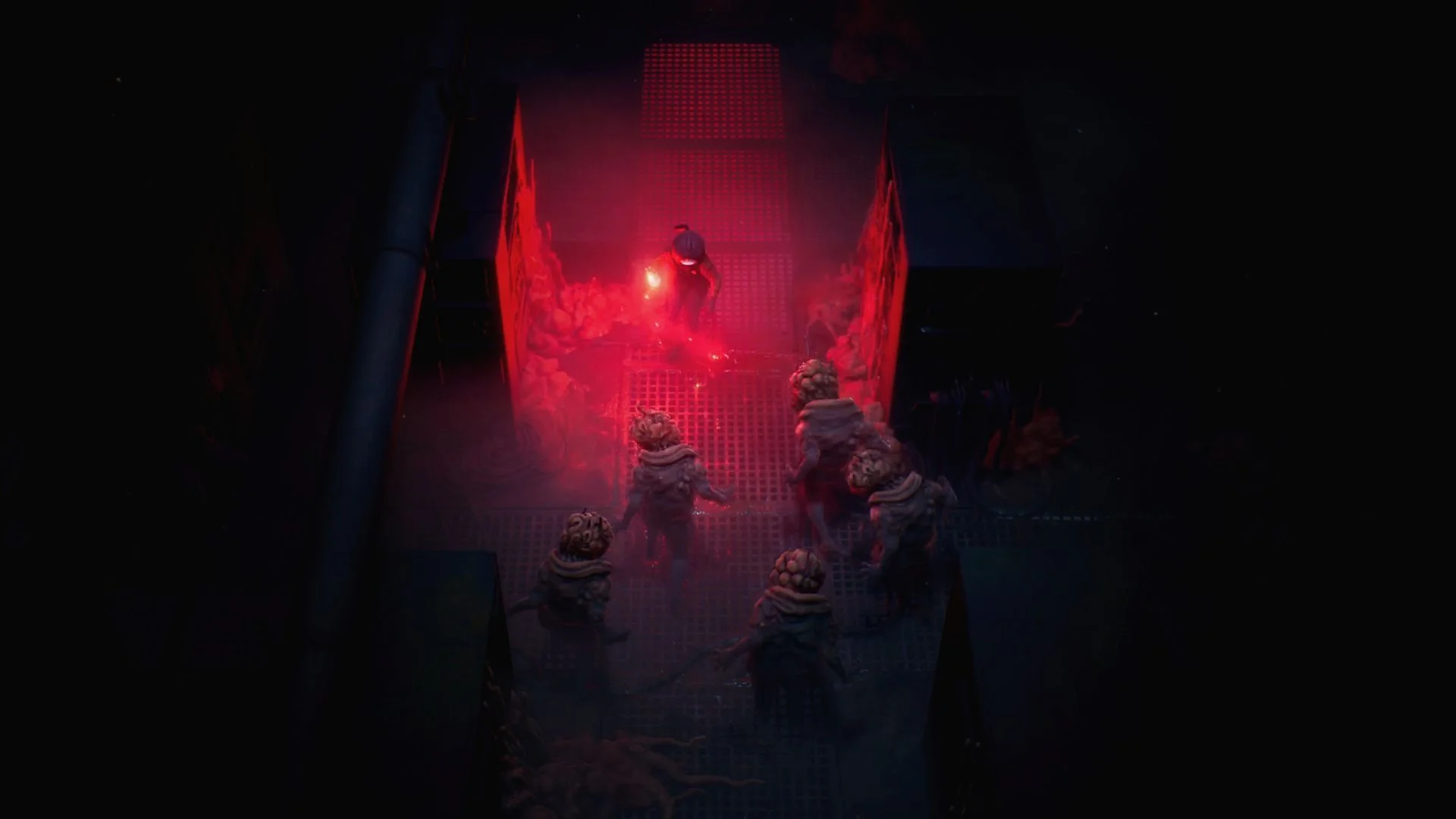
The presentation preserves uncertainty around that growing competence. The camera follows Cel through larger spaces and becomes static in smaller rooms, allowing the layout to shape what remains visible. Muted colours and industrial architecture establish the facility’s character, while shadows conceal movement within spaces the player can otherwise survey.
Persistent hornet buzzing in the ventilation ducts gives danger an audible presence; the centipede boss’s emergence from darkness turns anticipation into an immediate movement problem. These details make atmosphere operational. Sound and visibility affect the player’s readiness to move, aim, or retreat.
The story provides less satisfying returns on attention. Brief, cryptic cutscenes, sparse dialogue, environmental clues, and readable notes leave room for speculation about the facility and its transformed inhabitants. That restraint suits the isolation, but some notes and NPC exchanges mainly restate objectives.
They explain enough to keep Cel working without consistently enriching the reason for her work. The reactor establishes its presence across several floors through a precise physical rule; the narrative’s missing information has no equally clear pattern of discovery. Learning how to survive a place sustains exploration for a long time, but an instruction about the next mechanism cannot always sustain curiosity about the people who built it.
The Review
End of Abyss
End of Abyss makes exploration pay off through useful map knowledge, stronger equipment, and better survival options. Its unlimited pistol preserves a fallback without removing the pressure of enemy movement and confined spaces. Scanner-dependent searching can waste time, durable enemies sometimes outlast their tactical interest, and the cryptic story offers fewer discoveries than the facility itself. Still, its interconnected systems make preparation and understanding feel earned.
PROS
- Scanning and upgrades give return trips purpose.
- Combat rewards movement and tactical spending.
- Suit limits make preparation situational.
- Spatial hazards, sound, and shadows sustain tension.
CONS
- Overlooked interactions can cause prolonged searching.
- Enemy durability sometimes makes shooting repetitive.
- The first boss overloads the learning process.
- Sparse storytelling relies too heavily on objectives.