




























The distance between diagnosing a fungal infection and dangling inside a cave is remarkably short for Dr Ethan Winter. Richard Armitage’s Bristol forensic pathologist connects a disease associated with animal droppings to the Mendip Hills, then handles the underground descent himself. Waiting for a specialist team would apparently interrupt his flow. Conveniently, he has climbing equipment in the car. ITV’s Winter gives its leading man the deduction, the expedition, and the opportunity to look heroic while everyone else catches up. His boot seems to have been packed by a screenwriter.
Episode two supplies a quieter version of the same arrangement. A victim’s face has been removed, creating an identification problem that Winter’s own reconstruction software rapidly dispatches. The discovery moves the investigation along, but it also makes a potentially difficult obstacle feel like a demonstration awaiting its audience. His abilities are so accommodating that uncertainty has little time to settle. Watching somebody solve a problem can be satisfying; watching the programme supply him with a bespoke solution requires a different appetite. The cave descent at least puts his body at risk. The computer mostly threatens to finish the scene early.
There is useful urgency beneath these conveniences. The opening case develops from a woman found in a freezer lorry into a search for two missing children, giving the investigation a reason to hurry beyond the customary obligation to catch a murderer.
The standalone format keeps the questions manageable and offers the pleasure of a case completed within the hour. Adapted from Balthazar, the six-part series understands that familiar machinery can still provide entertainment. Its trouble is the distribution of difficulty. Winter gets the spectacular discoveries; the investigation gets whatever uncertainty he has left over.
His mortuary scenes are considerably stranger than the efficient casework surrounding them. He talks to bodies as he examines them, remarking on a kidney transplant or finger marks with the attention of somebody conducting an unusually one-sided consultation.
These addresses give forensic exposition a conversational shape. A medical finding becomes something he notices about a person, and Armitage’s sustained seriousness supplies a small suggestion of care. He delivers the information without inviting us to laugh, which makes the incongruity funnier. The corpse is spared the usual television experience of having its medical history explained to three people standing nearby.
Lighting and sound help turn these examinations into events. An Irma Thomas recording accompanies one autopsy, while the spacious, dim mortuary gives Winter room to circulate around his subject. Then the bodily details intrude: fly eggs around the eyes, exposed tissue, the physical damage that the elegant surroundings cannot soften. The collision has an odd appeal. Music makes the room feel inhabited; gore prevents it from becoming pure decoration. Armitage can sustain that atmosphere, but the hushed voice has a limited emotional vocabulary. It communicates attentiveness on the slab and anguish at home with much the same setting.
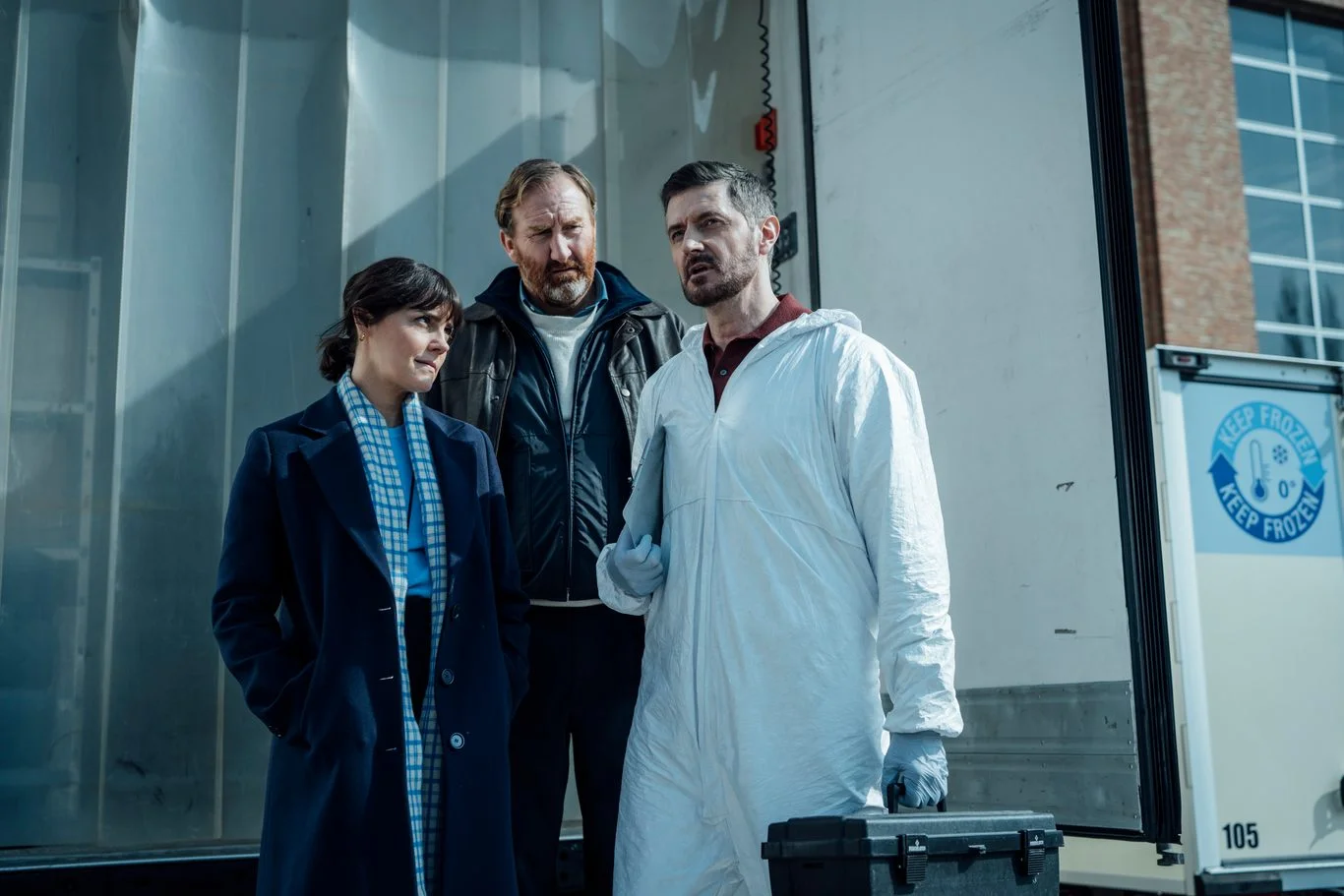
DI Lauren Bell provides the most promising source of resistance. Newly transferred from the Met, Annabel Scholey’s detective questions Winter’s methods while Jamie Kenna’s DS Ellis Daldry assures her of his extraordinary ability to interpret bodies.
That arrangement puts Bell at a disadvantage before the partnership has properly begun. Daldry already understands how things work here; her objections become evidence that she has yet to learn. Kenna gives the endorsement an easy, settled quality, making him a useful intermediary between the newcomer and the local phenomenon. The danger is that Bell’s professional judgment becomes another obstacle waiting for Winter to clear.
The interrogation-room intrusion exposes that danger neatly. Bell tells him he cannot intervene; he intervenes anyway. It is a familiar beat from the unruly-genius procedural, and Silent Witness has long demonstrated television’s willingness to extend a pathologist’s job description.
Here, though, repetition matters. An objection can generate lively friction if it changes the scene or forces a compromise. When the genius simply carries on, it functions as an introduction to his next performance. Scholey has authority in the protest, but the scene gives that authority very little leverage. Bell can object. Can she make anything happen?
The domestic encounters complicate the programme’s insistence on Winter’s charm. Arriving at Bell’s home at four in the morning and helping himself to food is a pointed way to establish casual intimacy, though it gives her ample reason to dislike him. His unauthorized access to her laptop pushes the same behavior into a less playful register.
Meanwhile, her husband’s comment on Winter’s attractiveness and her emphatic rejection of the suggestion make possible romantic movement conspicuous early on. Those exchanges tell us where the relationship might go before they establish much curiosity about how it will get there. Bell’s fridge is receiving a fuller demonstration of his confidence than Bell is of his consideration.
The continuing mystery offers a difficulty his confidence cannot readily erase. His photojournalist fiancée Simone, played by Carlotta Banat, was murdered a decade earlier, and she appears to him in the flat where she died. That gives his habit of addressing the dead a personal echo.
At work, he can use bodily evidence to answer questions; at home, the dead remain part of an unfinished conversation. Clues connected to Simone emerge within current cases, linking the weekly investigations to a history that refuses to stay closed. The structure supplies two viewing rhythms: the satisfaction of an answer tonight and a reason to return.
This is also where the atmospheric presentation needs greater emotional precision. Repeated scenes of Winter pacing his dim flat establish distress, but repetition alone gives that distress little development. Simone’s appearances are stronger material because they place another presence inside his isolation, complicating the picture of a man brooding handsomely by himself. The opening cases leave the continuing mystery with room to unsettle the routine. The decisive question is what that uncertainty will require of Winter. A difficult deduction would give him another chance to impress; an answer he cannot bear would finally interrupt him.
Winter premiered on ITV and ITVX on September 30, 2026. The forensic crime drama follows an analytical pathologist who pairs up with a driven homicide detective, using his deductive genius to assist her murder squad while hunting for clues about a tragic unsolved case from his past.
Full Credits
Title: Winter
Distributor: ITV, ITVX, PBS Masterpiece
Release date: September 30, 2026
Rating: TV-MA
Running time: 46–48 minutes per episode
- Cast: Richard Armitage, Annabel Scholey
The Review
Winter
Winter is an entertaining procedural whose star keeps solving problems faster than the drama can make them difficult. Richard Armitage’s commitment and the mortuary’s peculiar atmosphere give the familiar machinery personality, while the missing-children case supplies genuine urgency. Convenient breakthroughs weaken suspense, Bell’s objections carry little weight, and repeated brooding limits the emotional depth. Simone’s unresolved murder offers the strongest reason to keep watching: finally, a case that resists the leading man.
PROS
- Armitage’s committed delivery makes unlikely material watchable.
- Music, lighting, and gore create distinctive mortuary scenes.
- Weekly cases and Simone’s mystery provide complementary viewing rhythms.
CONS
- Convenient equipment and software remove investigative difficulty.
- Bell’s objections have limited dramatic consequences.
- Romantic signals arrive before the partnership develops much surprise.
- Repeated brooding gives grief little development.