


























Lee Yu-bin accepts a lift on Charo Island, then flees when his driver produces a heavy tool. The man appears to be clearing fallen trees from the road; Yu-bin has mentally promoted him to murderer. He runs off without his bag, which is an excellent way to survive an imaginary crime and lose your luggage to a real inconvenience. When the driver catches up and proves helpful, the embarrassment belongs entirely to his passenger.
Back in Seoul, Yu-bin can identify the wrong lighting on a table and insist that his design contract be respected. Put him beside an unfamiliar roadside obstacle, however, and his powers of interpretation collapse. Merry Berry Love gets useful comic mileage from that discrepancy. Ji Chang-wook plays his professional fussiness and panicked retreat as responses from the same easily offended man. Yu-bin expects the world to follow instructions. Japan has apparently misplaced its copy.
The premiere moves briskly through the destruction of his comfortable life. Yu-bin runs the successful design firm Y Space, but entrusts the legal side of a major deal to his friend and business partner, Kim Bong-su. Bong-su absconds with company money and client payments, leaving Yu-bin facing fraud accusations and closing his business.
The irony is efficiently established: the man policing a table’s color has missed what his partner is doing to the company. An inherited plot of land in Japan offers something he can sell, sending him toward an island where his remaining asset is already somebody else’s livelihood.
There is a quieter reason for the Japanese connection to matter. On the ferry, a child’s dropped sweet prompts a memory of Yu-bin’s father bringing the same confection home from Japan, where he worked, then announcing another departure. The flashback briefly interrupts the succession of setbacks without laboriously explaining Yu-bin. It gives the inheritance an association with absence and childhood disappointment. The premiere has room for that small emotional pause, even while its larger machinery is busily arranging his next humiliation.
Karin Shirahama, played by Mio Imada, has no spare time for an aggrieved designer. She is attempting to secure certification for her strawberries for the third year, with requirements covering the proportion of the farm devoted to them, their shape, and their taste. Failure this year threatens her relief aid. Her enthusiasm therefore has a deadline attached. Imada’s lively determination is appealing because Karin keeps directing it toward practical tasks: persuading a worker to stay, pursuing certification, finding replacement help. The farm gives her something to want before the romance arrives.
Their ferry-terminal encounter makes that romance start with a properly inconvenient grievance. There is one ticket left, and they settle the competition through rock, paper, scissors. Karin wins. Then she spots her exhausted worker Daniel leaving with his bags, and Yu-bin uses her distraction to buy the ticket himself. The scene establishes his opportunism while connecting her defeat to a problem already developing elsewhere. She loses transport while trying to retain labor. He gets a boat ride and an excellent reason for his future love interest to dislike him.

The language barrier also creates an effective gap between what Yu-bin knows and what the audience knows. At the village office, the helpful driver tells him that Karin occupies his inherited land. He fails to understand the warning.
His discovery that the cyclist Kunam is Korean, despite Kunam’s initial denial, supplies a possible translator, but the information has already slipped past him. These encounters keep supporting characters attached to the episode’s immediate business. The island is introducing itself; Yu-bin keeps missing the introductions.
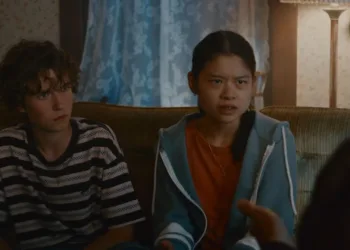
That confusion becomes costly when schoolchildren arrive at the farm with two teachers. They interpret his broken Japanese as permission to pick strawberries, then damage the carefully cultivated patch. The escalation makes structural sense: misunderstandings that previously injured his dignity now injure Karin’s livelihood. The damaged fruit matters because the episode has established the certification pressure. A familiar fish-out-of-water routine suddenly leaves somebody else facing the bill.
The scene’s behavior is considerably less persuasive than its function. Two teachers proceed without securing intelligible consent, and the children’s exaggerated destruction supplies exactly the catastrophe needed for Karin’s return.
Broad comedy allows people to overreact, as Yu-bin does with the driver. Here, the adults must neglect a basic responsibility so the plot can reach its next appointment. Apparently, supervision ends at the ferry terminal. The distinction matters because Karin’s financial difficulties are being asked to carry emotional weight inside a situation assembled with conspicuous carelessness.
Her determination has a sharper edge elsewhere. Daniel leaves because the workload is excessive, despite her attempts to persuade him to continue. That gives her persistence a cost for someone nearby and prevents the farm from functioning purely as a picturesque cure for Yu-bin’s city life. He wants to liquidate the land; she needs to keep working it. Their competing intentions provide a sturdier foundation for friction than nationality or prickliness alone.
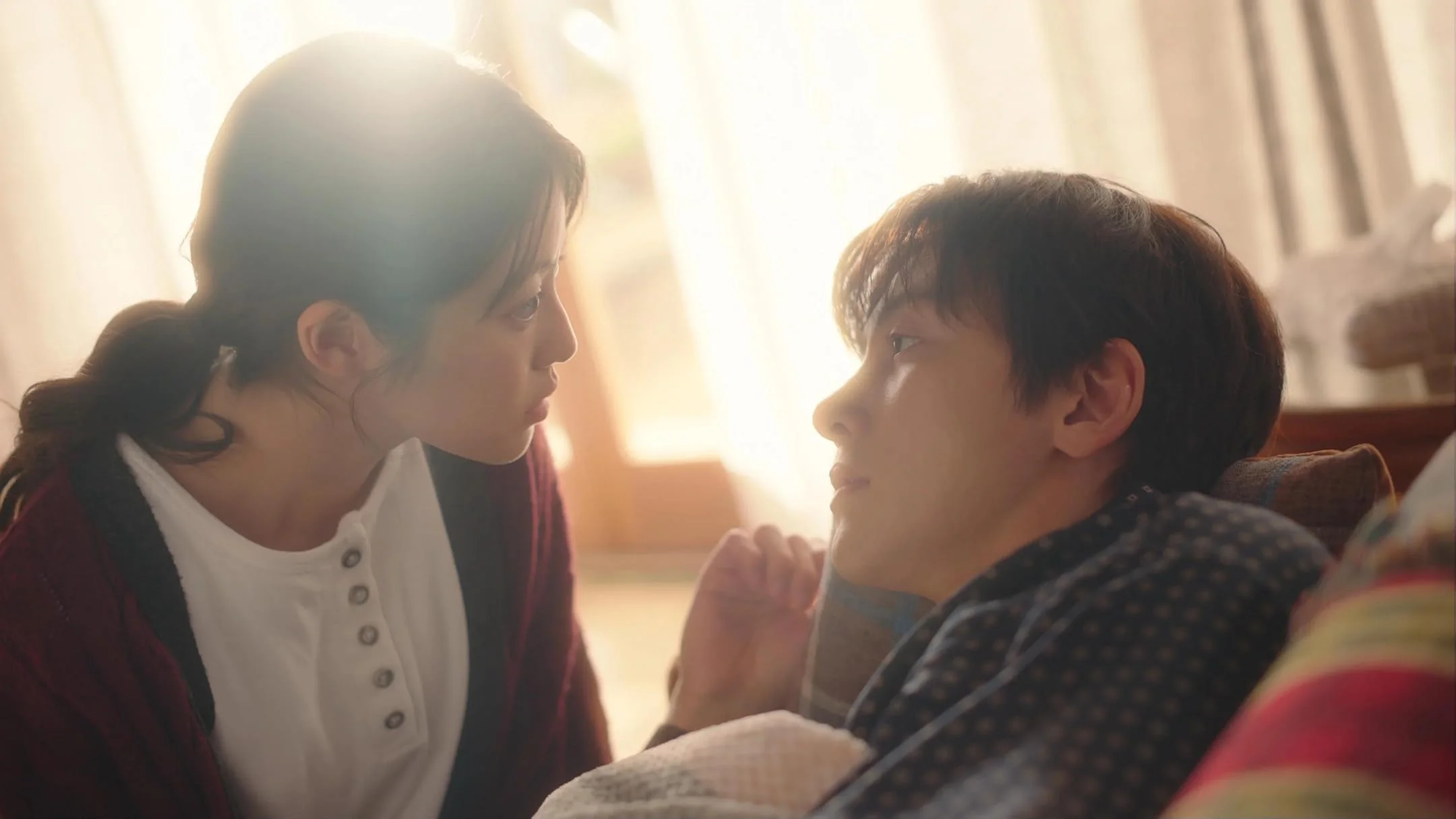
Then the premiere converts that friction into its romantic cliffhanger. Karin finds the ruined patch and Yu-bin eating a strawberry. Her heart rate rises, her monitor sounds, and she collapses; he throws the fruit into the air and catches her. The beat is cheerfully theatrical, with the strawberry eater abruptly required to become a rescuer. It gives Ji a protective action after an episode of indignation and self-interest, but also interrupts Karin’s anger at the exact moment she can finally express it to him.
Her unexplained illness makes the interruption difficult to assess beyond this episode. The catch offers immediate tenderness, while the damaged farm remains a problem neither attractive lead has solved. What the next episode owes Karin is the chance to remain angry after she gets back on her feet.
Merry Berry Love premiered globally on Disney+ and Hulu on October 7, 2026, alongside its television broadcast on Japan’s Nippon TV. The ten-episode joint South Korean and Japanese romantic comedy series follows a disgraced Korean spatial designer who moves to a quiet Japanese island to start over, where he crosses paths with a resilient local strawberry farmer.
Where to Watch Merry Berry Love Online


Full Credits
Title: Merry Berry Love
Distributor: Nippon TV, Disney+, Hulu
Release date: October 7, 2026
Rating: TV-14
Running time: 45–50 minutes per episode
Director: Kim Soo-jung, Noh Young-sub
Writers: Lee Jae-yoon
Producers and Executive Producers: Park Chae-eun, Lee Soo-ji, Kim Geun-sil, Kenji Ikeda, Soji Inose, Shinichiro Kubo, Reon Iwami
Cast: Ji Chang-wook, Mio Imada, Nam Yoon-su, Rinka Kumada, Jung Soon-won, Kim Tae-hoon, Moon Woo-jin, Kenta Satoi, Yasunori Danta
The Review
Merry Berry Love
Merry Berry Love earns its early charm by making Ji Chang-wook’s meticulous designer spectacularly bad at island life, while Mio Imada gives the strawberry farm a purpose beyond romantic scenery. The premiere’s misunderstandings build neatly until the school visit requires its adults to abandon common sense. Its closing rescue is sweet, but Karin’s damaged livelihood deserves attention after the catching is done.
PROS
- Ji Chang-wook’s shift from authority to comic indignation.
- Concrete farming pressures give Karin independent stakes.
- Misunderstandings connect the premiere’s encounters and conflicts.
- A brief childhood memory lends Yu-bin emotional texture.
CONS
- The school-trip disaster depends on implausible adult behavior.
- The romantic cliffhanger interrupts Karin’s chance to confront Yu-bin.