


























From the middle of the backseat, the camera looks toward Palmer and Iris with the easy familiarity of someone who has accepted a lift before asking about the driver. The position matters. Avalon Fast and Jillian Frank’s Drinking and Driving places us inside the company its title gives us reason to distrust. Quick cuts to a low-angle view of Palmer vomiting Twisted Tea put bodily unpleasantness within that same intimate range. The camera has joined them, and the invitation includes whatever comes up.
At the dirt track, the soundtrack offers a harsher account of belonging. Engines and spectators swallow much of Palmer’s exchange with her mother, while their traded profanity remains intelligible. Family communication arrives as something barely able to compete with the surrounding noise.
Fast and Frank resist isolating the encounter into a neatly explanatory domestic scene; hostility belongs to the place’s ordinary soundscape. Our proximity lets us hear the insult without granting access to everything beneath it. The film establishes a useful distinction between being present and understanding the people beside us.
Fast and Frank, who co-direct and play Palmer and Iris respectively, give that distinction a quietly revealing practical form. The women stayed in their hometown, work at the same restaurant, frequently share a bed, and now share a phone. Palmer threw hers into a lake.
When Iris gives their number to Levi, a customer she takes an interest in, even a possible new attachment must enter through the infrastructure of the old one. Palmer’s impulsiveness has become Iris’s logistical problem. The arrangement is funny in the mildly exhausting way that someone else’s bad decision becomes a household convenience.
Their conversation about boredom makes the pressure clearer. Palmer asks if Iris has tired of her; Iris offers reassurance while wishing they had a larger circle of friends. Fast lets the question expose Palmer’s need for security, and Frank gives the answer two obligations: preserve the friendship and express a desire it might restrict.
This is the pair’s strongest performance register, affection carrying a small amount of negotiation. Iris’s hesitation about challenging Palmer’s attachment to an institutionalized ex-boyfriend extends the problem. Caring for someone can involve leaving a damaging conviction undisturbed because challenging it might endanger the available closeness.
The kiss at Palmer’s grandmother’s house gives this closeness its most persuasive visual defense. A television displaying “NO SIGNAL” casts blue light across the women, furnishing a tender enclosure in temporary accommodation. Its failed entertainment becomes the illumination for their own.
Their hide-and-seek preserves something playful within circumstances that could easily be photographed as deprivation. Palmer’s mother offers limited welcome, and the grandmother’s house supplies a place to stay; the light allows us to understand why one another’s company is worth protecting. The scene’s beauty makes the later cost of that protection harder to dismiss.
Elsewhere, the camera’s social availability grows oppressive. During a cocaine party, a sustained take produces the unsettling impression that the camera is passing from person to person. There is no comfortable observational station, no clean separation between the gathering and the gaze recording it.
Duration keeps us among the participants after curiosity has begun to sour. Hailey’s casual cocaine use during a conversation with Iris, and Palmer drinking from a pint bottle beneath the bedclothes, establish how thoroughly intoxication has entered ordinary activity. These are habits with very little ceremony left. The party continues into the next morning’s posture.
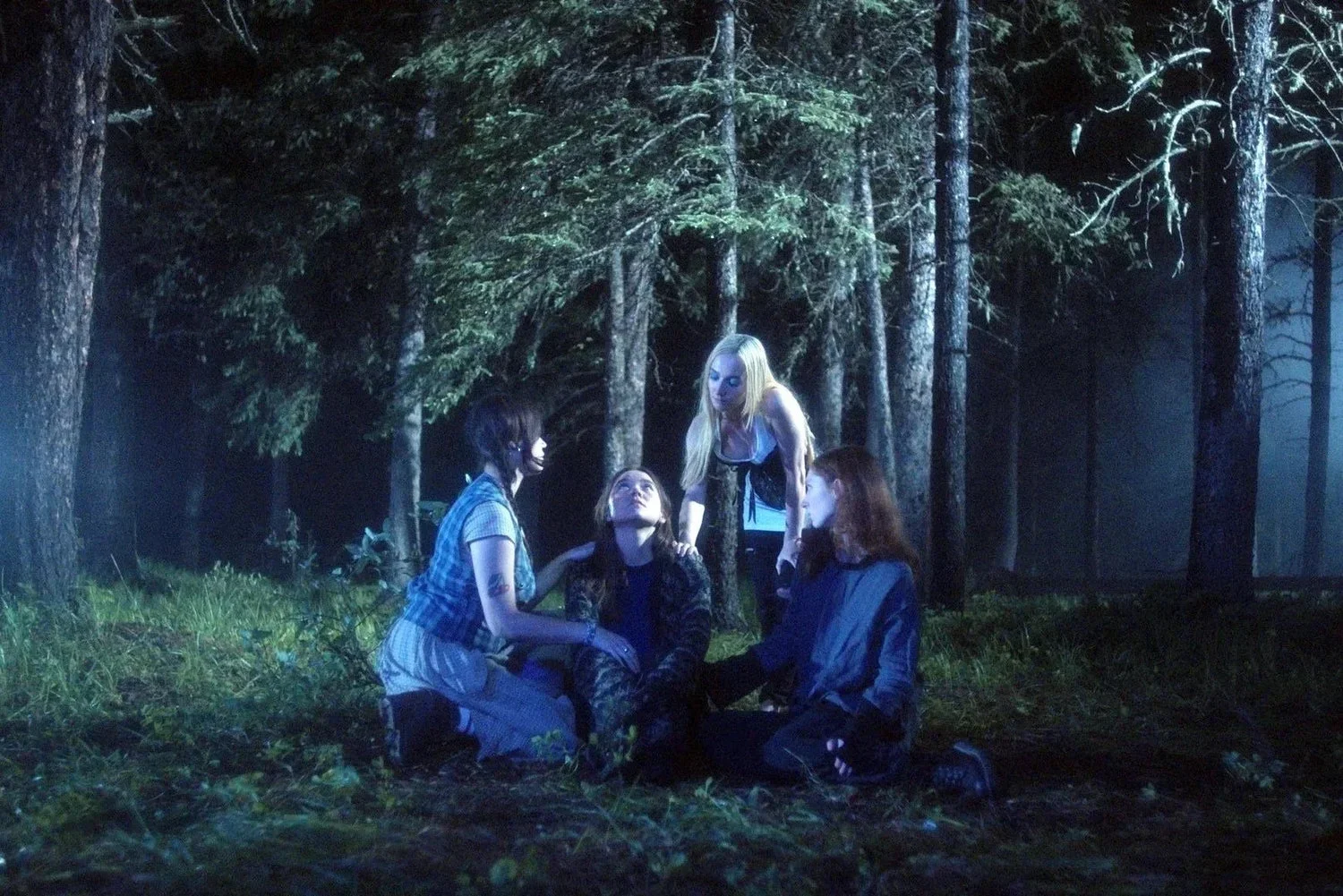
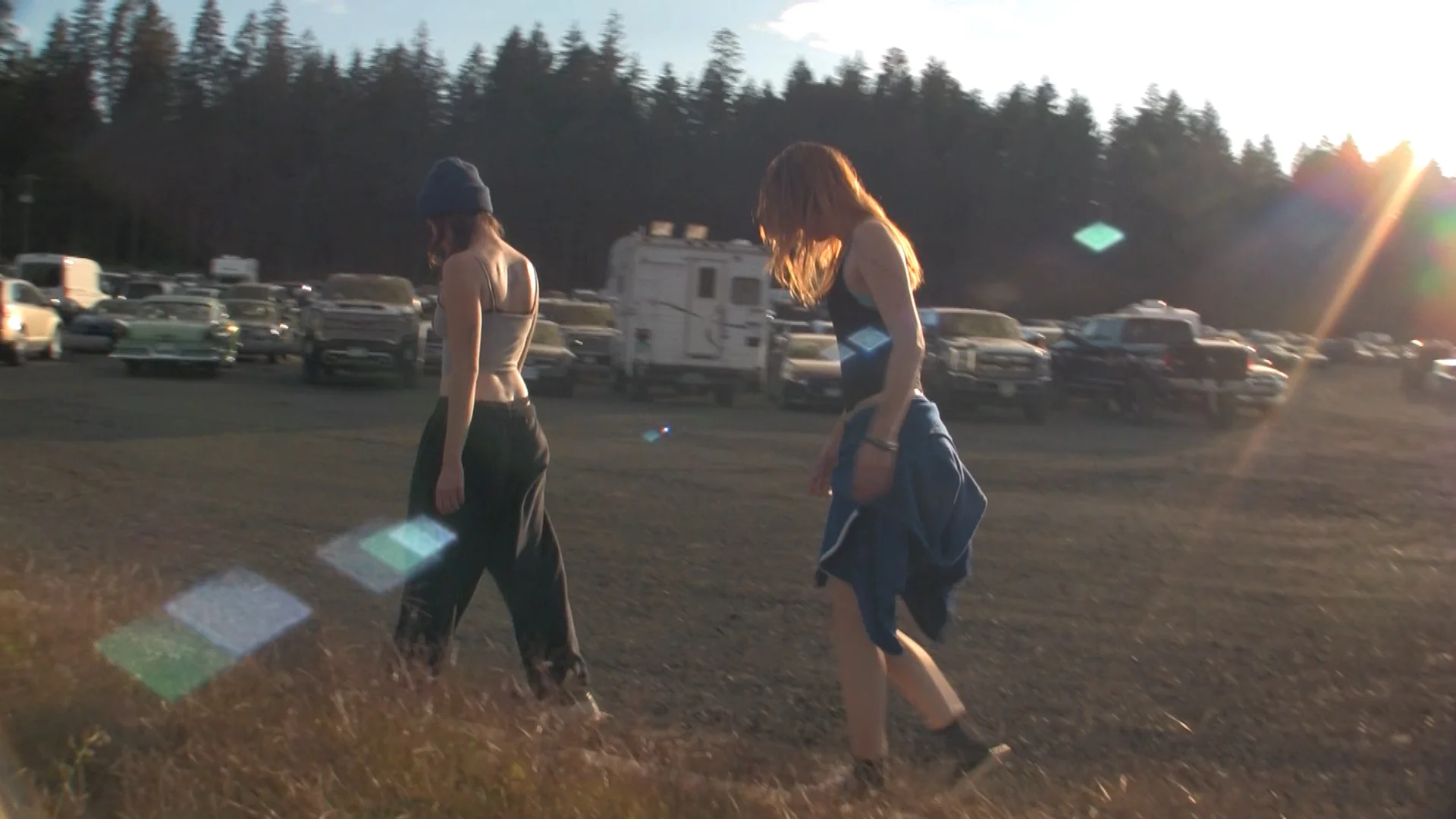
The rough digital texture is carefully employed. Muddy greens, grays, and browns compress the town’s surfaces; shadows gather grain, and bright light blooms across the image. Faces and surroundings share the same unstable visibility. There is a trace of noir’s visual fatalism here, attached to people whose compromised attachments require no criminal plot to hold them in place. Yet the film can change scale with striking precision.
A wide composition reduces the women against the mountains, exchanging the closeness of cars and bedrooms for a landscape that dwarfs them. The available space suddenly exceeds the lives they have managed to construct within it.
Fast and Frank’s accumulation of shifts, parties, and uncertain sleeping arrangements gives repetition a physical weight. The image of a cat beneath a trampoline occupied by sleepers is particularly acute: human excess has become part of the morning scenery.
But the film’s commitment to lingering carries a cost. The middle stretch allows established tensions to remain suspended for so long that suspension begins to replace development. Palmer’s fear of losing Iris and Iris’s wish for a larger social world could sustain considerable pressure without a conventional confrontation. As the film disperses its attention, those differences become less active. The images continue discovering things; the relationship has fewer opportunities to do so.
The increased prominence of Levi and his cousin Phoenix, played by Ethan Hawksworth and Henri Gillespi, makes that imbalance consequential. Levi’s account of a dream to Iris helps move the film toward a less stable reality, while Phoenix’s account of his mother’s death introduces grief into a relationship we have had less time to know.
A late overhead composition gives recounted trauma a visual intimacy that the sometimes difficult-to-parse dialogue cannot supply alone. The framing gathers emotional force, but the shift toward the cousins asks the audience to transfer an attachment built through the women’s detailed habits. It is a demanding transfer, and the film has prepared the image better than the feeling.
Full sunlight in the closing field offers no reliable clarification. The four characters occupy an exposed space while their connections become increasingly difficult to read, and repeated imagery of Levi moving through the meadow with his face obscured unsettles the apparent openness.
The passage permits a departure from routine without establishing that anyone has acquired a different way to live. Its abstraction also leaves Palmer and Iris’s earlier friction largely unresolved. When Levi walks toward the forest alone, the shared frame can no longer keep the company together. The film leaves us watching an individual withdraw from the intimacy through which we first learned to see him.
Drinking and Driving premiered at the Los Angeles Festival of Movies in April 2026, followed by international independent cinema and festival screenings through October 2026. The lo-fi indie drama follows two twentysomethings working in their hometown who share a restaurant job, a bed, and a reckless habit, before an encounter with an old acquaintance unravels the hazy reality of their summer.
Full Credits
Title: Drinking and Driving
Distributor: MUBI, ICA, Independent Film Circuit
Release date: April 2026 (Los Angeles Festival of Movies), October 2026 (ICA / International Festival Screenings)
Running time: 1 hour 46 minutes (106 minutes)
Director: Avalon Fast, Jillian Frank
Writers: Avalon Fast, Jillian Frank
Producers and Executive Producers: Avalon Fast, Jillian Frank
Cast: Payton Berg, Henri Gillespi, Jillian Frank, Avalon Fast, Ethan Hawksworth, Sophie Bawks-Smith
Editors: Avalon Fast, Jillian Frank
The Review
Drinking and Driving
Drinking and Driving makes affection and self-destruction occupy the same frame. Fast and Frank’s blue-lit intimacy, abrasive soundscape, and circulating party camera give reckless routines a troubling hospitality. Their performances establish a friendship whose comforts discourage difficult conversations. The diffuse middle and late shift toward the cousins weaken that precision, leaving the final images with emotional work they cannot quite complete.
PROS
- Framing and sound make spectator involvement morally uncomfortable.
- Fast and Frank convey affection strained by dependence.
- Blue television light gives temporary shelter genuine tenderness.
- Rough digital texture supports precise, expressive compositions.
CONS
- The diffuse middle and ending leave central relationship tensions underdeveloped.
- The late focus on the cousins gives grief insufficient emotional preparation.







