



























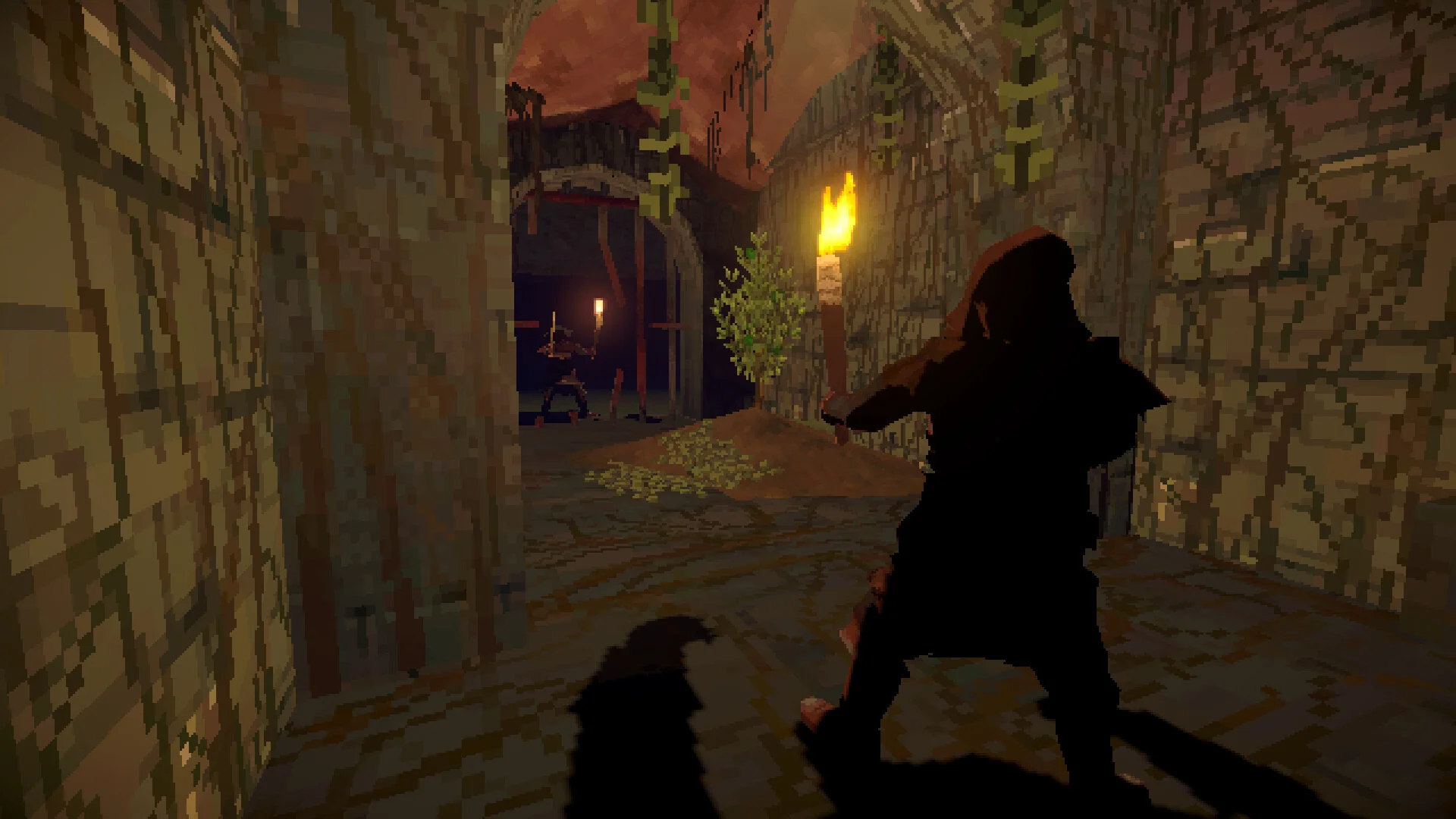

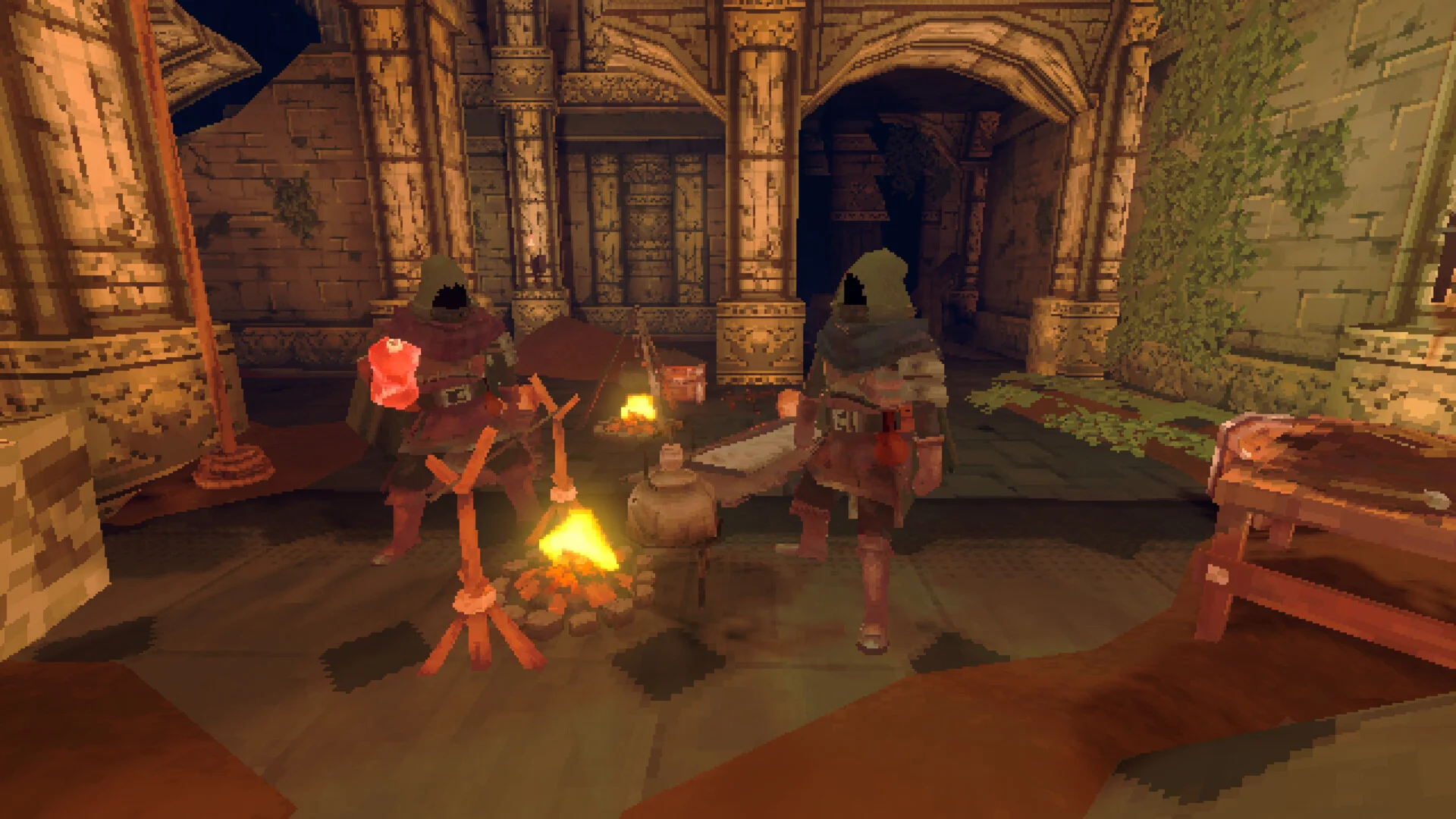
King’s Field supplies a useful point of departure for Deep Dish Dungeon: blocky architecture, oppressive darkness, and combat that makes approaching an enemy a considered act. Yet the sleeping bag, rotisserie fire, and storage chest waiting underground introduce another tradition into that space. Survival crafting asks the treasure hunter to establish a household among the ruins. A room becomes somewhere to return, organize possessions, and prepare dinner. The dungeon’s old hostility persists around this small pocket of domestic order.
Rat traps make that change particularly tangible. Their catches supply meat for cooking and hides for a backpack, linking bodily survival to the ability to carry further discoveries. A cooking pot and workbench gradually expand what the camp can provide. These activities give occupation a material logic: the player learns to use the dungeon’s inhabitants and discarded resources to remain there.
A letter in the early camp suggests somebody else attempted the same arrangement. The sparse notes and traces of previous adventurers leave room for speculation without supplying a substantial narrative. Much of the player’s own story takes shape through acquiring the means to stay.
The dungeon rewards this attention because its layout is handcrafted. Stacking crates to reach another floor or dragging a plank into position as a ramp makes exploration depend on recognizing possibilities in ordinary objects. Climbable columns and arches can conceal treasure, confirming that an apparently improvised route has a place within the design. The satisfaction comes from a conversation between environmental intent and player ingenuity. Deep Dish Dungeon preserves the secrecy associated with older dungeon crawlers while allowing a physical, practical response to it.
Its interconnections also give remembered places continuing value. A hammer opens rusted bars encountered earlier, changing a familiar obstruction into an invitation to return. Shortcuts fold lengthy routes back into known rooms, making the dungeon feel extensive through its relationships rather than sheer acreage. Such discoveries reward accumulated knowledge. A corridor that once seemed remote becomes part of an increasingly legible network, and earlier excursions retain their usefulness after the next passage opens.
That trust becomes harder to sustain when danger communicates the wrong lesson. The hammer can be seen behind a gate, but its accessible approach lies along a corridor whose enemy can make it appear premature to explore. Without a map or quest marker, mistaking resistance for a progression barrier can produce a long stretch of searching already visited rooms. Physical experimentation teaches the basic interactions effectively; the larger route sometimes demands a less dependable reading of the game’s signals. Secrecy works when close attention yields an answer. Here, close attention to an enemy’s threat can encourage the very retreat that delays progress.
Food introduces a different kind of pressure into that uncertainty. The three-slot arrangement recalls Valheim, with separate foods and drinks contributing combined benefits to health, stamina, and regeneration. Equipment and meals carry character improvement in the absence of conventional leveling. Cooking has a clear purpose: roasted meat offers better preparation than a raw apple, and stews extend the camp’s usefulness as further ingredients and equipment become available. The dungeon crawler’s growing competence is translated into provisioning. Strength depends partly on what has been gathered and prepared before leaving shelter.
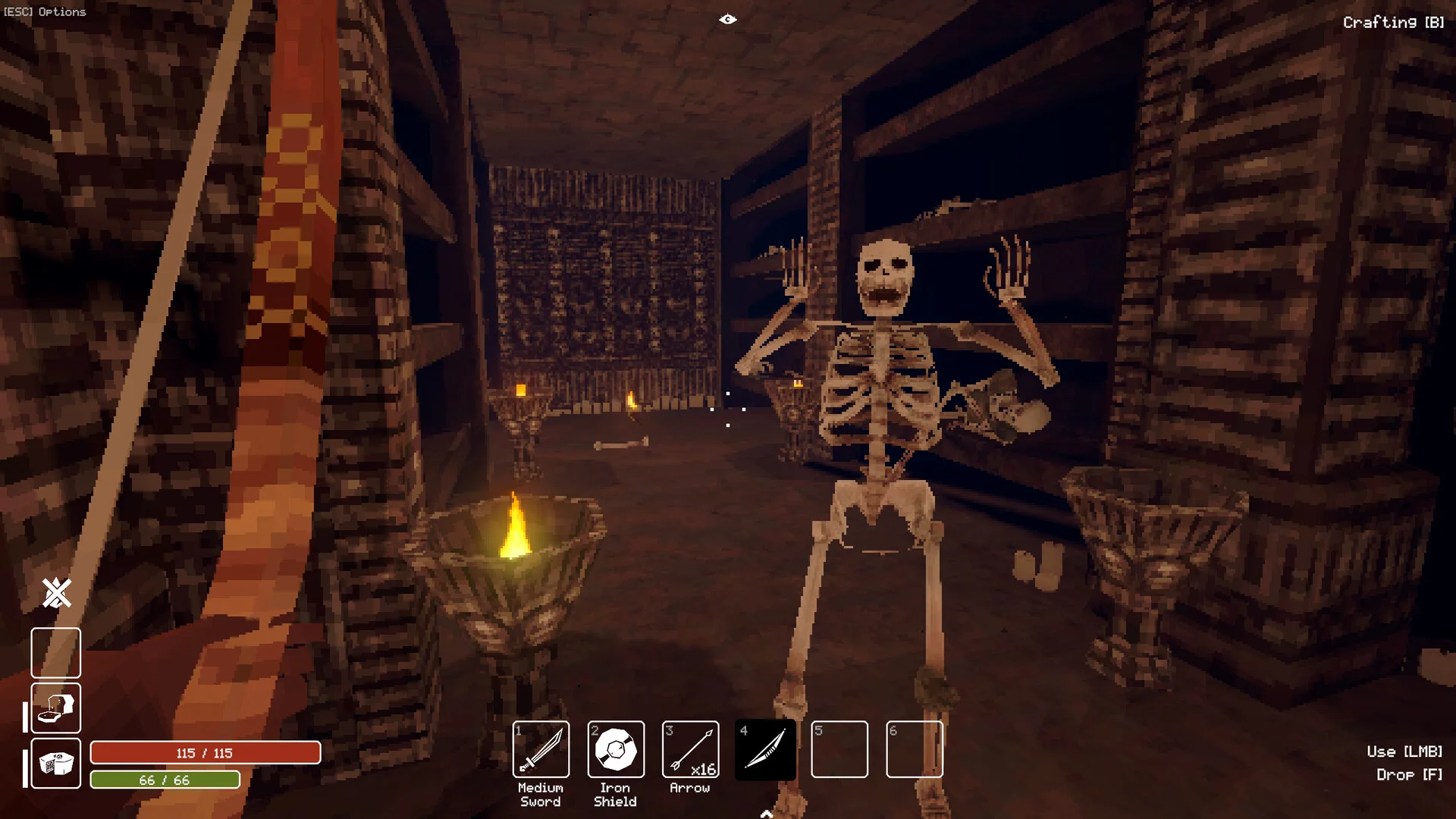
The translation becomes awkward during puzzle solving. Food benefits expire while the player is still trying to understand a room, and maximum stamina can fall sharply without a failed jump or mistimed attack. The dungeon asks for patient observation while the survival system keeps charging for the time that observation takes. Cooking therefore matters mechanically even when its expanding repertoire feels less interesting than its prominence suggests. Familiar provisions can sustain an expedition perfectly well, but additional preparation does not always create an equally interesting decision. The strongest culinary idea is the act of making this hostile place habitable; replenishing temporary benefits sometimes reduces that idea to routine maintenance.
Solo play concentrates these demands inside a particularly restrictive inventory. Six starting slots become nine with an early backpack, yet weapons, armor, tools, food, and gathered materials all compete for space. Returning to camp can be a satisfying part of preparation, especially when a newly opened shortcut makes the route convenient. Repeatedly depositing resources or retrieving a tool is another matter. The same interconnection that rewards spatial understanding becomes an efficient route for errands. Knowledge makes the inconvenience shorter without removing its cause.
Combat inherits the deliberate approach, strike, and retreat rhythm associated with King’s Field, though its limitations become conspicuous when one person must carry every useful option. Many enemies do not flinch under attack, and early encounters can end quickly. Death then requires a return from the sleeping bag to recover possessions. These consequences give preparation weight, but enemy pursuit is less convincing: creatures can abandon the chase after losing sight of the player or reaching a corner. Retreat exploits that limited response, weakening the impression of a hostile world whose dangers must be carefully understood.
Controller handling adds friction to the physical side of exploration. On Steam Deck, stick input behaves effectively as digital input, making movement and aiming less precise than the environment’s object manipulation deserves.
A movable plank offers an appealing puzzle solution; awkward positioning can interrupt the pleasure of executing it. The large UI setting also allows the crafting menu to obscure the upper hotbar row when a backpack is equipped, although switching to normal size alleviates this. These are control and interface problems distinct from performance, which appears comfortable on the handheld at High rendering quality with a 45 fps cap.
The option to bring two companions offers a plausible redistribution of the expedition’s work. Several inventories could divide essential tools and provisions, while separate players could occupy an enemy and approach it from different positions.
Those possibilities do not establish that co-op resolves the game’s difficulties, but they reveal how heavily solo play concentrates responsibilities. A lone explorer must prepare for routes whose requirements remain unknown, inside a bag too small to accommodate every contingency. Leaving a tool in storage is a reasonable decision until the next barrier calls for it, sending the player back through rooms they have already learned to understand.
The Review
Deep Dish Dungeon
Deep Dish Dungeon brings the secrecy of King’s Field into contact with Valheim-style provisioning, finding real pleasure in making hostile ruins habitable. Its handcrafted routes, physical puzzles, and tool-based discoveries reward close attention. The marriage is uneven: expiring food benefits interrupt patient investigation, and cramped solo inventories turn familiar corridors into supply routes. Awkward controller handling adds avoidable resistance. There is a dungeon worth understanding here, though the work of maintaining an expedition too often interrupts the pleasure of discovery.
PROS
- Interconnected dungeon rewards accumulated spatial knowledge.
- Physical puzzles encourage practical experimentation.
- Camp development makes survival progress tangible.
CONS
- Expiring food benefits disrupt patient puzzle solving.
- Restricted solo inventory causes repetitive supply trips.
- Ambiguous progression signals can prolong aimless searching.
- Imprecise controller input and obstructive UI settings.







