



























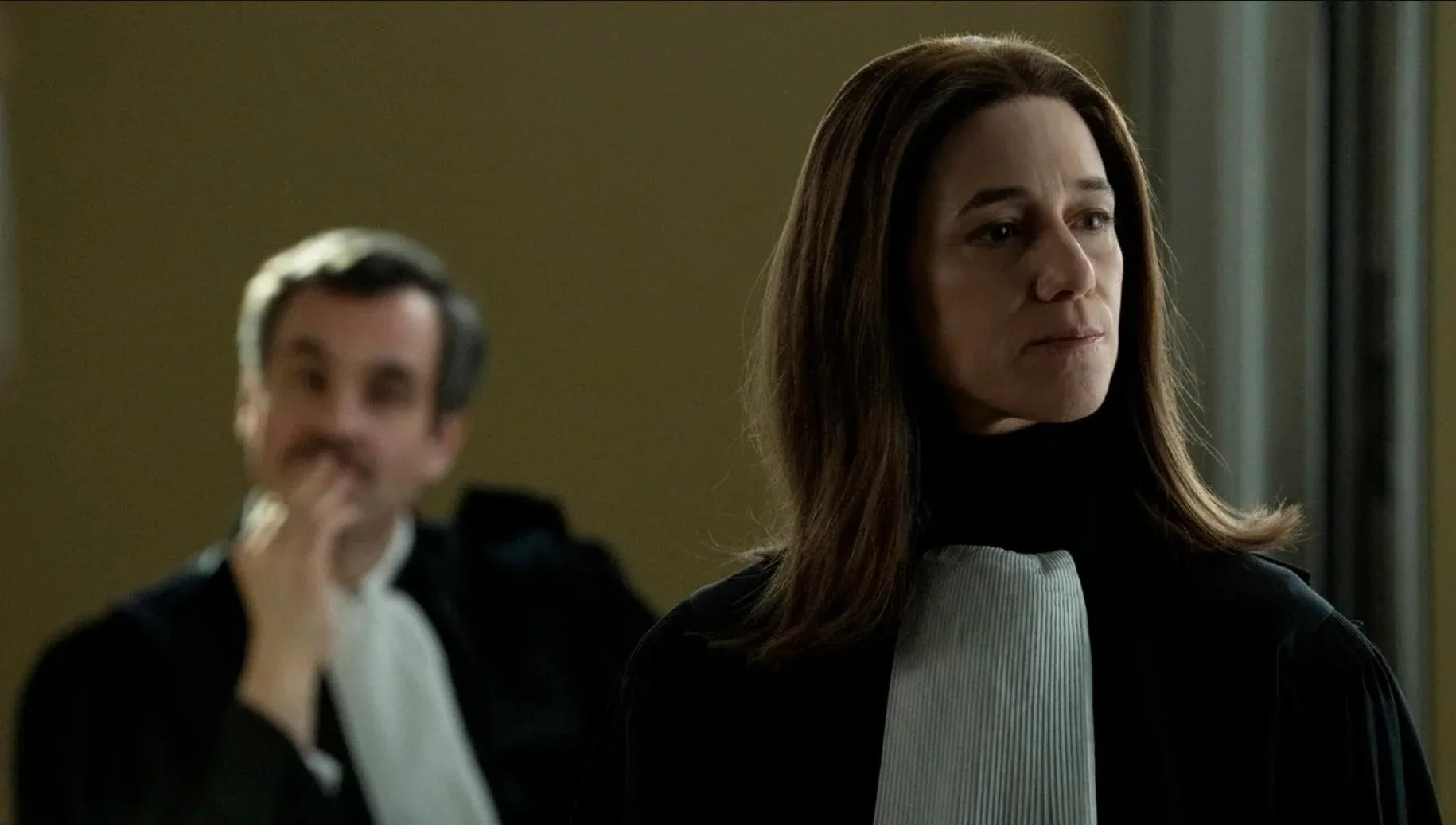

Gisèle Halimi keeps telling the women she represents to stop apologizing. In Women on Trial, that instruction unsettles the customary relationship between an accused woman and the authorities judging her. Remorse would offer the court a familiar spectacle: a woman acknowledging that she has failed its expectations, then asking for mercy. Halimi refuses the arrangement.
Defending sixteen-year-old Marie-Claire Chevalier after an illegal abortion in 1972, she contests the authority that makes an apology seem necessary. The girl became pregnant through rape; the classmate who assaulted her reported her to the police. He escapes consequences while she and the women who helped her face prosecution.
Even Michèle Chevalier’s jumpers become available for judgment. Marie-Claire’s mother, a transport worker played by Cécile de France, wears colorful, high-neck clothes that attract the judges’ attention as they assess her character. Emmanuelle Youchnovski’s costumes acquire a precise dramatic function here. Clothing supplies the court with another opportunity to inspect a woman whose conduct it already presumes to understand.
The film connects this casual scrutiny to a far uglier account of medical punishment: a doctor describes being ordered to perform curettage without anesthetic on women suffering complications from clandestine abortions, so they will remember. Pain becomes an instrument of instruction, administered under the cover of care.
Writer-directors Lauriane Escaffre and Yvo Muller are strongest when they give Halimi’s indignation practical work to do. Charlotte Gainsbourg plays her with a controlled insistence that makes preparation, persuasion, and tactical refusal absorbing. Her effort to secure a prominent doctor’s testimony reveals the labor behind courtroom eloquence.
The film moves between the Bobigny proceedings and the events preceding them, allowing the public argument to accumulate a private history. Its momentum comes from watching Halimi assemble the conditions under which these women might receive a hearing. A known historical outcome leaves plenty of room for interest in the work required to reach it.
That work involves borrowing authority from people who already possess it. Halimi recruits prominent supporters and witnesses, including Simone de Beauvoir and Delphine Seyrig, and recognizes the usefulness of men speaking publicly for the cause. The campaign exposes an inequality within the process of being believed. Michèle can explain what happened to her daughter; influential professionals and celebrities can help make that explanation publicly consequential.
Halimi’s access to these networks gives her clients resources they cannot summon themselves. The press presents its own obstacle in the France Soir reporter who tries to obtain sex from Halimi in exchange for coverage. Even an attempt to publicize male entitlement encounters a man treating access as something a woman should purchase with her body.
The collective around Halimi has welcome traces of disagreement. Colette, a member of the Choisir support group played by Escaffre, earns the lawyer’s attention because she is prepared to challenge her. Their relationship allows solidarity to include resistance to the commanding personality directing it.
Florence Loiret Caille supplies another register as Micheline Bambuck, the woman who performed the abortion. Her nervous facial expressions introduce humor without making the proceedings harmless. Beside the confidence of an advocate accustomed to speaking, Micheline’s discomfort preserves the vulnerability of someone suddenly required to answer for an act of assistance.
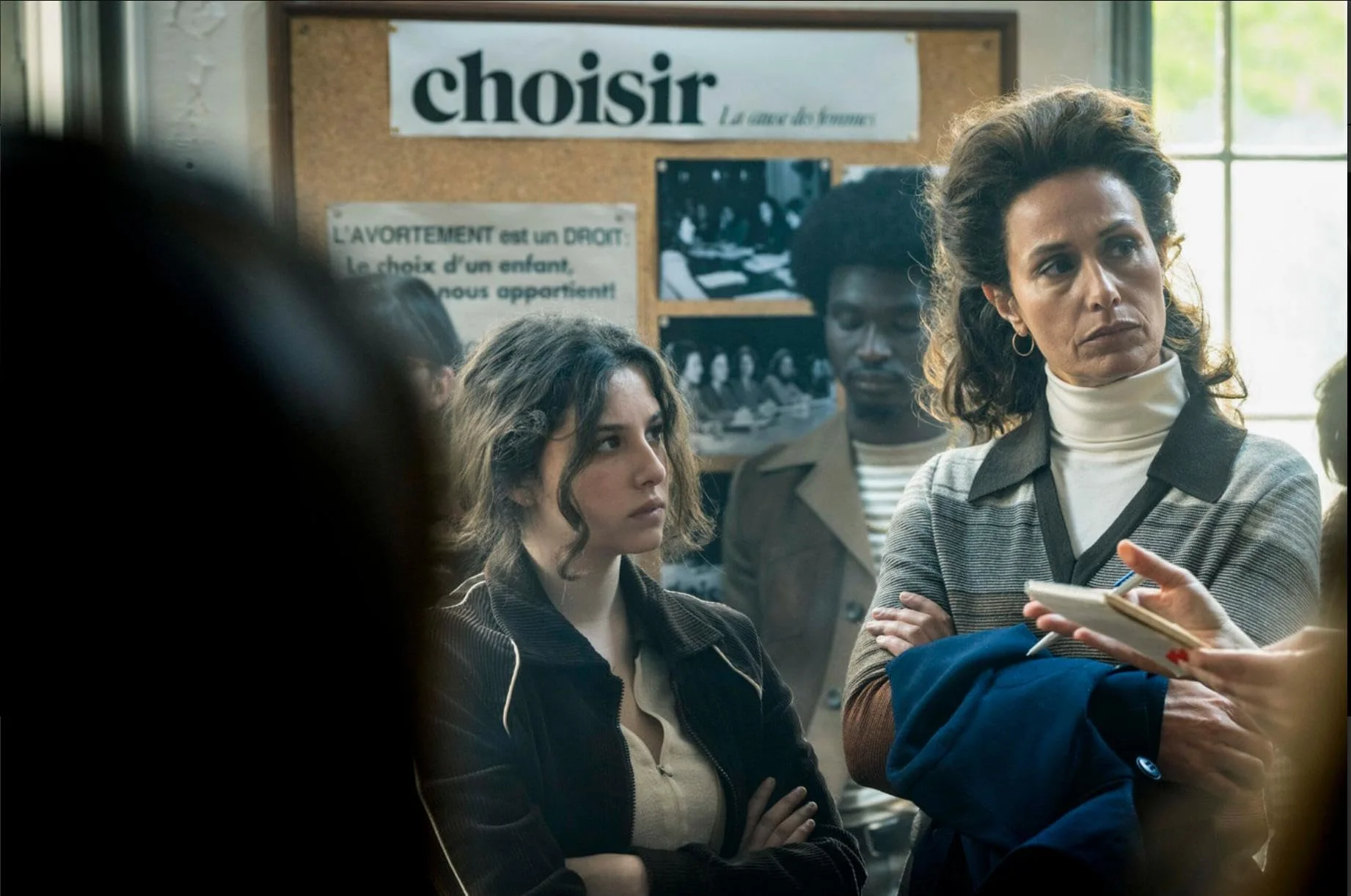
Yet the film’s fascination with its lawyer places a limit on that collective portrait. Halimi receives professional purpose, domestic conflict, strategic intelligence, and the force of Gainsbourg’s presence. Michèle and Marie-Claire receive concentrated opportunities to speak within a narrative largely propelled by their representative.
De France gives Michèle’s witness-stand speech emotional urgency, and Benchetrit’s Marie-Claire retains agency through a consequential choice concerning the publicity campaign. These moments matter, but the imbalance remains. The film makes the girl’s experience the basis of a public struggle while giving the advocate the fullest existence beyond it.
Its treatment of the rape is careful. Marie-Claire recounts the assault, and the directors spare her a visual reenactment. Her words carry the event without a staged image competing for authority. That restraint deserves recognition on its own terms; a graphic depiction would add nothing necessary to the case. The narrower issue is how much room she receives elsewhere. Respect for testimony and sustained interest in the person giving it are separate achievements, and the film is surer of the first.
Halimi’s household extends the question of who gets to define acceptable womanhood. Her mother, Fritna, asks why she cannot be a normal woman, bringing the pressure to conform into a relationship already marked by unequal affection.
Fritna’s warmth toward her grandson makes her coldness toward her daughter painful without requiring an explanation that excuses it. Her opposition to the case also prevents the film from assigning restrictive beliefs exclusively to men. Still, the repeated reproaches give her a limited dramatic function. She is allowed to complicate Halimi’s emotional life while remaining largely fixed as the person who disapproves.
Claude Faux, played with tenderness by Grégory Gadebois, occupies the reassuring position at the other side of that domestic arrangement. His support gives Halimi space to work, though his unwavering encouragement leaves him similarly compressed as a character.
Jean-François Hensgens’ photography and Stéphane Taillasson’s production design make the household’s promise of refuge palpable: lamplight, greens, and ochres soften the surroundings, against the courtroom’s blues and harder, cooler light. Fritna’s presence troubles that visual division. The home can shelter Halimi from official hostility while housing expectations closely related to those she confronts at work.
The courtroom passages rely on recognizable pleasures, including consequential witnesses, Michèle’s speech, and Halimi’s closing argument. Their clarity serves the political argument, although the accumulation of persuasive testimony gives the proceedings a tidiness that the uneasy family scenes sometimes escape. The case helped prepare the ground for the 1975 Veil law, and the film understandably takes satisfaction in preserving that struggle.
Its final transition, from the actors on the courthouse steps to a photograph of their real counterparts, briefly changes the terms of recognition. Gainsbourg’s Halimi gives way to the woman herself, with Michèle and Marie-Claire present in the same historical image. After a film so attentive to the advocate’s power to represent, the photograph lets the women appear without anyone performing on their behalf.
Women on Trial premiered at the Cannes Film Festival in May 2026 before its theatrical rollout handled by Gaumont. The French biographical historical drama recounts the landmark Bobigny trial, charting a pivotal legal battle that helped shape the modern advancement of women’s reproductive rights.
Full Credits
Title: Women on Trial
Distributor: Gaumont, France 3 Cinéma
Release date: May 2026 (Cannes Film Festival), November 4, 2026 (France)
Running time: 1 hour 42 minutes (102 minutes)
Director: Lauriane Escaffre, Yvo Muller
Writers: Lauriane Escaffre, Yvo Muller
Producers and Executive Producers: Foucauld Barré, Nicolas Duval
Cast: Charlotte Gainsbourg, Cécile de France, Florence Loiret Caille, Grégory Gadebois, Sarah Suco, Saul Benchetrit, Lauriane Escaffre, Yvo Muller
Editors: Valérie Deseine, Céline Cloarec
The Review
Women on Trial
Women on Trial finds its political force in the conditions imposed on women seeking justice: remorse, respectability, and endorsement by influential people. Charlotte Gainsbourg makes Halimi’s resistance absorbing, while the film gives medical cruelty and everyday scrutiny concrete expression. Its attention to the advocate leaves Marie-Claire less fully explored, and the supporting family roles remain compressed. The courtroom’s persuasive clarity sometimes smooths the struggle, but the performances preserve its human stakes.
PROS
- Gainsbourg’s controlled, strategically intelligent Halimi.
- Concrete connections between legal scrutiny and social punishment.
- Thoughtful handling of Marie-Claire’s testimony.
- Expressive courtroom and domestic visual contrasts.
CONS
- Marie-Claire receives limited attention beyond the case.
- Halimi’s mother and husband occupy narrow dramatic roles.
- Persuasive courtroom testimony makes the proceedings feel overly tidy.







