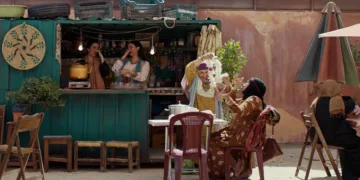




























Fighter jets cross the soundtrack while women go about their business below. Sara Ishaq’s opening tracking shot surveys a town whose adult men have largely disappeared into war, leaving adolescent faces on martyr posters. Movement belongs to the living women; public commemoration belongs to the dead boys. This division governs The Station, set around a women-only petrol station in Yemen, where Layal is trying to keep her twelve-year-old brother, Laith, from joining those faces on the walls. The aircraft give military power an acoustic reach that the station’s gate cannot interrupt.
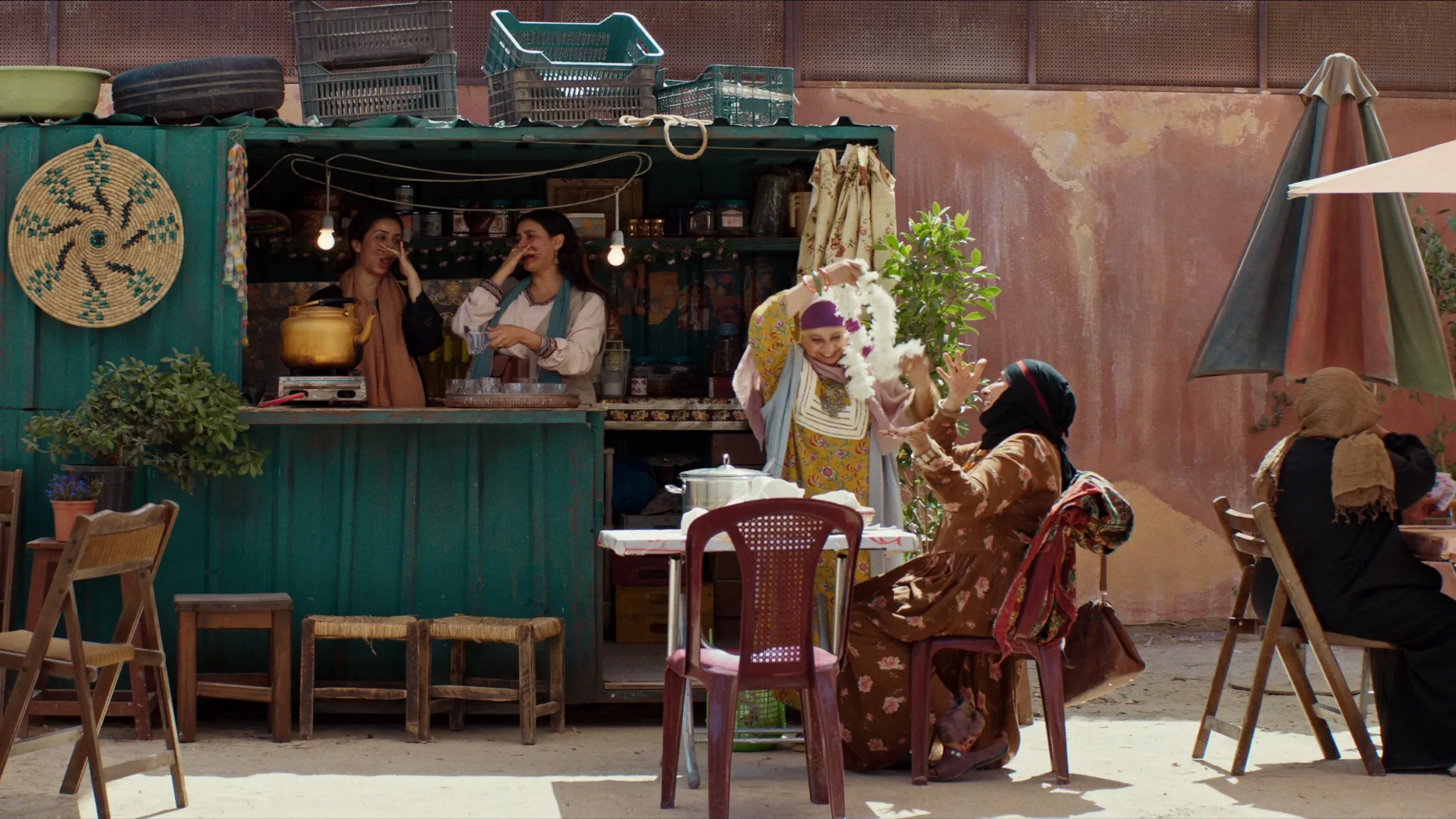
Inside the courtyard, cinematographer Amine Berrada gives the women space to occupy without appearing to inspect them. His fluid camera and warm palette accommodate smoking, shopping, gossip, and the pleasant disorder of people relaxing together.
Customers remove their face coverings and factional armbands before entering. The second removal matters as much as the first: affiliations that organize danger outside temporarily lose their visible authority. Ishaq locates freedom in these small adjustments to social behavior. A woman can buy lingerie, try makeup, or laugh without being required to explain which army has her allegiance.
The largely non-professional ensemble makes this arrangement feel habitual. Conversation has the ease of people who know how to share a room, while the sudden concealment of illicit goods reveals another kind of familiarity. Prayer books and linens replace the offending merchandise with practiced efficiency.
The change is funny, but its timing carries an unpleasant qualification: everyone knows the inspection can come. Berrada’s inviting light does not make the courtyard independent of the forces outside it. These women have learned to produce an acceptable appearance for anyone empowered to object.
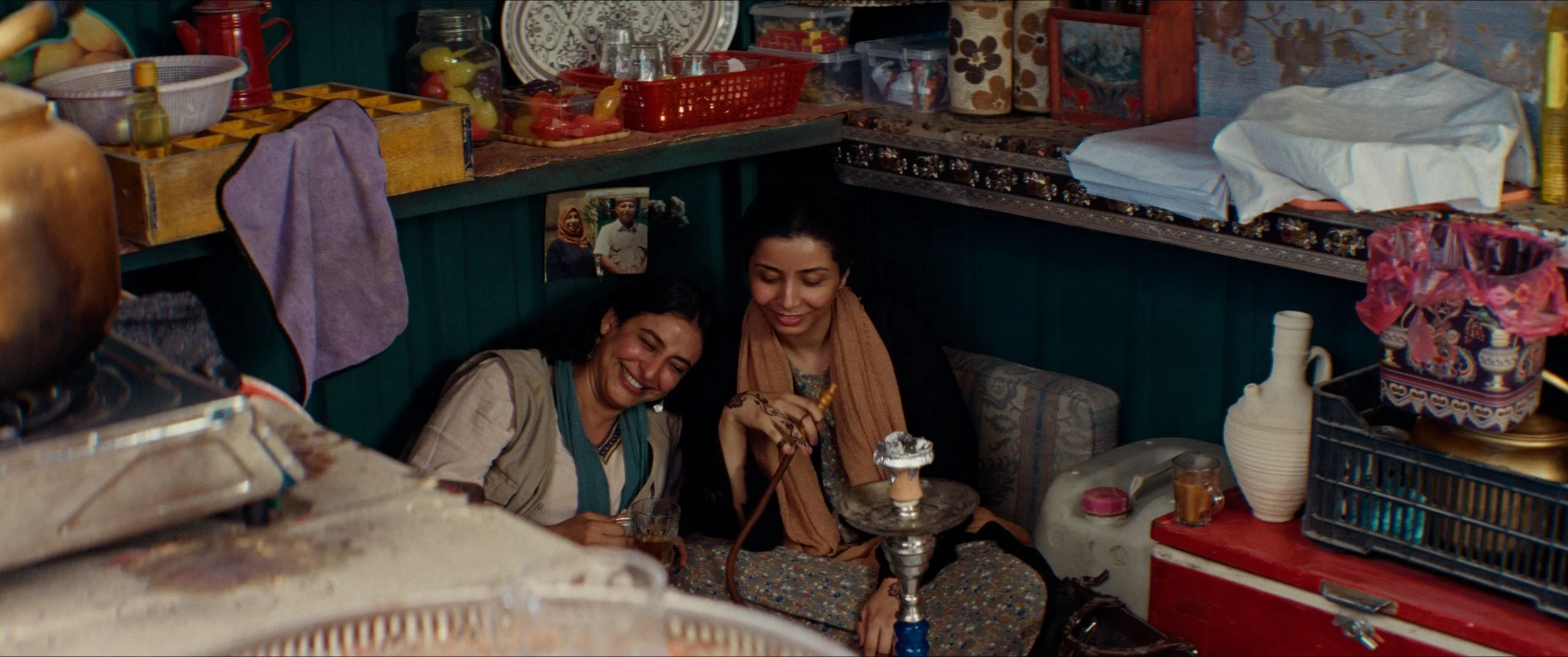
Umm Abdallah, the local sheikh’s wife, can enter this protected female space and communicate the terms on which Laith may remain there. Layal must pay to keep him from being recruited. Her argument that he is the family’s surviving boy has ceased to offer dependable protection.
The exemption has an adjustable price. Ishaq gives coercion a familiar visitor’s face, complicating the apparent division between the station’s women and the men beyond its gate. Access and allegiance are separate matters. The same enclosure that permits intimate solidarity permits a female representative of authority to reach Layal directly.
Laith’s own response makes protection harder still. He cares for a pet lizard, wants company, and remains susceptible to the ordinary pleasures of play. He also sings along to recruitment propaganda on the radio. The film’s sound design acquires a different menace here: the jets announce a threat, while the song offers him an invitation.
Boys who bully him for living among women give that invitation an emotional use. Soldiering promises an escape from embarrassment and dependency. Layal understands the likely destination of this promised adulthood; Laith hears an opportunity to stop being treated as a child. Keeping him within sight cannot settle that difference.
Ahmed, the thirteen-year-old who accompanies Layal’s estranged sister Shams, exposes the absurdity of the adult status being offered. Tall enough to be mistaken for a grown man, he is required to serve as a woman’s male chaperone while remaining unmistakably a boy.
His friendship with Laith loosens the role imposed on him. Their companionship supplies a persuasive measure of what recruitment takes away: time in which neither child needs to command, protect, or prove himself. Ishaq allows their ordinary behavior to challenge the public images of masculine duty. The martyr posters have already supplied the alternative.
Shams brings a less manageable history into the courtyard. She has lost her husband and the siblings’ brother Tareq, whose death feeds the estrangement between the sisters. Layal seeks money tied to Laith’s inheritance; Shams crosses hostile territory without having the financial solution Layal needs.
Their shared objective does little to simplify their reunion. Manal Al-Mulaiki and Abeer Mohammed sustain the strain between the necessity of cooperation and the persistence of blame. Shams’s affiliation with the opposing faction further troubles the station’s attempt to suspend political identity. Removing an armband is easier than suspending the grief attached to it.
The film’s treatment of those factions is less searching. An opening disclaimer establishes a parallel world inspired by lived experience, and the rival groups receive contrasting colors while exercising comparable pressures on the people caught between them.
This abstraction keeps the recruitment threat intelligible without turning the drama into a geopolitical briefing. It also narrows the available moral inquiry. Once both sides perform much the same dramatic function, the question becomes how to escape their demands; the differences that sustain their power receive little attention. The station’s social detail is richer than the political world enclosing it.
As the drama tightens into a thriller, Berrada’s images lose their earlier warmth and become harder to read in the night. The transition is effective, though its emotional instructions are familiar: the hospitable space darkens as its protection fails. Greater complexity comes from our accumulated knowledge of its inhabitants.
We have watched them relax, conceal goods, negotiate authority, and disagree. Reduced visibility now obstructs our access to people whose habits have become legible. The tension depends on that earlier observational patience, rather than on darkness carrying a ready-made moral significance.
A late confrontation gives the film a sharper visual proposition. Faced with angry men who remain offscreen, the women use their head coverings to defend the station. Ishaq keeps attention on the people responding to the threat, denying the men the visual command that an entrance could grant them.
Clothing previously removed to permit ease inside the courtyard becomes available for collective action. The gesture is emphatic, but it belongs to the film’s established interest in who controls appearances. Earlier, the women rearranged their goods to satisfy an inspecting authority. Here they choose what the men outside will be allowed to see.
The Station had its world premiere in the Critics’ Week section at the 79th Cannes Film Festival on May 17, 2026, with world sales handled by Paradise City Sales and MUBI. Directed by Sara Ishaq, the Yemeni drama follows a woman who runs a female-only fuel station as a peaceful refuge amid an ongoing civil war, forcing her to reunite with her estranged sister to protect her younger brother from forced military conscription.
Full Credits
Title: The Station
Distributor: Paradise City Sales, Memento Films, MUBI
Release date: May 17, 2026 (Cannes Film Festival), October 2026 (International)
Running time: 1 hour 52 minutes (112 minutes)
Director: Sara Ishaq
Writers: Sara Ishaq, Nadia Eliewat, Kate Leys
Producers and Executive Producers: Nadia Eliewat, Nicolas Leprêtre, Kifah M. Al-Shouqi, Derk-Jan Warrink, Ruben Thorkildsen
Cast: Manal Al-Mulaiki, Abeer Mohammed, Rashad Khaled
Director of Photography (Cinematographer): Amine Berrada
Editors: Romain Namura
Composer: Tessa Rose Jackson, Darius Timmer
The Review
The Station
Sara Ishaq gives shelter a persuasive cinematic form, then tests its limits through intrusive sound, compromised authority, and a boy’s attraction to the forces threatening him. The relaxed ensemble makes the courtyard worth defending before the thriller takes hold. Simplified factions and a familiar progression into darkness reduce some of the complexity, but the film’s attention to protection, dependency, and imposed adulthood remains sharp.
PROS
- Expressive camerawork and lighting make protection tangible.
- Sound connects military threat with recruitment’s appeal.
- The boys’ friendship challenges their imposed adult roles.
- Natural ensemble performances sustain warmth and family tension.
CONS
- Rival factions receive limited political differentiation.
- The shift from warm refuge to darkness follows familiar visual cues.







