



























Pelu keeps his workplace and loses his place in it. Employed as a projectionist at a municipal cinema in Córdoba, he is reassigned to night security after budget cuts, remaining inside a building whose relationship with him has quietly altered. Octavio Bertone plays this displaced custodian in Ezequiel Salinas and Ramiro Sonzini’s The Night Is Fading Away. When Pelu’s housing arrangement collapses, he secretly moves into the cinema. The familiarity of the place acquires a painful intimacy: he must now make a home inside the institution that has ceased to need his original work.
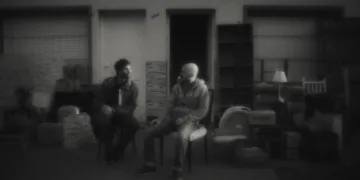
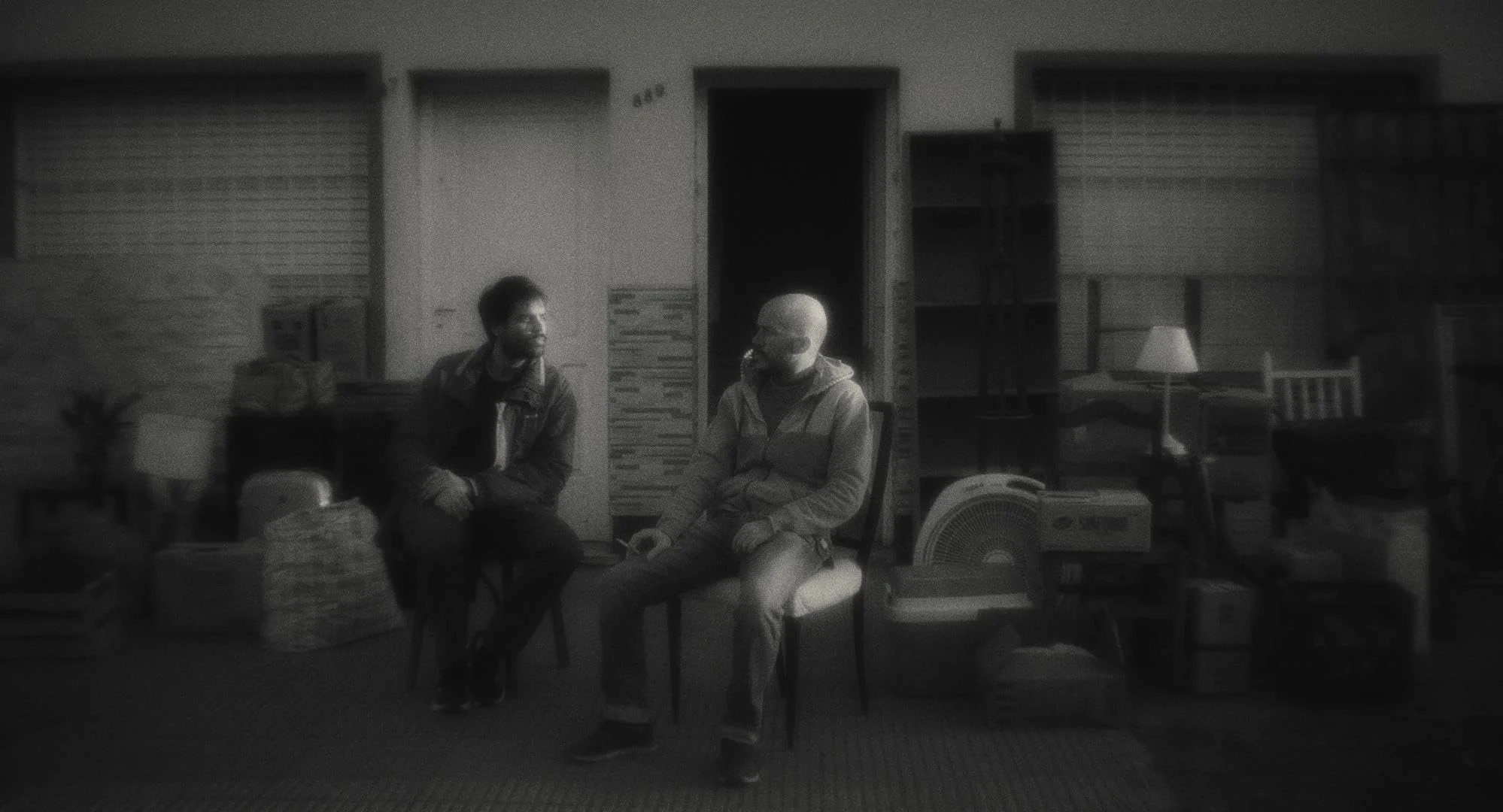
The luminous black-and-white photography gives this habitation an uncertain softness. Light seems to loosen the building from the ordinary city, allowing the rooms to feel briefly exempt from the conditions that have driven Pelu into them. Yet the softness cannot be separated from his predicament. What looks dreamlike is somewhere a man needs to sleep. The filmmakers allow these perceptions to occupy the same image, so that the pleasure of looking carries an accompanying discomfort. To find the cinema beautiful is also to see how little beauty can guarantee the person living there.
Pelu’s reassignment leaves a peculiar wound because he has been allowed to stay. A dismissal would establish a clean division, however brutal, between a former life and whatever follows. Here, continuity conceals the loss. He remains attached to the cinema through a diminished position, then becomes dependent on it for shelter, until the distinction between belonging somewhere and having nowhere else to go becomes difficult to sustain. The film’s economic anxiety enters through this narrowing of possibilities. There is still a job, still a roof, still an arrangement that can be made. Each concession asks him to accept a smaller life.
His occupation gradually becomes communal. An unemployed former roommate, an older drifter, and a sex worker enter the cinema’s unofficial household, bringing needs that cannot be contained within its public function. Their presence changes the emotional temperature of Pelu’s residence. Secrecy initially encloses him; company gives that enclosure a different use. Watching films together into the early morning, these people establish a repeated appointment with one another, something to return to when the other arrangements of life have become unreliable. The tenderness lies in that recurrence. For another night, there will be people here.
The sex worker’s livestreamed erotic performances give this shared space a particularly welcome untidiness. A cinema occupied by admirers of great directors could easily become a shrine in which everyday life is admitted only after it has learned to speak reverently. Here, another kind of image-making takes place under the same roof, connected directly to someone’s livelihood. The building accommodates activities that a more precious film might keep apart. Its inhabitants have bodies, work, pleasures, and embarrassments. Their presence keeps the affection for cinema from becoming airless, while the gentle comedy allows them an existence beyond the hardship that has brought them together.
The nightly screenings extend this sense of life being sustained through repetition. Renoir, Ozu, and Bresson belong to the inhabitants’ present tense, available to be watched alongside whoever happens to be there. Ozu’s Good Morning is particularly at home in a film attentive to the small accommodations of coexistence. The significance of these screenings rests less in the prestige of the names than in the circumstances of reception. People whose days have been unsettled give their attention to something together. The images provide a shared duration, a stretch of time during which solitude is interrupted without anyone having to explain themselves completely.

An extended passage of Charles Laughton reciting the Gettysburg Address gives that attention a heavier burden. As a listener responds with tears, Lincoln’s language about the living taking responsibility for unfinished work reaches beyond its historical occasion.
Within this threatened cinema, the speech can be heard as a demand made by an inheritance: what has reached us requires something from us. The film lets the passage last, accepting the risk that borrowed eloquence might overwhelm its quieter lives. The emotion remains persuasive because we are watching someone receive it. What it will enable that person to do is a separate, less settled matter.
The film’s own spell becomes less consistent when it leaves Pelu and the cinema for prolonged stretches with other characters and locations. These excursions widen the world surrounding the building, but they sometimes loosen the concentration achieved inside it.
The reservation concerns attachment rather than speed. Within the cinema, the same space holds employment, shelter, private activity, and collective pleasure; each use presses against the others. Away from it, that density diminishes, and the film can feel longer without deepening its emotional pressure. Its patience is most rewarding when we can feel what is accumulating between the people sharing a place.
A secret tunnel leading outside prevents the cinema from becoming a sealed chamber of consolation. There is an exit within the refuge, a physical connection to the city from which its residents have withdrawn. The gathering around a fire, with songs and stories exchanged among the outcasts, carries their companionship beyond the auditorium. Attention survives the absence of a screen. This movement matters to the film’s politics, which acquire urgency against municipal cuts and the Argentine climate following Javier Milei’s 2023 election. The people have found temporary protection, and that protection has given them something they may have to defend.
The fencing erected around the cinema ahead of remodeling makes the threat material. Pelu’s response, kicking it down, has a bodily impatience that the nightly screenings have held in suspension. He can listen, watch, accommodate others, and make a life within the building, but the fence announces that decisions about its future are being made elsewhere. His action interrupts that authority without giving him control over what follows. The uncertainty remains with the place he has occupied and the people who have come to depend on it, now exposed to the possibility of losing their shelter together.
The Night is Fading Away had its world premiere at the FICValdivia Film Festival in October 2025 before making its UK debut at the Institute of Contemporary Arts in London on October 23, 2026. Directed by Ezequiel Salinas and Ramiro Sonzini, this Argentine black-and-white comedy-drama follows a former projectionist turned night watchman who secretly moves inside a municipal cinema, turning the theater into a sanctuary for local outcasts amidst societal flux.
Full Credits
Title: The Night is Fading Away (Spanish: La noche está marchándose ya)
Distributor: Gong Cine, Punto de Fuga Cine, La Bruja Roja
Release date: October 2025 (FICValdivia), October 23, 2026 (UK theatrical)
Running time: 1 hour 44 minutes (104 minutes)
Director: Ezequiel Salinas, Ramiro Sonzini
Writers: Ezequiel Salinas, Ramiro Sonzini
Producers and Executive Producers: Pablo Piedras, Eva Cáceres, Magdalena Schavelzon, Ana Lucía Frau, Ezequiel Salinas, Ramiro Sonzini
Cast: Octavio Bertone, Juana Oviedo, Rodrigo Fierro, Martín Emilio Campos, Fabián Costa, Lionel Castelli, Martín Álvarez, Pablo Limarzi
Director of Photography (Cinematographer): Ezequiel Salinas, Ramiro Sonzini
Editors: Ezequiel Salinas, Ramiro Sonzini
Composer: Francisco Albarracín
The Review
The Night is Fading Away
The Night Is Fading Away finds tenderness in the uneasy space between having shelter and belonging somewhere. Its luminous monochrome and shared nocturnal screenings give companionship a palpable warmth, while Pelu’s diminished circumstances keep that warmth vulnerable. Excursions beyond the cinema sometimes dissipate the emotional concentration achieved inside it. Yet the film makes the desire to protect this imperfect home deeply understandable, without pretending affection can secure its future.
PROS
- Luminous black-and-white photography grounded in material hardship.
- Warmth built through shared viewing and everyday coexistence.
- Cinephilia connected to care and practical responsibility.
- Defiant ending that preserves uncertainty.
CONS
- Prolonged excursions outside the cinema weaken emotional concentration.