




















Kikunosuke has become famous for a killing that seems to belong to somebody else. Eighteen months after the young samurai apparently avenged his father outside an Edo theatre, the visiting ronin Soichiro Kase struggles to reconcile that achievement with the gentle person he knows.
The witnesses have a satisfying account: a confrontation, a fight, a severed head. Kase’s doubts make that satisfaction difficult to share. Watching Takashi Minamoto’s Samurai Vengeance, I found myself worrying about the distance between the young man and his reputation before becoming especially concerned with how the trick of the mystery would work.
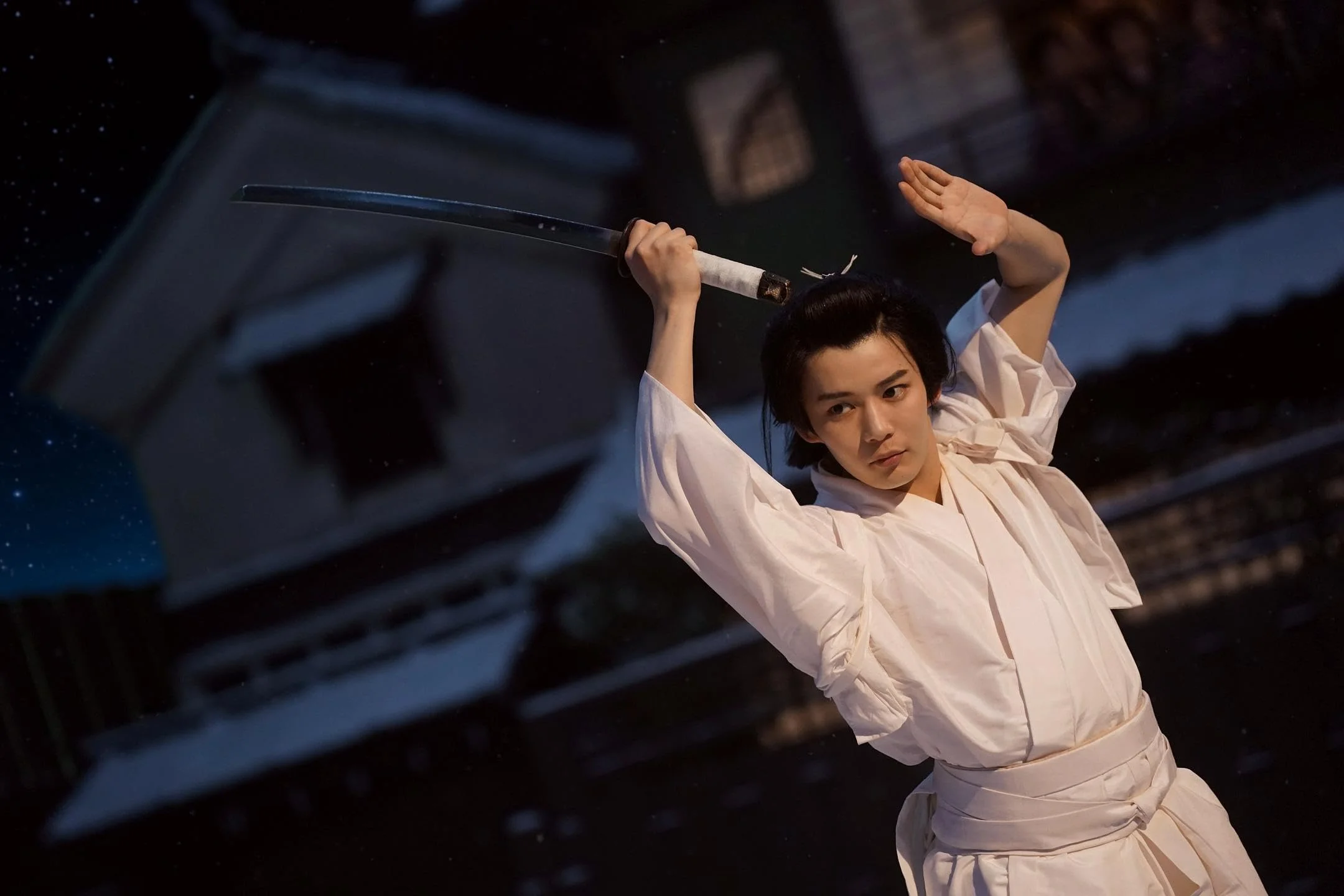
Kento Nagao gives that worry somewhere to settle. His delicacy makes Kikunosuke’s public display of ferocity feel like a role demanding considerable effort. The broad sword movements and theatrical illumination encourage spectators to read his actions clearly, while his vulnerability leaves room for another response.
These people have just watched Kanadehon Chushingura, the story of the 47 Ronin, inside the theatre. Outside, in the snow of 1810, they seem to have received an unexpected extra performance. Their familiarity with the revenge story helps them accept what they see. It also leaves Kikunosuke very little space to be anyone else.
Kase makes a remarkably agreeable guide through the doubts that follow. Tasuku Emoto lets him smile, complain about his stomach, and drift into conversations with the apparent aimlessness of someone happy to have company. You enjoy being around him before you understand how carefully he is listening.
As his questions sharpen, Emoto keeps the friendliness intact. That continuity matters: the humor remains part of the investigation, giving people reasons to talk and giving us reasons to underestimate the person asking. His intelligence emerges through his persistence without requiring a grand announcement that the fool has been fooling everyone.
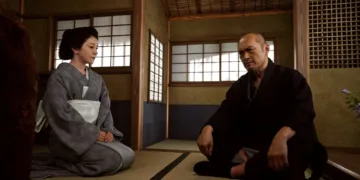
The pleasure becomes uneasy once we start enjoying the people he questions, too. A private meeting between the barker Ippachi, swordmaster Sagara, and former onnagata Hotaru makes the theatre workers’ guarded behavior seem potentially sinister.
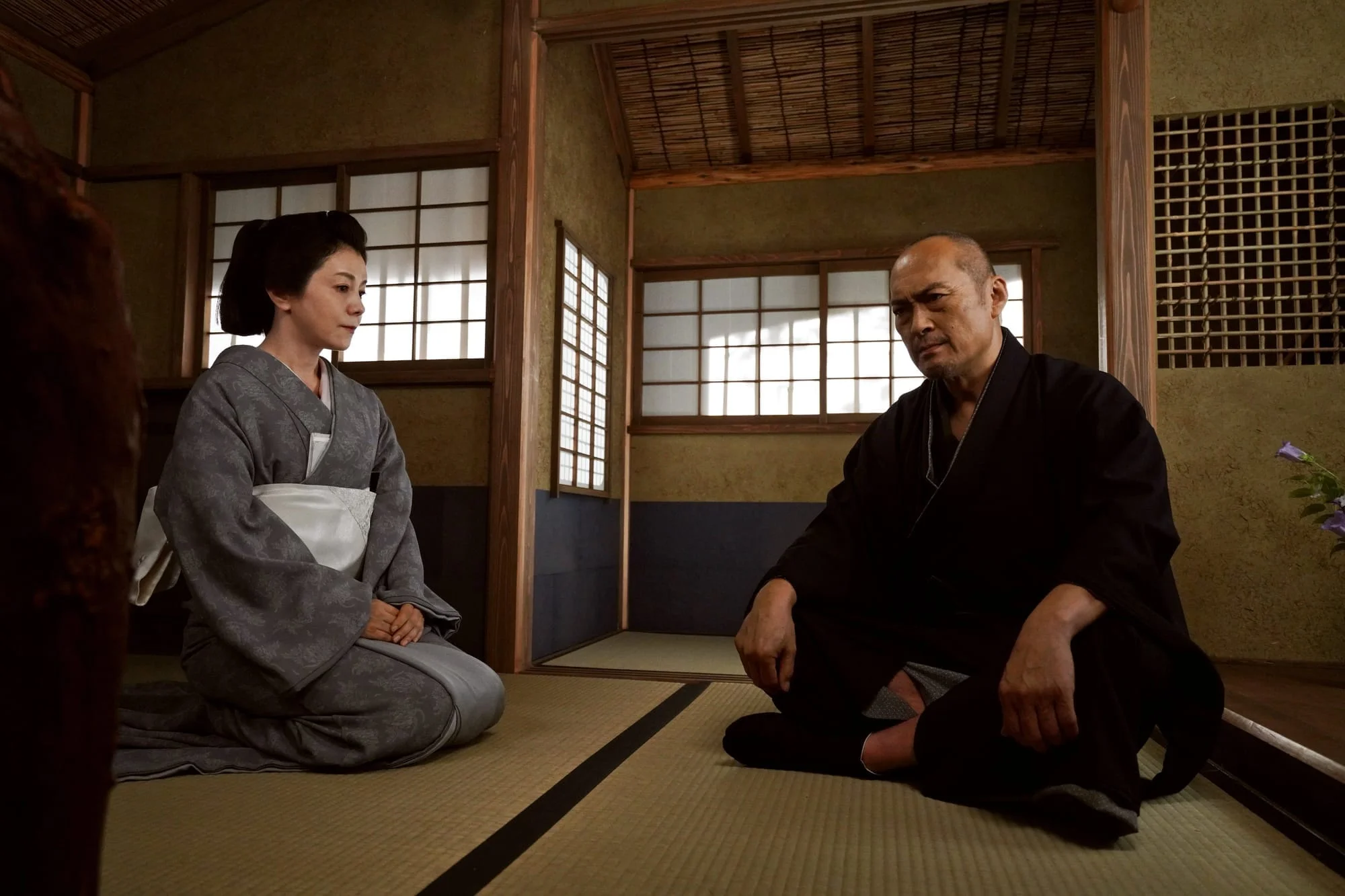
It also establishes that Kase’s arrival has consequences beyond his own curiosity. Ken Watanabe’s playwright Kinji Shinoda adds another kind of uncertainty. His measured delivery gives friendly information the weight of a warning; the authority is there before he needs to insist upon it. Between Emoto’s sociability and Watanabe’s reserve, conversation becomes an exchange in which hospitality and suspicion can occupy the same room.
Minamoto repeatedly takes us back through the events under discussion, allowing testimony to alter our understanding of the confrontation. At its best, this structure changes the emotional meaning of something already witnessed.
A gesture that looked straightforward acquires another possible intention, and someone who seemed incidental begins to matter. The opening’s lighting and expansive movements remain available for reconsideration. They were visible from the beginning, which gives the later explanations the pleasure of recognition. The film trusts that a spectacle can attract our attention while leaving us uncertain about what we have understood.
It is less trusting about our ability to remember. Some returns replay substantial stretches of an event or battle before reaching the information that changes it. During those passages, curiosity briefly becomes waiting: we know where we are, and we are ready for the account to move.
This is a specific drag on an otherwise inviting investigation. The dialogue itself often has the attraction of spending time with a good storyteller, especially with Emoto listening so attentively. Repeated action can be less accommodating, holding us at an emotional point we have already passed.
The theatrical clues also make parts of the explanation possible to anticipate. That need not spoil the experience, since the film gives us a reason to care about the answer beyond being wrong-footed. The more we learn about the company, the more interesting its shared abilities become.
Costumes, makeup, props, choreography, and carefully managed appearances belong to people who earn their living making an audience believe. The mystery gives those familiar tasks an urgency that expensive period decoration alone could never supply. A costume has been selected and fitted; a movement has been practiced; somebody has thought about what an onlooker will notice.
That sense of work is where affection for the theatre begins to take hold. Its former samurai, performers, and displaced people have assembled a place where their different abilities are useful. Minamoto allows the skills supporting a performance to become part of our understanding of the community supporting Kikunosuke.
The emotional effect depends on recognizing several people’s contributions, rather than admiring a solitary mastermind. Watanabe’s commanding presence could easily overwhelm that collective effort, but the other workers’ secrecy and specialized knowledge keep the company alive around him. You begin watching for what each person can do.
Hotaru’s presence gives the making of appearances a human ease. Played by Kazuya Takahashi, this former performer of female roles belongs to a workplace where changing one’s presentation is an ordinary, skilled activity. Kikunosuke’s initial feminine appearance belongs within that theatrical world, too.
Against the demands placed upon a young samurai, such flexibility becomes quietly moving. Clothes and gestures permit possibilities that an inherited obligation might close off. The film’s humor about warrior dignity benefits from this proximity: the theatre workers understand how much preparation goes into looking natural, authoritative, or fearsome.
Kikunosuke’s obligation to avenge his father carries the threat of disgrace for his family, making gentleness a difficult quality to preserve. Nagao keeps that pressure personal, while the company’s practical ingenuity opens room around it. The later revelations draw their warmth from the effort people expend on creating that room. Minamoto can occasionally take too long explaining how the pieces fit, yet the attention to shared labor gives the explanation an emotional destination. We have been learning what these people know so that we can appreciate what they are prepared to do with it.
The closing montage lets the actors pose in kabuki stances, openly enjoying the performative skill that the mystery has kept us examining for clues. After so much attention to concealed intentions, their willingness to present themselves is unexpectedly affectionate. There is time to appreciate faces, bearing, and the pleasure of a deliberately held pose. The people whose smallest gestures have invited suspicion get to offer a gesture simply for the audience’s enjoyment.
Samurai Vengeance was released theatrically in Japan by Toei Company on February 27, 2026, and celebrated its international premiere at the New York Asian Film Festival in July 2026. Directed by Takashi Minamoto and adapted from Sayako Nagai’s Naoki Prize-winning period novel, the Edo-set mystery drama follows a suspicious samurai who arrives at a kabuki theater to investigate a famous revenge killing carried out a year and a half prior, uncovering dark, hidden secrets behind the celebrated event.
Full Credits
Title: Samurai Vengeance (Japanese: 木挽町のあだ討ち / Kobikicho no Adauchi)
Distributor: Toei Company
Release date: February 27, 2026 (Japan), July 10, 2026 (NYAFF International Premiere)
Running time: 2 hours 0 minutes (120 minutes)
Director: Takashi Minamoto
Writers: Takashi Minamoto, Sayako Nagai
Producers and Executive Producers: Yasushi Suto, Miki Watanabe, Gen Nakazawa, Junpei Horiguchi
Cast: Tasuku Emoto, Ken Watanabe, Kento Nagao, Kazuki Kitamura, Kōji Seto, Kenichi Takitō, Yasuko Sawaguchi, Hirotarō Honda
Director of Photography (Cinematographer): Yoshihito Asakura
Editors: Keiji Koizumi
Composer: Umitaro Abe
The Review
Samurai Vengeance
Samurai Vengeance leaves you attached to the people working behind its celebrated act of violence. Emoto’s disarming investigator and Nagao’s vulnerable young samurai give the mystery its human stakes, while theatrical ingenuity gradually becomes an expression of care. The repeated sequences sometimes hold up discovery, and a few revelations are foreseeable. Still, learning what this company can accomplish together brings a warmth that survives knowing where parts of the explanation are headed.
PROS
- Emoto’s humor makes his probing questions quietly unsettling.
- Nagao gives the revenge legend a vulnerable human presence.
- Stagecraft connects the mystery to the company’s shared care.
- Watanabe makes hospitality feel charged with authority.
CONS
- Extended replays interrupt the investigation’s momentum.
- Some revelations are foreseeable.